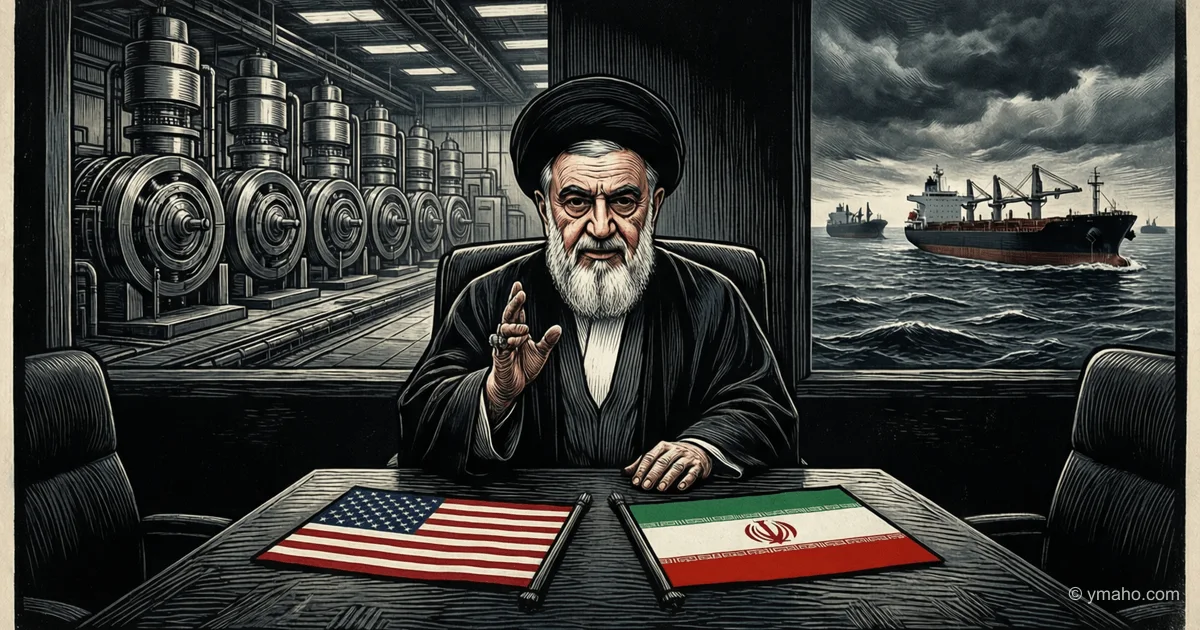
Iran's Supreme Leader Bans Export of Enriched Uranium
Iran's Supreme Leader Mojtaba Khamenei issued a directive banning the export of enriched uranium, hardening Tehran's stance and creating new obstacles in negotiations with the US to end the war.
Khamenei's Directive: Why the Uranium Export Ban Is Not a Failure, but a New Price for a Deal
[The Gist]: What's Really Happening
A superficial look at the news about the ban on exporting Iranian uranium paints a picture of deadlock. The Supreme Leader said "no" to a key Trump demand, negotiations are frozen, the war continues. A nice drama for headlines.
But as an analyst who tracks "gray" money flows and the structure of behind-closed-doors deals, I see something else. Khamenei didn't close the door. He just rewrote the price tag for entry.
Notice the detail almost everyone missed: Iranian sources told Reuters directly that there are "workable formulas" — for example, diluting uranium under IAEA supervision right on Iranian soil. That's the key to everything.
Iran isn't saying: "Uranium stays at 60% purity." It's saying: "Uranium stays physically with us, but we're ready to make it useless for a bomb." The difference between "export" and "on-site dilution" for the US is a matter of transport security and control. For Iran, it's a matter of regime survival.
440 kg of uranium enriched to 60% is Tehran's only insurance that after the material leaves, the US or Israel won't strike its conventional infrastructure. Once the last gram leaves the country, Iran has no hostages left. Khamenei understands this. And Trump, I think, does too.
Timeline and Context
It's important to understand how we got to this point. On May 20, Reuters reported Khamenei's directive, citing two senior sources. On May 21, Trump gave a harsh response: "We will get that uranium. We don't need it. We don't want it. We will most likely destroy it."
It would seem the sides have drifted apart. But look at the sequence more broadly.
Just a day before Khamenei's directive, on May 19, a Qatari delegation was in Tehran. Earlier, in early May, a draft 14-point memorandum leaked to the press, in which Iran, according to some reports, was ready to discuss uranium exports. Bloomberg wrote that the sides were close to a breakthrough.
Non-obvious insight: Khamenei's directive was a reaction not to a "bad US move," but to the leak of a possible compromise, which weakened Iran's position. Khamenei publicly hardened his rhetoric to prevent his negotiators from making concessions too quickly. This is a classic "red line" tactic that turns out to be gray.
Note another factor. On May 21, The New York Times and Bloomberg simultaneously published reports that Iran is discussing with Oman a system of tolls for passage through the Strait of Hormuz. This is no coincidence. Iran is linking uranium and the strait into one package. You want freedom of navigation? Give us security guarantees on uranium.
Who Wins and Who Loses
The direct loser is the Trump administration in terms of public rhetoric. The president promised to export the uranium. Khamenei said "no." Trump looks like he's been outplayed. But don't jump to conclusions.
Russia wins — and this is the second non-obvious beneficiary. Moscow proposed back in mid-May to take Iranian uranium to its territory. Iran's Foreign Minister Abbas Araghchi confirmed that this topic was discussed with Putin. Now that direct export to the US is impossible, and on-site dilution doesn't solve the "uranium under Western control" problem, the "uranium to Russia" option becomes increasingly realistic. Peskov has already stated that Washington does not accept this proposal, but that only raises the stakes. If uranium ends up going to Russia, Moscow will gain not only nuclear material but also leverage in future US-Iran negotiations.
Quiet win — for speculators in oil and gas volatility. Over the past 48 hours, Brent futures have shown intraday swings of $6-8 on every new phrase from Khamenei or Trump. Traders sitting in straddles and strangles on oil options are making fortunes.
Who loses — Europe. While the US and Iran haggle, the Strait of Hormuz operates with interruptions. Wood Mackenzie this week confirmed a recession scenario for the eurozone of -0.5% GDP in 2026 if current tensions persist.
What the Media Isn't Saying
The biggest lie is in the headlines about "failed negotiations." Negotiations are not failed. They have entered a new phase — a phase of technical details that will determine what the compromise actually looks like.
Here's what's really happening. Iran officially cannot say "yes" to uranium export — that would be political suicide for the regime. Instead, Khamenei says "no to export," but his sources immediately add "yes to on-site dilution." Diluting 60% uranium to 3.67% under IAEA supervision makes the material unusable for weapons. Technically, it's the same as export, but politically, it's completely different. Uranium remains "ours" but loses its military value.
The second omission: $25 billion in Iranian assets frozen in foreign banks haven't gone anywhere. They are the real currency of the deal. Khamenei can only make concessions on uranium if he gets guarantees to unfreeze this money and lift sanctions on oil exports. That's what's being discussed behind closed doors in Muscat and Doha right now.
Third: Israel. Netanyahu said the war cannot end until the uranium is exported. But Israeli officials, according to Reuters, confirmed that Trump assured them the uranium would be exported. This means there is already some "Plan B" behind Khamenei's back that the public doesn't know about. Perhaps it involves the diluted 3.67% uranium leaving Iran disguised as "commercial fuel" purchased by some third country.
Forecast: Next 30 Days and 90 Days
30 days: An agreement on the "on-site dilution under IAEA supervision + partial asset thaw" formula will be reached within 2-3 weeks. This will allow Trump to declare that Iranian uranium no longer poses a threat, and Khamenei to declare that uranium remains in Iran. Expect an announcement in the first ten days of June 2026.
90 days: Once the strait is unblocked (tentatively June-July 2026), deferred oil supply will flood the market — 1.5–2 million barrels per day from Iran. Brent, currently holding around $105–115 due to the war premium, will begin to decline to $75–85 by the end of Q3. Long oil positions at current levels are a trap for retail investors. Smart money is already opening short positions with a 3-4 month horizon.
Editorial Forecast
Asset and direction: Brent Oil (decline) — short-term pullback on news of possible progress.
Although Khamenei's directive looks like a hardening of stance, the market is beginning to price in a high probability of a compromise based on the "dilution under IAEA supervision" formula. The next 48-72 hours could bring a Brent correction down by $3–5 from current highs.
Key levels: Resistance — $112.80. Support — $107.50, then $104.20.
Confidence level: Medium (55%). Rhetoric remains tough, and any new statement from Trump or Khamenei could reverse the market 180 degrees.
Main risk to forecast: If information about a breakdown in talks or new military escalation emerges in the next 24 hours, Brent will break $115 and head toward $120-$122. Follow the accounts of Reuters and Bloomberg journalists covering the talks — they publish insider information 2-3 hours before official statements.
— Editorial Team









