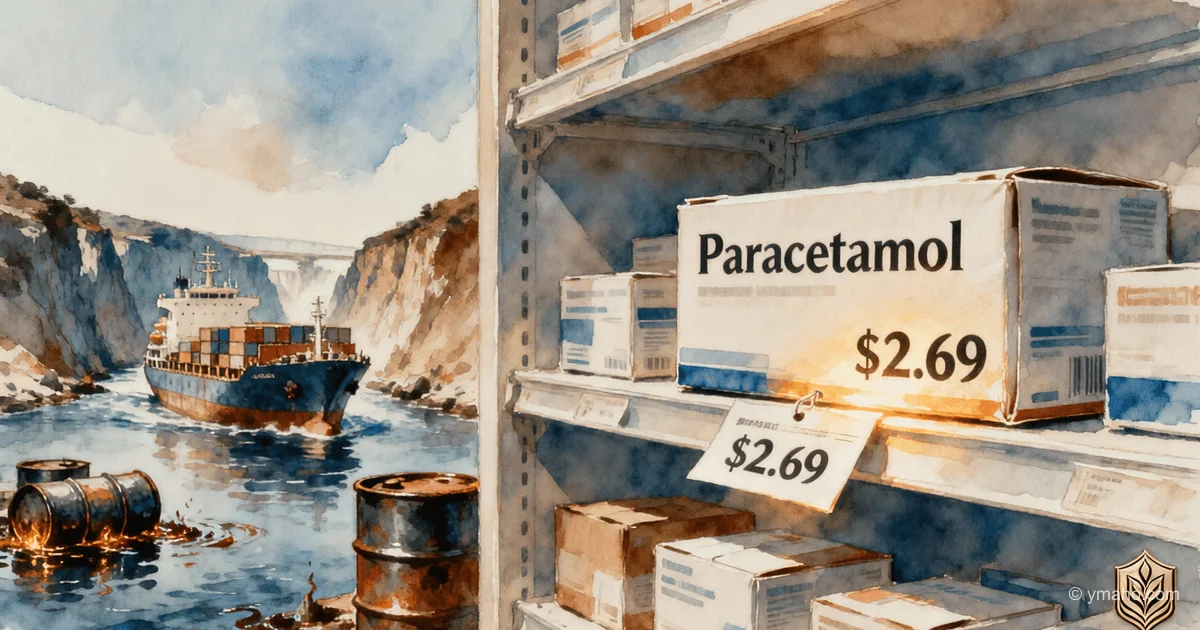
How the Iran conflict is making medicine more expensive worldwide
If you've recently bought over-the-counter painkillers and noticed the price is higher, you're not alone. The US-Israel war with Iran is disrupting global supply chains in ways that are now hitting the medicine cabinet.
The Strait of Hormuz chokehold
Early in the conflict, Iran blocked the Strait of Hormuz, a narrow waterway in the Persian Gulf. In normal times, about 20% of the world's oil and liquefied natural gas (LNG) passes through it. But here's the part many people miss: pharmaceutical production relies heavily on petrochemicals — chemicals derived from oil and gas — that come from this region.
Think of it like a car factory. If the supplier of steel shuts down, the car plant can't build cars. Similarly, if the supply of petrochemical feedstocks (the raw ingredients for many drugs) is disrupted, medicine production faces delays and cost increases.
Air cargo chaos
Medicines don't just travel by ship. About 35% of all pharmaceuticals, and 90% of life-saving drugs and vaccines, are shipped by air. They need special handling — many must stay cold from factory to pharmacy, a so-called "cold chain." The war has caused widespread flight cancellations, airspace closures, and a looming jet fuel crisis.
According to Wouter Dewulf, a professor of pharma logistics at the University of Antwerp, about 22% of global air cargo is exposed to Middle East disruptions. That means delays, rerouting, and higher costs. For generic medicines — where profit margins are very thin — even a small increase in shipping costs can lead to a big jump in price.
Which medicines are getting more expensive?
Pharmacies in the UK and India are reporting sharp price increases for common drugs:
- Paracetamol (acetaminophen), a basic painkiller and fever reducer, has seen price jumps of up to 96% in India, according to a former board member of the Visakha Chemists Association.
- In the UK, the price of a pack of 100 paracetamol tablets rose from about $1.42 to $2.69 in March, before easing slightly to $1.47.
- Other over-the-counter medicines in the UK have gone up 20-30%.
The main reason: raw material costs are rising because of supply chain disruptions.
Who is hit hardest?
The pain isn't spread evenly. Here's how different regions are affected:
- India — a major producer of generic drugs — depends heavily on raw materials from the Gulf. It's particularly vulnerable.
- The US has its own domestic oil and petrochemical supply, so it's less affected.
- China can source most of its needs from elsewhere.
- European Union countries have strategic stockpiles of medicines (enough for 2-10 months), but the UK's National Health Service is already warning of possible shortages.
- Sub-Saharan Africa and countries like Sudan, Yemen, and Palestine have little to no stockpiles and cannot afford price hikes. They face the most acute shortages.
- Lebanon, Palestine, and Iran are directly in the conflict zone and are the most exposed.
- Gulf countries like the UAE and Qatar have rerouted shipments after major hubs like Dubai and Doha were hit by airstrikes. So far, they are managing, but risks remain for cold-chain and cancer medicines.
What does this mean for regular people?
You might see higher prices for common painkillers and other generic drugs in the coming months. If you live in a country with stockpiles, shortages are less likely — but costs will still rise. For people in poorer or conflict-affected regions, the situation is more serious: essential medicines could become unavailable or unaffordable. This crisis shows how a war far away can reach into your local pharmacy.
Key takeaways
- The Iran conflict has blocked the Strait of Hormuz, disrupting petrochemical supplies needed for medicines.
- Air cargo — critical for 90% of life-saving drugs — is severely disrupted, causing delays and higher costs.
- Prices of common drugs like paracetamol have already jumped up to 96% in India and 20-30% in the UK.
- Poorer countries without stockpiles or financial reserves are most vulnerable to shortages.
- The situation is manageable in wealthy nations but could worsen if the conflict escalates.
— Editorial Team









