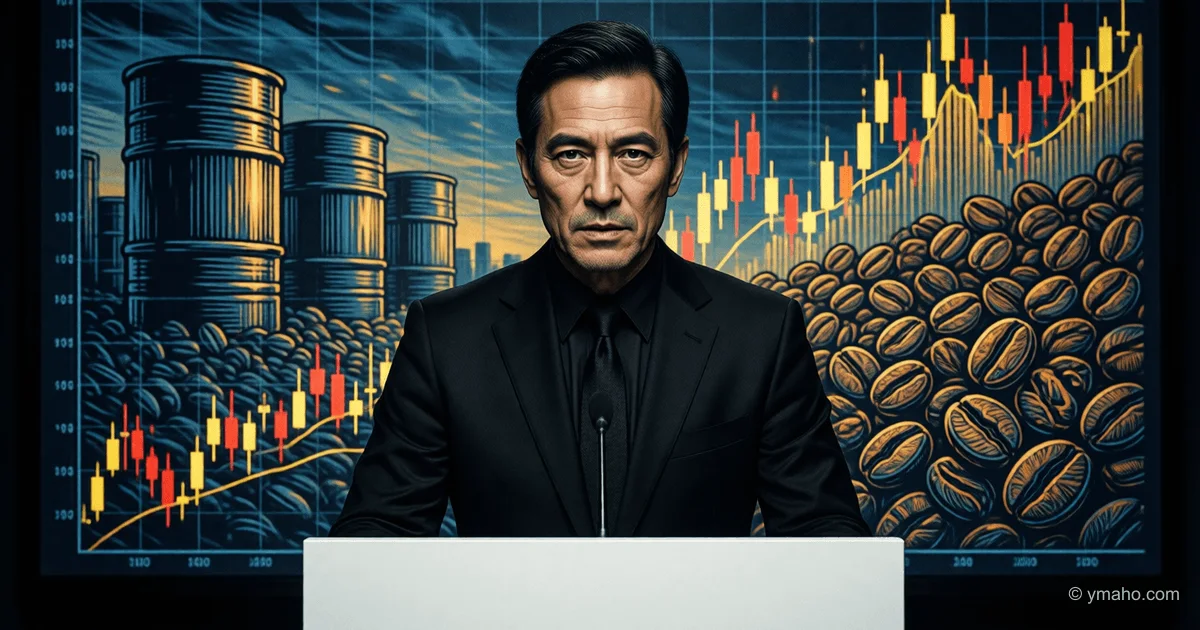
Kevin Warsh's Appointment as Fed Chair Sparks Optimism in Commodity Markets
New Federal Reserve Chairman Kevin Warsh takes office. His appointment has already driven up coffee prices, and markets await his first statements to understand future monetary policy amid persistently high inflation.
The man who crashed gold but boosted coffee: what Kevin Warsh's appointment really means for global markets
The gist: what's really happening
The key issue is a catastrophic mismatch between expectations and reality. Markets see Warsh as a Trump appointee who should slash rates, but his intellectual track record suggests otherwise. He is hostage to others' illusions. The White House views him as a bulldog who will tear down expensive money policy, but I have a memo on my desk analyzing his actions during the 2008 crisis. Warsh was then the youngest governor and the only one who openly criticized Bernanke for Quantitative Easing (QE), calling balance sheet expansion "the greatest adventure of our time."
Now, with inflation stuck above 3%, his hands are tied not by political pressure but by simple math. If he cuts rates, real yields will plunge deep into negative territory. That would be a death sentence for the dollar. That's why coffee, copper, and energy are rallying. Commodity traders, unlike equity traders, feel this dissonance in their bones. They understand: either Warsh crushes inflation through hawkishness, or inflation crushes the dollar. There is no third option. Optimism in commodity markets is not faith in a bright future; it's a 100% bet that the new sheriff won't tame the ghost of rising prices.
Timeline and context
The devil, as always, is in the timeline. The White House ceremony is not just beautiful symbolism. The last time a president personally swore in a Fed chair was nearly forty years ago, in 1987, when Reagan appointed Alan Greenspan. With this gesture, Trump clearly signals a power vertical and hints at manual rate management. But there is a nuance. Stephen Miran, who held a seat on the Board of Governors specifically for this deal, leaves his post simultaneously with Warsh's inauguration. His role was to stay in the chair longer than the White House planned, so that the investigation against Powell over headquarters reconstruction wouldn't undermine confidence in the new candidate.
We saw this play in April. When Warsh went through Senate hearings, gold slid from all-time highs to a paltry $4,745 per ounce, losing nearly a thousand dollars. The bond market instantly digested his hawkish mantras that the Fed should "stay in its lane" and stop playing global navigator. By May 13, he was confirmed almost along party lines with a margin of just a few votes, despite fierce opposition from Democrats and some Republicans, whom Senator Thom Tillis skillfully stalled.
Today, May 22, 2026, he officially took the helm. The key word here is not even his reluctance to cut rates from the current 3.5–3.75%, but his obsession with the Fed's balance sheet. He intends to shrink the asset portfolio more aggressively than anyone could imagine. For commodities, this matters more than rates. Withdrawing dollar liquidity through QT kills speculative demand for derivatives, but it only heats up the physical market for oil and food, because commodity producers lose access to cheap funding.
Who wins and who loses
Beneficiaries:
Low-cost miners. I have in mind Agnico Eagle and Pan American Silver. While gold hovers around $4,750 per ounce with average all-in sustaining costs (AISC) near $1,680, giants like Newmont are swimming in cash. But if Warsh launches aggressive QT and Treasury yields rise again, precious metals will come under pressure because holding "yieldless" gold becomes too expensive. That's where efficient producers who can generate cash in any environment win.
Non-traditional commodity assets. As I said, the coffee rally is not an anomaly. It's a safety valve. Institutional investors can't just jump out of the dollar, but they can hedge inflation risks through food and energy. If Warsh can't raise rates due to White House pressure and inflation stays above 3%, real yields will turn negative, triggering an avalanche flight into any hard asset.
Losers:
Silver speculators. This will be a brutal bloodbath. In late January, when Warsh's nomination was announced, silver crashed over 31% in a single session. That's the worst drop since 1980. Why? Because silver is a surrogate for cheap liquidity. As soon as the Fed seriously tackles the balance sheet, margin requirements rise, and brokers forcibly close positions of the most leveraged players. If Warsh utters a single word about tighter QT, silver will plunge again, regardless of what happens in the Strait of Hormuz.
Jerome Powell. He is denied a peaceful retirement. Remaining on the Board of Governors until 2028, he becomes a permanent dissident and a living target for Trump's criticism. This creates a unique dual-power situation within the regulator, where the former chair, with his authority, can block or at least challenge the most populist initiatives of the new administration.
What the media isn't telling you
No one dares to write the truth about "Productive Dovishness." There is a crazy but very dangerous theory now being discussed in the backrooms of major hedge funds. Warsh genuinely believes that Artificial Intelligence (AI) can offset any price increases. He calls it "Productive Dovishness": we don't raise rates because AI will fix everything tomorrow and optimize costs. This is an intellectual trap. If AI doesn't live up to these hopes and rates remain low, we'll get an explosive rise in consumer prices that will kill the consumer sector but send commodity futures to the moon.
And the second point — a lie to save the Fed's independence. The White House ceremony is a smokescreen. The real threat to Fed independence lies not in the inauguration but in the personnel purge of the analytical staff. Warsh intends to remove the "doves" focused on the labor market from the committee and replace them with technocrats for whom the mantra of "price stability" matters more than employment. This is a monetary coup, but it's kept quiet because it happens silently, through bureaucratic procedures.
Forecast: next 30 days and 90 days
30 days. Everyone is now watching the June FOMC meeting. I expect a surprise. Contrary to Trump's expectations, Warsh won't cut rates in his first month. He will keep the rate at 3.5–3.75% but announce a halt to reinvestment of mortgage-backed securities (MBS) proceeds. This will cause an immediate shock in the US housing market and strengthen the dollar. For commodities, this will mean a short-term correction of 3-5%, which smart money will use to build long positions in Brent and copper.
90 days. By September, the conflict between the White House and the Fed will enter an open phase. Trump needs a victory in Iran and cheap gasoline before the midterm elections. Warsh needs to bring down inflation at any cost. Due to a split on the Board of Governors (four dissenting votes at the last meeting), the FOMC will lose its monolithic character. The dollar will start to fluctuate. That's when Brent oil will finally settle above $115 per barrel. The key risk to this scenario: administrative pressure forces Warsh to resign within the first year of his 14-year term, instantly crashing the DXY by 5% and triggering a hyperinflationary spike in all commodities.
Editorial forecast
Asset: US Dollar Index (DXY) futures. Direction: up in the next 24–72 hours. Key levels: firm break above 100, followed by a move to resistance at 101.5. Confidence level: high. The inauguration and Warsh's first official rhetoric as Fed chair will focus on fighting inflation and reducing the balance sheet, creating a hawkish impulse for the US dollar. The main risk to the forecast: any direct political statement from Donald Trump at the ceremony demanding an immediate and aggressive rate cut could instantly weaken the dollar despite the Fed's own stance. This is the editorial opinion, not investment advice.
— Editorial Team









