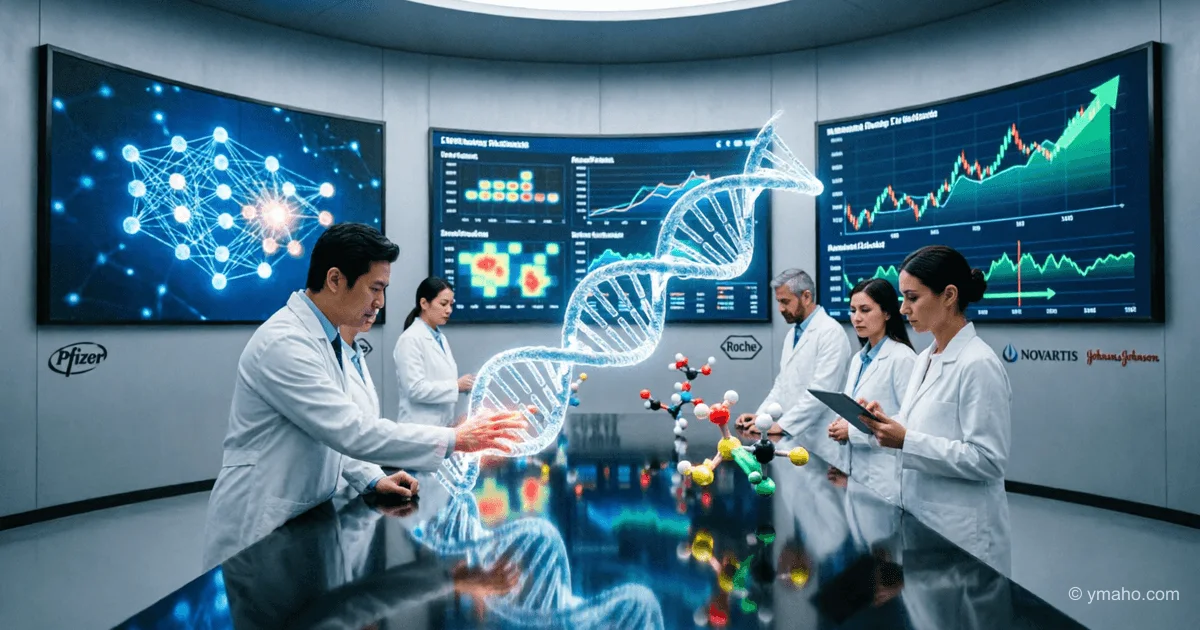
Analysts Predict M&A Boom in Pharma Due to AI-Accelerated Drug Development
Major companies are spending tens of billions, eager to buy time and technology rather than wait 8-10 years for in-house development. Biotech startups using machine learning for clinical trials are of particular interest.
Artificial Intelligence as a Catalyst: Why Big Pharma Is Buying Biotech Startups for Speed
Introduction
The pharmaceutical industry is entering a period of unprecedented transformation, where artificial intelligence is becoming not just a supporting tool but a central driver of mergers and acquisitions. The largest players—Eli Lilly, Merck, AstraZeneca, and Johnson & Johnson—are actively acquiring biotech startups specializing in machine learning for clinical trials, spending tens of billions of dollars. The main motivation is simple and ruthless: in-house drug development takes an average of 8-10 years and costs up to $2 billion, while acquiring a ready-made AI platform can cut this cycle dramatically.
The strategic context is amplified by the so-called "patent cliff": by 2030, about 190 branded drugs will lose patent protection, putting between $236 billion and $400 billion in annual revenue at risk. In this race against time, AI startups are becoming not a luxury for Big Pharma but the only way to replace lost revenue before the patent cliff hits their financials.
Event Details and Timeline
February-March 2026 became a period of landmark deals confirming the new trend. At the J.P. Morgan Healthcare Conference in January 2026, Eli Lilly and NVIDIA announced the creation of a joint AI lab worth $1 billion in South San Francisco—the TuneLab project aims to compress the drug development cycle through trillions of molecular simulations annually.
In March 2026, Eli Lilly also signed an agreement with Insilico Medicine worth up to $2.75 billion (approximately €2.39 billion). Under the deal, the US pharma giant obtained exclusive global rights to develop and commercialize drugs created using the Pharma.AI platform. Insilico received an upfront payment of $115 million and is eligible for subsequent tranches tied to clinical and regulatory milestones. Notably, Insilico's annual revenue in 2025 was only $56 million, and the $2.75 billion valuation reflects the value of its AI infrastructure rather than current financial performance.
Meanwhile, Merck announced it is ready to spend over $15 billion on acquisitions in 2026, focusing on late-stage assets and AI platforms. Bristol Myers Squibb has already completed deals worth $30 billion, and Pfizer allocated a business development budget of $6 billion.
Also noteworthy is the April deal (April 2, 2026) between AI company Anthropic and biotech startup Coefficient Bio for $400 million. It is significant because the buyer was not a pharmaceutical corporation but a developer of large language models—signaling the convergence of AI and biotech sectors into a single market.
Impact and Significance
The ongoing shift has fundamental implications for the entire drug development ecosystem.
AI moves from experimental to infrastructure. As recently as 2025, machine learning algorithms were seen as useful but auxiliary tools. By early 2026, the situation has changed radically: AI is becoming the "operating system" of pharmaceutical R&D. The Insilico Pharma.AI platform, for example, covers the entire cycle—from identifying biological targets to molecule design and clinical trial planning.
Compression of time horizons. The specific numbers are impressive. Moderna used machine learning to cut candidate molecule selection from 18 to 6 months. Illumina uses the DRAGEN AI platform to reduce whole-genome analysis time from 30 hours to less than 30 minutes. This is not gradual improvement but a qualitative leap that changes the economics of the entire industry.
Changing nature of M&A. Previously, pharma companies bought individual promising molecules or late-stage assets; now, the subject of deals is increasingly platforms—technologies capable of generating multiple drugs for different diseases. ING forecasts a 15% increase in the number of deals in 2026 (to about 520 transactions) and a total volume of up to $230 billion.
The China factor. The share of Chinese biotech companies in global out-licensing deals rose from 3% in 2020 to 40% in 2026. The Eli Lilly-Insilico deal (Insilico has Chinese roots) and Lilly's November partnership with Shanghai-based Xtalpi for $345 million confirm that geopolitical tensions do not stop commercial logic.
Reactions of Key Players
The positions of leading companies demonstrate several strategic patterns.
Eli Lilly chose the path of aggressive technological leap. In addition to the two deals mentioned above, the company invested in Insilico's IPO on the Hong Kong Stock Exchange and created a physical AI lab with NVIDIA. As Lilly's Vice President of Molecule Discovery Andrew Adams stated, "Insilico's AI-driven drug discovery capabilities are a powerful addition to our clinical development expertise."
Merck focuses on oncology and immunology, preparing a portfolio of new products worth $70 billion to compensate for the loss of the Keytruda patent in 2028. The company launched 16 global Phase III studies for its ADC candidate sac-TMT.
Pfizer and Bristol Myers Squibb use a different tactic—large one-time acquisitions. Pfizer, after competing with Novo Nordisk, bought Metsera for up to $10 billion, while BMS spent $30 billion on portfolio diversification.
Tech giants are also entering the market. The Anthropic-Coefficient Bio deal and Amazon/NVIDIA's participation in OpenAI rounds show that the boundary between AI labs and pharmaceutical companies is blurring. Coefficient, acquired by Anthropic, specialized in protein design—and now this competence is integrated into the Claude ecosystem.
Regulators signal flexibility. The FDA had already approved 46 cell and gene therapy products by August 2025, and ARPA-H is funding the development of "agentic AI" for treating chronic diseases.
Forecast and Conclusions
2026 is highly likely to be a turning point for AI-driven pharma for several reasons.
First, the pace of deals will accelerate in the second half of the year. ING points out that the Fed rate cut in 2026 will reduce the cost of capital and increase appetite for risky acquisitions. An additional catalyst is the US administration's favorable attitude toward mega-deals.
Second, competition for AI platforms will intensify. The number of mature AI-biotech startups with proven clinical efficacy remains limited, while demand from Big Pharma continues to grow. This inevitably pushes valuations up and may lead to a "bubble" in the AI-biotech segment.
Third, regulatory risks remain underestimated. As ING notes, investors tend to ignore political risks until they materialize—yet ongoing price negotiations under the Inflation Reduction Act and potential simplification of biosimilar market entry could reduce the future profitability of acquired assets.
For the industry as a whole, the main conclusion is this: AI is fundamentally changing the "risk logic" of pharmaceutical investments. Companies using predictive models to optimize targets and trial design can build a more compelling investment case than traditional biotechs. Pharma, which for decades operated on a "one molecule, one disease, ten years of development" model, is turning into an industry of platform technologies, where the key asset is not a specific drug but the ability to quickly and predictably generate new medicines with AI.
— Editorial Team









