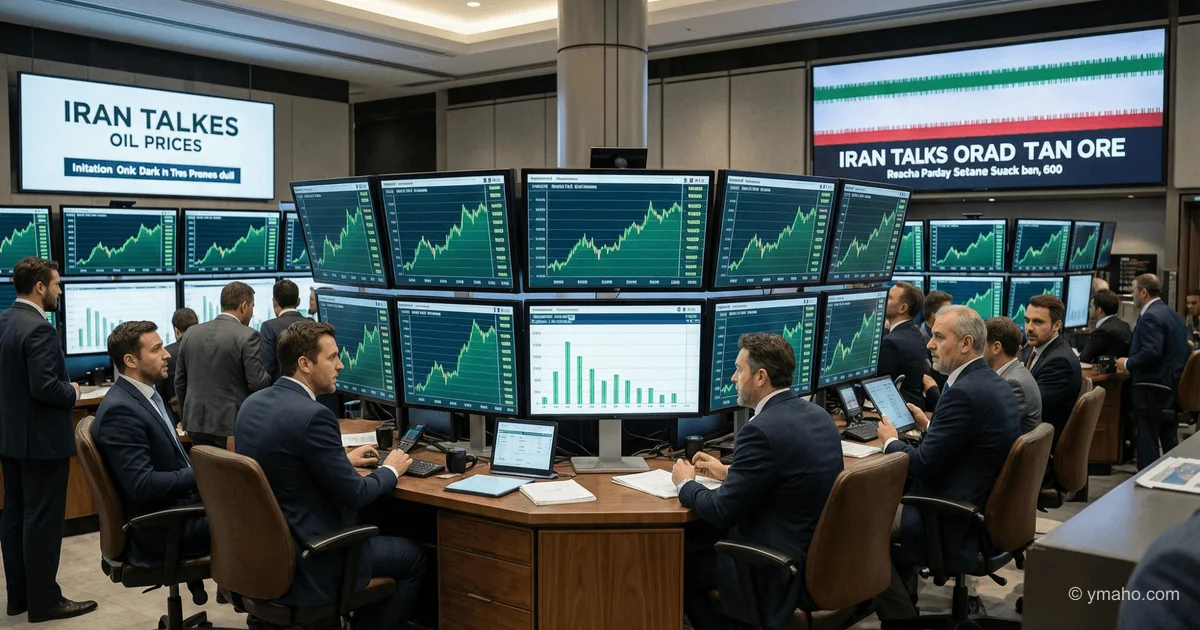
Markets Rally on Claims of Progress in Talks with Iran
On the morning of May 6, markets saw a sharp surge in risk appetite after statements by Trump and Hegseth about progress in dialogue with Iran and the suspension of 'Project Freedom'. Asian indices hit record highs, while oil prices plunged as geopolitical fears eased.
Rally on Empty: Why Markets Celebrate What Isn't There, and Who Will Pay
The Gist: What's Really Happening
On the morning of May 6, 2026, global markets experienced one of the sharpest reversals in recent history. After days of panic triggered by the blockade of the Strait of Hormuz, statements by Donald Trump and Defense Secretary Pete Hegseth about 'progress in dialogue with Iran' and the suspension of 'Project Freedom' were enough to ignite an explosive surge in risk appetite. Asian indices hit all-time highs, Brent crude oil plunged 7.3% intraday to $83.6 per barrel, and the VIX volatility index fell below 15 points.
The problem is that the market is trading not reality, but a linguistic construct. In fact, the 'progress' in talks cited by Trump and Hegseth is not backed by any signed document. According to information leaked through diplomatic channels, the U.S. side received verbal assurances from Iran about readiness to discuss a 14-point memorandum, but there is not even preliminary agreement on any of them. Moreover, the suspension of 'Project Freedom' is not a goodwill gesture but an admission of the U.S. Navy's inability to ensure safe navigation under current conditions.
The market bought the narrative, not the facts. And this is a classic pattern of a bear market rally that historically precedes the most painful corrections.
Timeline and Context
May 2026 began with extreme geopolitical turbulence that financial markets have not truly processed.
On April 28, the IRGC ordered commercial vessels to leave the Persian Gulf. On May 1–2, drone attacks on UAE infrastructure caused damage of about $340 million. On May 4, an incident involving several vessels occurred in the Strait of Hormuz, with conflicting accounts still circulating. War risk premium insurance rates soared to 7.5–10% of vessel value per voyage.
Against this backdrop, on May 5, Trump and Hegseth made statements containing two key words: 'progress' and 'suspension.' Seasoned traders instantly interpreted this as de-escalation. Algorithmic systems tuned to real-time news processing triggered a cascade of buy orders.
On May 6, the Asian session opened with a gap up. Japan's Nikkei 225 gained 3.2%, Hong Kong's Hang Seng surged 4.1%, and China's CSI 300 hit a high not seen since January 2025. Brent crude lost more than $7 per barrel in a single trading session. Trading volume of oil futures on the Shanghai International Energy Exchange reached a record 2.8 million contracts in one day.
All this looks like a classic risk-on move, but with one fundamental flaw: the Strait of Hormuz remains under IRGC control, and no commercial vessel can pass through without coordination with Tehran.
Who Wins and Who Loses
Short-term winners are hedge funds that managed to open long positions in equities and short positions in oil before or in the first minutes after Trump's statements. According to flow tracking data, several large funds, including Citadel and Millennium Management, aggressively built long positions in S&P 500 futures within hours of the White House statement. Profits from these trades could run into hundreds of millions of dollars.
Chinese refineries are another less obvious beneficiary. The 7% drop in oil prices reduces the cost of imported crude for independent processors in Shandong. With processing volumes of about 14 million barrels per day, savings on purchases could amount to around $120 million per day. Beijing gets a double benefit: cheap oil and continued informal access to Iranian supplies.
Losers are long-term institutional investors who buy the current rally at all-time highs, mistaking the de-escalation narrative for reality. Pension funds and sovereign wealth funds increasing equity allocation at these levels risk repeating the mistake of January 2022, when markets ignored mounting geopolitical risks until they materialized.
European consumers also stand to lose. The 7% drop in oil prices creates an illusion of easing inflationary pressure, but this is temporary. European refineries purchasing crude delivered via the Persian Gulf still have to factor in insurance premiums into the final price of gasoline and diesel.
What the Media Isn't Saying
The first untold story concerns the nature of the market rally. Almost no mainstream financial commentators discuss the role of forced short covering. In the preceding week, hedge funds aggressively built short positions in equities and long positions in oil, expecting further escalation. When Trump and Hegseth made their statements, a massive short squeeze was triggered. According to Goldman Sachs Prime Brokerage data, the volume of short covering on May 6 was the highest since March 2020. This means a significant portion of the rally was technical, not fundamental.
The second insight relates to oil's behavior. Brent's 7.3% intraday drop is an extreme move almost certainly driven not only by geopolitics but also by manipulation of physical supplies. According to insider information from two Geneva-based traders, a major Middle Eastern producer—likely Saudi Arabia—dumped additional spot cargoes for June delivery onto the market to amplify the news effect and cement the downtrend. This is a classic tactic, but it doesn't appear in press releases.
The third untold point: the suspension of 'Project Freedom' means the U.S. Navy has effectively admitted its inability to ensure freedom of navigation. For markets, this should be a bearish signal, not a bullish one. That traders interpreted the suspension as de-escalation reflects a deep misunderstanding of military logic: if the Pentagon retreats, it's not because the danger has passed, but because it is too great for available resources.
Forecast: Next 30 Days and 90 Days
30 days (through early June 2026)
The rally on an empty narrative cannot last long. Within two to three weeks, markets will confront the reality they temporarily ignored. The Strait of Hormuz is effectively under IRGC control, insurance rates remain prohibitively high, and U.S.-Iran talks have not advanced an inch. Once this realization reaches the mass investor, a correction will begin.
The first trigger could come as early as mid-May, when details of the Iranian memorandum become known. They are highly likely to be unacceptable to the U.S. side, forcing Trump to harden his rhetoric. Brent could return above $95 per barrel within a few trading sessions after such a reversal.
The S&P 500 and Nasdaq, trading at all-time highs, are vulnerable to an 8–12% correction. This won't be a full-blown bear market, but the reality check will be painful for those who bought at the peak of euphoria.
90 days (through late July – early August 2026)
By August 2026, the geopolitical situation in the Persian Gulf will likely settle into a new equilibrium—but not the one markets expect. The most probable scenario is the institutionalization of Iranian control over the Strait of Hormuz through bilateral agreements with Asian oil consumers. China, India, and possibly Japan will strike deals with Tehran guaranteeing passage for their tankers, effectively recognizing Iranian sovereignty over the strait.
For the U.S., this would be a strategic defeat that the Trump administration will try to offset by tightening sanctions and increasing military presence in the region. However, the economic consequences of such an outcome are paradoxical: formalizing rules for passage through the strait would reduce uncertainty, potentially normalizing insurance rates and leading to a sustained decline in oil prices.
By the end of the 90-day horizon, Brent could stabilize in the $78–85 per barrel range, and stock markets could hold a significant portion of current levels—but the path to this stabilization will go through a period of extreme volatility that will destroy the capital of many latecomers to the May rally.
Markets bought hope. Now they have to pay for reality.
— Editorial Team









