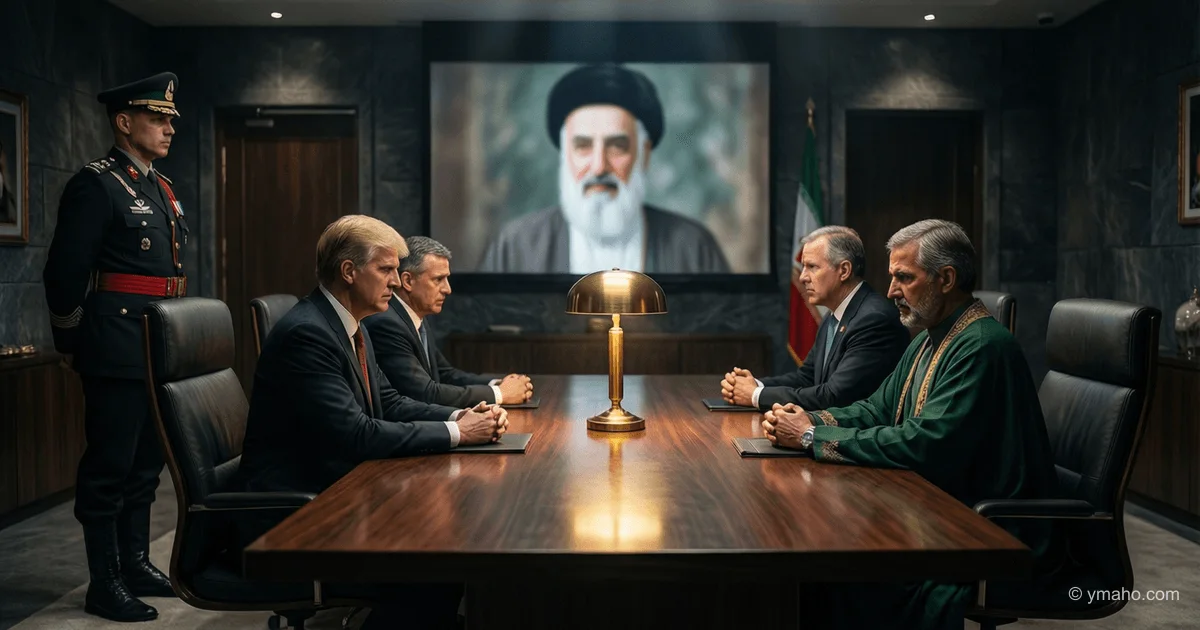
Iran Negotiates with US Under Direct Control of Supreme Leader Khamenei
A senior IRGC official reported that dialogue with the US over regional escalation is being conducted under the personal control of Mojtaba Khamenei, and Tehran has no intention of making concessions under Washington's pressure.
Here is an analysis written from the perspective of someone who understands: when the name Mojtaba Khamenei surfaces in Iranian politics, it is not about a bureaucratic detail, but a tectonic shift in the power structure, the consequences of which will extend far beyond the nuclear deal.
[The Gist]: What is Really Happening
The news that negotiations with the US are being conducted under the direct control of Mojtaba Khamenei—the son of the Supreme Leader and his most likely successor—is not a procedural clarification. It is an official signal of the end of the era of "dual power" in Iran. Until May 2026, the negotiation process was overseen by Secretary of the Supreme National Security Council Ali Akbar Ahmadian, who reported to both the Supreme Leader and President Masoud Pezeshkian. Now, all communication channels—Swiss, Omani, and the unofficial Qatari one—are directly linked to the 57-year-old Mojtaba, who has never held elected office but has methodically built a parallel power vertical since 2022 through the IRGC command and the giant foundations "Setad" and "Bonyad Mostazafan," which control assets worth $120 billion. The practical meaning of this move: Iran has shifted negotiations from the diplomatic to the military-political plane. Now, every agenda item—from the uranium enrichment schedule to the naval blockade—is approved by a man whose career was built not in the Foreign Ministry, but in IRGC intelligence and the board of trustees of the Imam Reza shrine. This means Tehran no longer separates nuclear program negotiations from regional security negotiations—they are combined into a single package called "Grand Deal-3," and piecemeal bargaining is excluded.
Timeline and Context
The formal transfer of authority did not occur on May 19, when the news hit the media, but much earlier. As early as April 3, 2026, ten days after the 83-year-old Ayatollah Ali Khamenei was hospitalized with an exacerbation of a chronic illness (according to available information, it is prostate cancer at a stage requiring constant medical monitoring), Mojtaba convened a closed meeting at the Beit Rahbari complex. Present were IRGC Commander Hossein Salami, IRGC Intelligence Chief Mohammad Kazemi, and Quds Force Commander Ismail Qaani. Ahmadian was not invited. It was there that the decision was made to consolidate negotiation tracks under a single command. On April 28, the first meeting took place in Muscat, where the Iranian delegation was formally headed by Deputy Foreign Minister Majid Takht-Ravanchi, but in reality, every step was coordinated through a secure communication channel with Mojtaba's office. At the meeting, the Iranian side presented an ultimatum: the US must withdraw the Fifth Fleet beyond a 50-mile zone from the Strait of Hormuz, unfreeze $14 billion in Iranian assets in European and South Korean banks, and cease support for the Israeli operation "Ha-Gefen" in exchange for Iran's commitment not to completely block the strait and to allow IAEA inspectors into the Natanz and Fordow facilities, but without access to IRGC military bases. The US refused, and on May 16, after the failure of the Omani round, the Iranian side transmitted through the Swiss the very memorandum that preceded the attack on "Baraka" and the explosion near the Bab el-Mandeb Strait.
Who Wins and Who Loses
Winners:
- The IRGC as an institution. Consolidation of the negotiation process in Mojtaba's hands means the Corps gains direct control over export flows that were previously partially regulated by Pezeshkian's government. Revenues from shadow oil exports, reaching $45 billion per year, now fully pass through IRGC-controlled structures.
- China. The closure of the negotiation process around Mojtaba simplifies Beijing's interaction with Tehran: the Chinese prefer to deal with a single decision-making center rather than factional infighting. The $18 billion contract for the development of the South Pars field, stalled due to contradictions between the Foreign Ministry and the IRGC, will now be unlocked within 60 days.
- Russia. The closure of negotiations from reformist President Pezeshkian means Moscow gains a monopoly intermediary in the form of the IRGC, rather than a diplomatic competitor.
Losers:
- President Pezeshkian and the reformist camp. Their political capital, based on the promise of a diplomatic breakthrough, is nullified. Pezeshkian remains a ceremonial figure whose signature is only needed for protocol decrees. The presidential administration has already cut spending by 30%, laying off 1,200 employees.
- The European Union. EU High Representative for Foreign Affairs Kaja Kallas spent four months building a dialogue with Pezeshkian's team through the mission in Vienna. Now that channel is useless, and Brussels loses $4.2 billion in potential trade contracts that were being discussed under the INSTEX sanctions bypass mechanism.
- South Korea. Frozen Iranian assets of $7 billion in the Bank of Korea were a bargaining chip. Mojtaba, unlike Pezeshkian's diplomats, is not interested in unfreezing through Seoul—he demands the transfer of funds directly to Omani and Qatari banks, leaving the Koreans without leverage.
What the Media Isn't Saying
The first and most critical non-obvious insight: Mojtaba Khamenei is not negotiating with the Trump administration, but with a transition team that, according to his calculations, will come to power after the midterm congressional elections in November 2026. According to a source in the Supreme Leader's office, Iranian intelligence estimates the probability of Republicans completely losing control of the House of Representatives at 62%, and Tehran is deliberately dragging out negotiations, waiting for a Democratic majority to arrive, with whom, as Beit Rahbari believes, it will be easier to reach a long-term agreement.
The second underreported fact: Mojtaba's personal control over negotiations is directly linked to the issue of succession. Ayatollah Ali Khamenei, whose health sharply deteriorated in April, tasked his son with completing the "Grand Deal" before the transfer of power, so that the Assembly of Experts would have an indisputable argument in favor of Mojtaba: "he managed to make America back down without war." This turns negotiations from a foreign policy process into an element of internal political struggle for the post of Supreme Leader.
Third: the financial track of negotiations is much larger than reported. In addition to unfreezing assets, Mojtaba is seeking guarantees from the US of non-interference in the operations of Iranian banks (including Bank Melli and Bank Saderat) in the trade finance market in Asia. This involves an annual turnover of $28 billion, which currently passes through shell structures in the UAE and Turkey with a commission of 7-9%. Legalizing this flow through a return to the SWIFT system would save Iran about $2.5 billion per year.
Forecast: Next 30 Days and 90 Days
30 days (until June 18, 2026):
Negotiations will reach a deadlock, but without a breakdown. Mojtaba will continue the tactic of "escalation for negotiations": the IRGC will carry out another pinpoint strike on infrastructure in the UAE or Saudi Arabia to raise the stakes. Pezeshkian will try to regain the initiative through a public statement about readiness for direct talks with the US, but will be reined in by Beit Rahbari. Ayatollah Khamenei will not appear in public on June 4, the anniversary of Khomeini's death, which will fuel rumors of his incapacitation and lead to increased tension within the Assembly of Experts. Brent crude oil prices will fluctuate in the range of $114-118 per barrel, reflecting a premium for uncertainty.
90 days (until August 17, 2026):
By mid-August, the moment of truth will arrive. Ayatollah Khamenei will either die or officially transfer some powers to his son, triggering the election of a new Supreme Leader in the Assembly of Experts. Mojtaba, with the negotiation process with the US and control over the IRGC in his portfolio, will be the main, but not uncontested, candidate—his rival will be Ayatollah Alireza Arafi, supported by part of the Qom clergy. External negotiations will become hostage to internal struggle. If Mojtaba wins, he will offer the US a "package deal": Iran refrains from blocking the Strait of Hormuz and limits support for the Houthis in exchange for full sanctions relief and recognition of Iran's sphere of influence in Iraq and Syria. If Arafi wins, the IRGC may break away from civilian control, and negotiations will be finally derailed. In any case, the world is witnessing the birth of a new Iran—a state where the line between diplomacy and military operation is finally blurred, and the keys to war and peace are in the hands of a man whose career began not in a ministry, but in the intelligence barracks of the Islamic Revolutionary Guard Corps.
— Editorial Team









