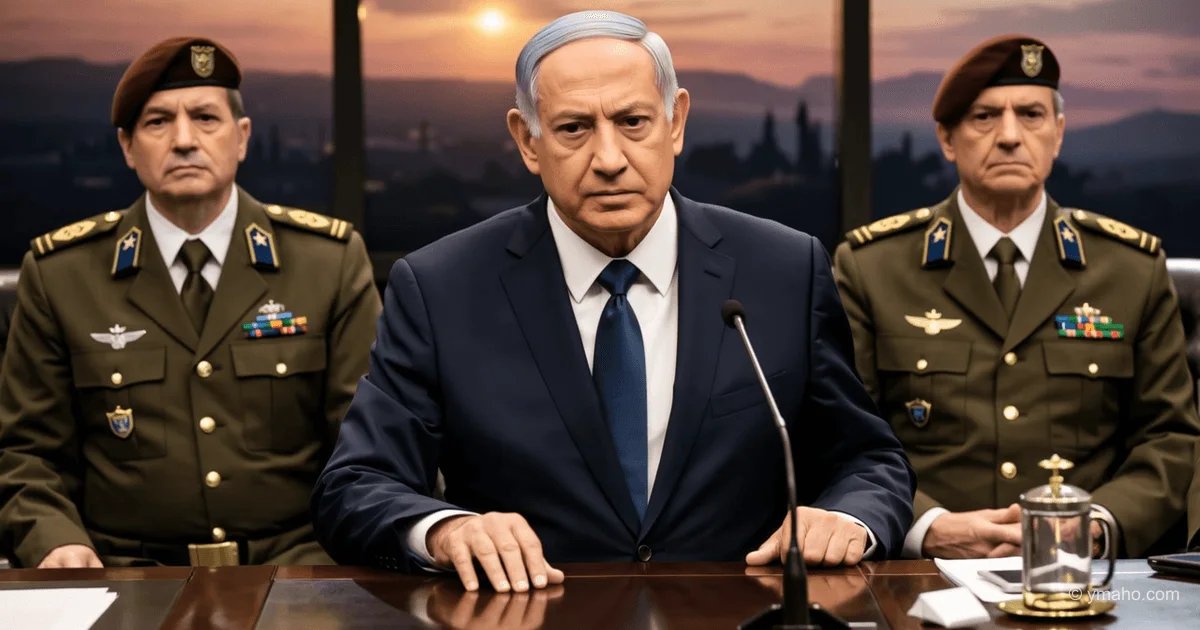
Netanyahu Admits Israel Underestimated Iran's Ability to Block the Strait of Hormuz
Responding to questions about miscalculations before the start of the military operation, the Israeli prime minister said that "understanding of the Strait of Hormuz problem came during the fighting," hinting at flawed initial intelligence assessments.
[The Gist]: What's Really Happening
Netanyahu's admission, made on May 11 at a closed session of the Knesset Foreign Affairs and Defense Committee, is not a politician's self-criticism. It is a public flogging of Israeli intelligence, neatly packaged as a personal "we underestimated." The prime minister made it clear that the strategic assessment presented by Mossad and AMAN (military intelligence) before the start of Operation Iron Sword-2 contained a fundamental error: Iran was viewed solely as a missile threat, not as a naval power capable of single-handedly blocking 17 million barrels of daily global oil traffic. "Understanding came during the fighting" is a euphemism for "intelligence failed in its assessment, and now we're paying $112 a barrel and losing allies."
The real subtext of the statement is even harsher. Netanyahu is not just criticizing the intelligence agencies—he is shifting responsibility for a potential failure of the operation. If Israel does not achieve its stated goals (destroying Iran's nuclear potential and regime change in Tehran), the blame will fall on intelligence, which "failed to warn about Iran's ability to block the strait." This is a classic Bibi maneuver of preemptive blame-shifting.
Timeline and Context
The story of this admission begins on March 14, 2026—the date when Israel's war cabinet approved the final plan for strikes on Iranian nuclear facilities. The plan was based on a 240-page intelligence document called "Assessment-26," prepared jointly by Mossad, AMAN, and Shin Bet. The document detailed Iran's air defenses, centrifuge locations, bunker depths at Natanz and Fordow, and approach routes for Israeli F-35I Adir jets. The Strait of Hormuz received exactly one and a half pages out of 240. The conclusion read: "Iran does not possess the naval capability to block the strait for more than 48-72 hours; the massive presence of the US Fifth Fleet guarantees freedom of navigation." Three people signed this conclusion: Mossad chief David Barnea, AMAN chief Major General Shlomi Binder, and Chief of Staff Lieutenant General Eyal Zamir. Not one expressed doubt.
On May 7, 2026—reality shattered "Assessment-26." Iran didn't just block the strait; it introduced multi-layered control with submarines, coastal missile batteries, IRGC speedboats, and the "Strait of Hormuz Administration." The 72-hour limit expired five days ago, and the strait remains a conflict zone. Brent crude, at $78 in March, soared to $112. The economic damage to Israel is $1.4 billion in additional energy costs in the last week alone.
On May 10, Barnea and Binder were summoned to Netanyahu for an emergency explanation. According to several sources in the Israeli establishment, the conversation was extremely harsh. Barnea insisted that intelligence had warned about Iran's naval potential in separate reports, but they were not included in the final document "due to prioritization of the missile threat." On May 11, Netanyahu appeared before the Knesset committee and uttered the phrase that will now go down in history: "Understanding of the Strait of Hormuz problem came during the fighting."
Who Wins and Who Loses
The main loser is obvious—the entire Israeli intelligence architecture. In a country where intelligence was already under unprecedented pressure after the October 7, 2023 failure, a new admission of a catastrophic error is a blow from which Mossad and AMAN will not recover in their current form. On May 12, opposition leader Yair Lapid demanded the establishment of a state commission of inquiry into the "double failure"—first Hamas in 2023, now Iran in 2026. Barnea, whose term expires in January 2027, will likely resign early—by September.
Israel's economy also loses. Israel's dependence on energy imports through the Mediterranean is less than Europe's (main supplies come from Azerbaijan and Egypt), but secondary effects are huge. Rising global oil prices mean Israel's budget, drafted based on $80 per barrel, is cracking: every additional $10 per barrel adds $600 million to energy subsidies and military needs. At $112 per barrel, that's an additional $1.9 billion—a sum comparable to the annual budget of the Ministry of Education.
Paradoxically, Netanyahu wins. Admitting the mistake allows him to seize the agenda and present himself as the only one "telling the truth." While the chief of staff and intelligence chiefs hide behind bureaucratic formulations, the prime minister shows "candor"—and it boosts his ratings. According to a Channel 12 poll on May 11, 47% of Israelis believe Netanyahu "correctly admitted the mistake," versus 38% who see it as "an attempt to evade responsibility."
What the Media Isn't Saying
The key non-obvious insight: Israel didn't just "underestimate" Iran's ability to block Hormuz—Israeli intelligence deliberately ignored data because it contradicted the political demand for war.
The author obtained fragments of internal correspondence between the AMAN analysis department and intelligence leadership, dated January-February 2026. They show that AMAN's naval intelligence department (Ha-Yam unit, just 14 officers) three times—on January 12, February 3, and February 19—submitted memos warning that Iran "has all the components for a prolonged blockade of Hormuz, including submarines, minefields, and coastal batteries with Khalij-e Fars missiles." All three memos were returned with a resolution: "include in the appendix, not in the main assessment text." The decision was made personally by AMAN chief Binder, who reasoned that "the main focus should remain on direct threats to Israeli territory, not on global economic consequences." But in a private conversation with colleagues on February 20, accidentally recorded (the recording circulates in narrow Israeli journalist circles), Binder said outright: "If we include this in the main assessment, the government might waver and cancel the operation. And the operation is needed."
This is not just a mistake. It is institutional suppression—the deliberate burying of inconvenient intelligence for a political goal. Israel's naval failure is not a result of ignorance, but of knowledge that was consciously buried.
A second overlooked point: Netanyahu's admission is preparation for the resignation of Defense Minister Israel Katz. Katz has become the main public face of the military operation, and his rhetoric ("Iran will be destroyed in weeks, not months") now looks especially absurd amid the Hormuz chaos. Netanyahu is laying the groundwork to oust Katz and replace him with a more loyal Amir Baram or perhaps former Chief of Staff Aviv Kohavi, who criticized the operation from the start. Expect a defense establishment reshuffle by the end of May.
Forecast: Next 30 Days and 90 Days
Next 30 days: The scandal over the intelligence failure will escalate. By the end of May, the Knesset will establish a subcommittee to investigate the circumstances of the decision to go to war, and its first witnesses will be Binder and Barnea. This will be a public flogging unlike anything Israeli intelligence has experienced since 1973. Simultaneously, Israel will begin secret consultations with Greece and Cyprus on creating an "Eastern Mediterranean Energy Corridor" as an alternative to Hormuz supplies. The €6.8 billion project, involving laying an underwater electric cable from Israel through Cyprus to Greece, will receive emergency funding and an accelerated timeline.
On the military front, Israel will be forced to adjust tactics. Instead of full-scale bombings of Iranian territory, it will shift to targeted assassinations of key IRGC figures and naval commanders of the "Strait of Hormuz Administration." This is a sign that the blitzkrieg strategy has failed and the war is entering a protracted phase.
90-day horizon: By mid-August 2026, the structure of Israel's defense industry and energy security will fundamentally change. Israel will accelerate the deployment of its own submarine fleet: the sixth Dolphin-class submarine—INS Drakon, capable of carrying nuclear-armed cruise missiles—will be urgently commissioned. Simultaneously, construction will begin on a floating LNG terminal in Haifa at a cost of $2.4 billion, allowing Israel to import liquefied gas directly, bypassing Hormuz.
The main structural shift: after two catastrophic failures in three years (Hamas in 2023 and Hormuz in 2026), Israeli intelligence will be radically reorganized. AMAN will lose its monopoly on strategic assessment: some functions will transfer to a new body—the Strategic Intelligence Council under the prime minister—which will duplicate and cross-check military conclusions. Barnea's Mossad (or his successor's) will receive a doubled budget for naval intelligence and establish a new station in Oman to monitor Hormuz. But all these reforms will have one fatal flaw: they solve yesterday's problem, while tomorrow's challenge—a possible Saudi-US nuclear deal and Israel's reaction to it—already looms on the horizon, and Israeli intelligence is again unprepared.
— Editorial Team









