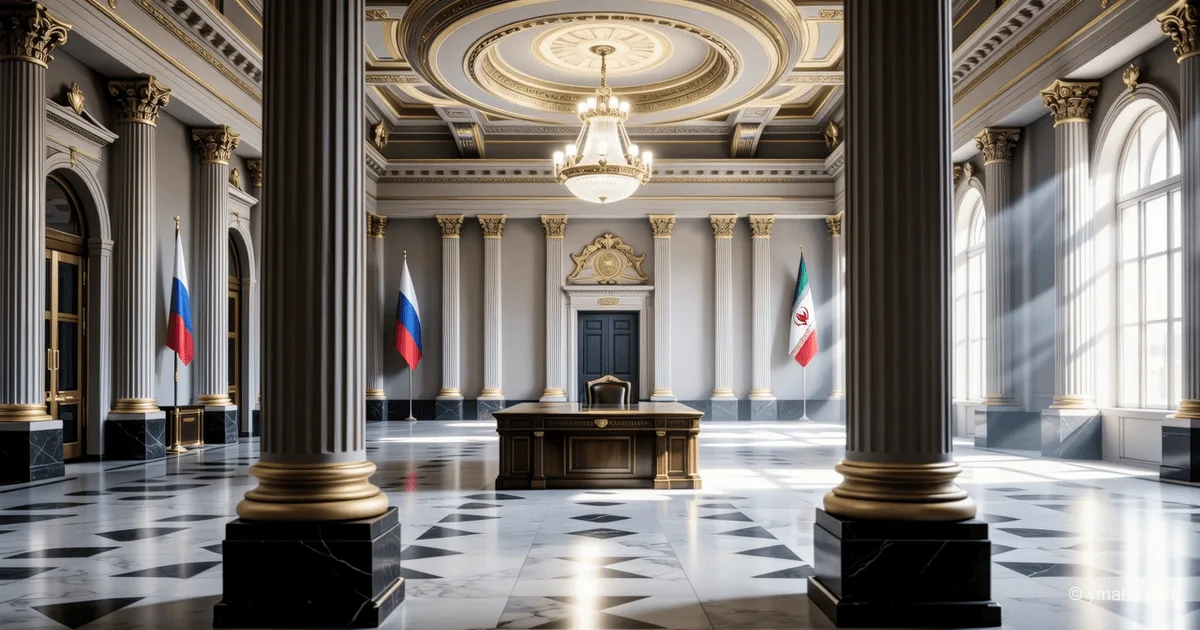
Putin Warns Further Escalation in the Middle East Will Lead to Loss for All Sides
Russian President stated at a press conference on May 9 that Moscow continues dialogue with all parties to the Middle East conflict. He emphasized that further escalation benefits no one, including the US and Iran, as expanding the scale of hostilities would ultimately result in all involved powers losing.
Analytical Note
May 10, 2026
Confidential
The Gist: What Is Really Happening
Vladimir Putin's statement on May 9 is not routine Victory Day rhetoric or a goodwill gesture. Behind the scenes of this press conference lies a specific diplomatic operation: Russia is attempting to seize the mediation agenda in the Middle East at a time when the US-Iran track is stalling and the Pakistani channel is faltering. A source familiar with the preparations for Iranian Foreign Minister Abbas Araghchi's visit to Moscow (scheduled for next week) reports that Tehran has requested active Russian involvement in the negotiation process precisely now, when the "Strait of Hormuz Administration" has been established but its operational mechanism is not yet fine-tuned. Iran wants Russia to help convert this administrative structure into a bargaining chip in future negotiations with the US, rather than a casus belli.
Simultaneously, Putin is signaling to Washington: Moscow remains the only power capable of talking to all sides simultaneously—Iran, Israel (despite the complexity of these relations after October 2023), Saudi Arabia, Hezbollah, and the Houthis. Given that the Pakistani channel is faltering due to internal political turbulence in Islamabad (Pakistan's prime minister faced a no-confidence vote on May 8), Russian mediation becomes not an alternative but a necessity.
Putin's phrase that "ultimately all involved powers will lose" is not an abstract warning but a veiled offer: Russia is ready to provide a platform for trilateral or multilateral consultations similar to the Geneva talks on Syria in 2013–2015. Moscow has already begun probing through its channels in Ankara and Doha.
Timeline and Context
Russian diplomatic activity in the Middle East has sharply intensified since mid-April. The timeline of events preceding the May 9 statement is as follows:
- April 18: Phone call between Putin and Iranian President Masoud Pezeshkian. The Kremlin reported discussions on "preventing further escalation," but without details.
- April 22: Putin held consultations with Saudi King Salman. Riyadh's press service noted that the sides "discussed oil market stability," which in the context of the Hormuz crisis means coordinating positions on oil prices.
- April 24: Russia and China, at a meeting of deputy foreign ministers in Beijing, agreed on a joint statement calling for "an end to provocations in the Persian Gulf and compliance with freedom of navigation." The statement was published on April 26 and became the first bilateral document between Russia and China directly addressing the current conflict.
- May 2: A closed meeting in Moscow with representatives of Hezbollah and Palestinian factions. The content was not disclosed, but Lebanese sources reported that Moscow sent a signal to Tehran about the need to coordinate Hezbollah's military actions with Iran's overall strategy.
- May 5: Russian Presidential Special Representative for the Middle East Mikhail Bogdanov visited Tel Aviv, where he held talks with Prime Minister Netanyahu's national security adviser Tzachi Hanegbi. They discussed parameters for a possible ceasefire in Lebanon.
- May 7: Russia and China issued a joint statement at the UN Security Council, calling for "the urgent resumption of negotiations on the Iranian nuclear program in the format of the original six international mediators." This is an important signal: Moscow and Beijing propose returning to a proven negotiation format rather than the bilateral US-Iran track being pushed by Kushner and Witkoff.
It is the context of this diplomatic offensive that makes Putin's May 9 statement more than just festive rhetoric. Moscow is building a parallel negotiation track involving China, which could either complement the US-Iran talks or become an alternative if they fail.
Who Wins and Who Loses
Winners:
- Russia as a geopolitical player. Direct involvement in resolving the Middle East crisis gives Moscow three specific bonuses: first, diverting global attention from the Ukrainian front; second, strengthening its negotiating position in dialogue with the US on strategic stability; third, reinforcing Russia's status as a power without which key global problems cannot be solved.
- Iran as a negotiating party. Russian mediation provides Tehran with a protective umbrella and an alternative channel of communication with the West, reducing dependence on the Pakistani track. Additionally, Moscow shares Tehran's position on the inadmissibility of strikes on Iranian nuclear infrastructure, which is a red line for Iran in negotiations.
- China as a silent partner. Beijing has already reaped concrete economic benefits from the crisis: charter rates for Chinese tankers have risen by 28% since the conflict began, and Chinese companies dominate Iranian oil shipments. Meanwhile, China remains publicly in the shadows, letting Russia play the role of public mediator.
Losers:
- Pakistan as a mediator. Russian diplomatic activity directly threatens Islamabad's monopoly on serving as a communication channel between the US and Iran. The Pakistani prime minister faced an internal crisis precisely when his mediation was supposed to yield dividends—a coincidence that diplomatic circles found "suspiciously timely." If the Moscow track gains traction, the Pakistani channel will lose relevance, along with its leverage and financial bonuses estimated at $500–700 million.
- The US as a monopoly in the negotiation process. The Trump administration invested political capital in a bilateral track with Iran (via Kushner and Witkoff), but stalled negotiations are driving Tehran to seek alternative mediators. A return to a multilateral format (the "P5+1") means Washington loses control over the agenda and must coordinate positions with Moscow and Beijing—something the administration sought to avoid.
- The European Union. Confirmation of Russia's status as an indispensable player in the Middle East makes it harder for Brussels to argue for Moscow's international isolation. The EU faces a choice: either recognize Russia's role and coordinate with Moscow (politically problematic) or remain on the sidelines of a process that directly affects Europe's energy security.
What the Media Is Not Saying
First non-obvious insight: Putin's May 9 statement is also a signal to a domestic audience, but not a Russian one—an Iranian one. In Tehran, there is a split between the so-called "pragmatists" (President Pezeshkian, Foreign Minister Araghchi) and "hawks" (the IRGC, especially its naval wing under Admiral Tangsiri). The former want to use the "Strait of Hormuz Administration" as a bargaining chip in negotiations; the latter as a fully operational tool for controlling shipping. Putin's public warning that escalation would lead to losses for all sides is addressed to Iranian hawks and is an attempt by Moscow to strengthen the pragmatists' position ahead of Araghchi's visit. Russia is interested in a stable Iran, not one teetering on the brink of military confrontation with the US.
Second point: No one is discussing the financial underpinnings of Russian mediation. In March 2026, Russia and Iran signed a strategic partnership agreement that includes provisions for joint investments in the North-South Transport Corridor worth $25 billion. This corridor is becoming critically important now that the Strait of Hormuz is a zone of instability. If Iran creates alternative export routes via the Caspian Sea and Russian territory, the strait's significance for global trade diminishes. Moscow gains not just geopolitical influence but control over energy logistics that could generate $3–5 billion in annual transit fees by 2028.
Third: Putin's statement came 36 hours before Trump's meeting with Xi Jinping in Beijing (scheduled for May 11–12). This is no coincidence. Russia and China are coordinating diplomatic signals: first a joint statement at the UN Security Council, then Putin's statement, followed by discussions on the Middle East at the Trump-Xi meeting. Moscow and Beijing are effectively squeezing US diplomacy into a triangle where Washington will have to consider the positions of both powers in negotiations with Iran.
Fourth: The oil aspect. Russia, as one of the largest oil producers, has directly benefited from the crisis: the rise in Brent prices from pre-conflict $76 to the current $95–100 has brought an additional $4.2 billion per month to the Russian budget. However, Moscow's oil strategy is dual: high prices benefit the budget, but a protracted crisis threatens to destabilize the entire region, including Syria, where Russia has a military base in Tartus. Putin needs not an endless conflict but a managed de-escalation that keeps oil above $85 per barrel while removing the risks of a full-scale war.
Forecast: Next 30 Days and 90 Days
Next 30 days (until June 10):
- Araghchi's visit to Moscow (May 13–14) will be a key event. Russia is expected to offer Iran a package of three elements: security guarantees for nuclear infrastructure through the P5+1 mechanism; unfreezing $10–12 billion in Iranian assets via Russian financial infrastructure as a temporary measure until sanctions are lifted; and "gradual normalization" of the Strait of Hormuz under international monitoring. In exchange, Moscow expects Tehran to agree to a return to the multilateral negotiation format.
- Trilateral consultations between Russia, China, and Iran in Beijing or Moscow by the end of May. Probability: 70%. This format, rather than the Trump-Xi meeting, could become the real catalyst for a settlement.
- Russia will begin non-public consultations with Saudi Arabia on production levels within OPEC+. Key question: whether to maintain current quotas if Iranian oil potentially returns to the market in the event of a truce. Moscow is interested in a gradual production increase to avoid a price collapse below $70 per barrel.
- The Kremlin's public rhetoric will remain emphatically neutral: "Russia supports all efforts for a peaceful settlement," without specifying concrete initiatives, to avoid accusations of undermining the US track.
Next 90 days (until August 10):
- Scenario A (probability 50%): By mid-July, a parallel track of the P5+1 international mediators (Russia, China, France, UK, Germany, US) on the Iranian nuclear program is formed, complementing or replacing the bilateral US-Iran format. The first round takes place in Geneva or Vienna. The Hormuz crisis de-escalates: the "Strait Administration" formally remains but effectively does not collect fees until negotiations conclude. Brent falls to $82–86. Russia solidifies its status as a key mediator.
- Scenario B (probability 30%): The US-Iran track maintains its monopoly, but Russia remains a "shadow" mediator, providing communication between the IRGC and Western militaries to prevent accidental clashes in the Persian Gulf. This is a less favorable scenario for Moscow, but acceptable: Russia still gains access to the negotiation kitchen.
- Scenario C (probability 20%): Full-scale escalation, which Putin is trying to prevent. If a direct clash between US and Iranian forces with casualties occurs in the Strait of Hormuz, Russian diplomacy will shift to crisis mode—emergency consultations at the UN Security Council, a hotline between Moscow and Washington, and possibly a personal meeting between Putin and Trump to prevent further escalation. In this scenario, Brent rises above $110, and the global economy faces a recessionary shock.
The key indicator for the next two weeks is not Trump's statements or reports from the Persian Gulf, but the outcome of Araghchi's visit to Moscow. If, upon its conclusion, the convening of consultations in the P5+1 format is announced, it means Russia has successfully seized the mediation agenda and the settlement moves into a multilateral phase. If not, it means Tehran is not yet ready to entrust Moscow with the leading role, and the Pakistani track, despite the internal crisis in Islamabad, remains relevant.
— Editorial Team









