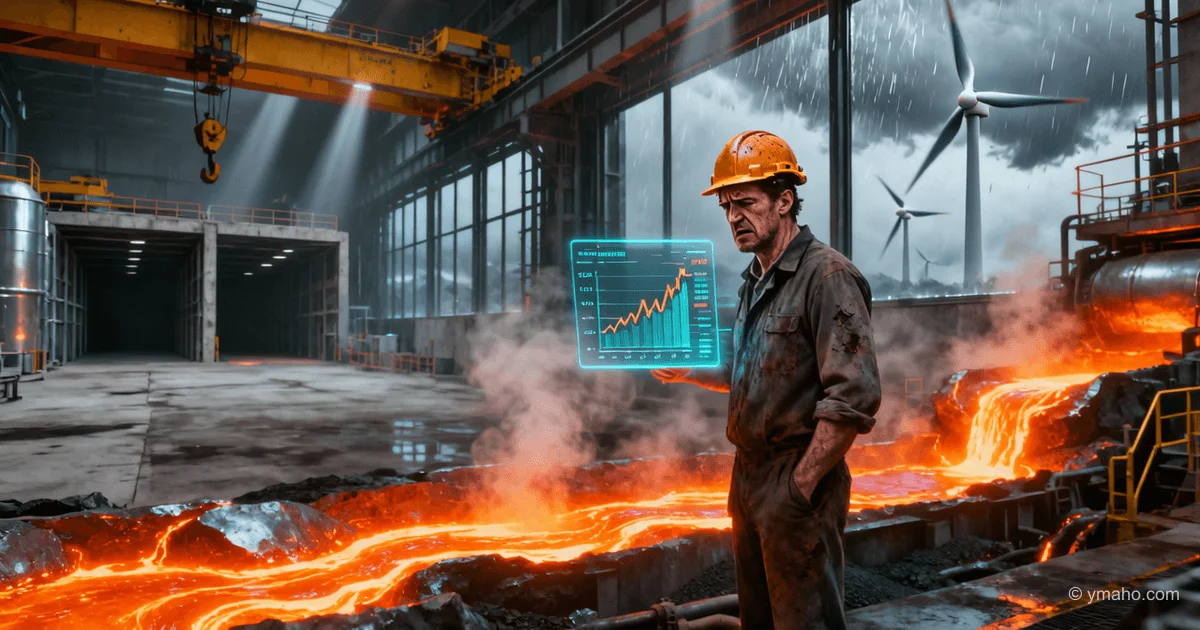
Record Surge in Metal Prices Threatens EU Industry
The World Bank forecasts a 19% rise in metal prices, including a 22% increase in aluminum due to the Middle East conflict, jeopardizing the EU's green transition plan.
Green Transition Under Fire: Why Record Metal Prices Are More Than Just a Market Spike
The Core: What's Really Happening
The World Bank's forecast of a 17% rise in metal prices (close to the mentioned 19%) and a 22% increase in aluminum is not just a reaction to the Middle East conflict. It's a symptom of a deep structural rift between "green" ambitions and industrial reality. The EU, which has committed to decarbonization and energy transition, finds itself in a trap: building wind turbines, solar panels, and electric vehicles requires vast amounts of metals, but their record-high prices are undermining the economic viability of the green transition in its current form.
The Middle East conflict has merely acted as a catalyst, exposing a fundamental problem: the inelasticity of metal supply amid explosive demand growth. Producers are physically unable to ramp up output quickly, and the energy intensity of smelting processes drives costs skyward along with electricity prices. Aluminum in Europe has long been called "solidified electricity"—now this phrase takes on literal meaning. With LME prices around $3,600 per ton and Rotterdam premiums exceeding $440 per ton, producing a range of industrial goods within the EU becomes economically pointless.
Timeline and Context
The first quarter of 2026 was a moment of truth for European metallurgy. The Metals and Minerals Price Index rose by 13% in that period alone. Aluminum surged amid supply disruptions from the Persian Gulf—the very region that accounts for a significant share of global exports of this metal. In Bahrain, Alba was forced to declare force majeure on shipments in February due to the regional conflict.
Simultaneously, from January 1, 2026, the EU's Carbon Border Adjustment Mechanism (CBAM) came into full effect, adding an extra €50–90 per ton to the cost of high-carbon aluminum. The result is predictable: European buyers rushed to find low-carbon suppliers, but there is a catastrophic shortage of them on the market. A two-tier pricing system has emerged: "green" aluminum sells at a huge premium, while "gray" aluminum becomes a toxic asset for European importers.
The World Bank warned back in April that if the Middle East conflict drags on, commodity prices could peak at levels not seen since 2022. Now, in May 2026, that forecast is materializing before our eyes.
Who Wins and Who Loses
Low-carbon metal producers are absolute winners. Norway's Norsk Hydro, with its Circal brand aluminum produced using hydropower, is seeing explosive growth in orders from European automotive and construction companies seeking to minimize CBAM payments. US-based Alcoa, which has invested in the ELYSIS inert anode technology, forecasts a net positive effect of $10 per ton. Rio Tinto is restructuring its portfolio toward renewable sources. These companies are reaping the benefits of the crisis, capturing both price and carbon premiums simultaneously.
European industry is the main victim. The EU steel sector is already in a state of structural collapse: crude steel production in Germany fell to 34.1 million tons—the lowest since 2009—and capacity utilization has breached the critical 70% mark. Now, record-high non-ferrous metal prices are adding to the pain. Automakers and aerospace giants are forced to factor the cost of "embedded carbon" into final product prices, and aluminum recycling has shifted from a financially desirable option to a strict necessity.
China and India are losers, but with caveats. The carbon gap of €50–90 per ton is pushing their high-carbon aluminum out of the European market. However, they are redirecting flows to Southeast Asia and domestic markets, where such regulations do not yet exist. This is not a fatal blow, but losing the premium European market is a significant wake-up call.
The European Green Deal is an unexpected loser. CBAM was designed as a tool to protect European producers from "carbon leakage" and to stimulate global decarbonization. In practice, it has created new barriers, driven up costs, and called into question the profitability of entire sectors. A parliamentary inquiry by Jordan Bardella in the European Parliament in February 2026, demanding an explanation of how the Commission intends to ensure the green transition without guaranteed raw material supply chains, remains unanswered. The European Court of Auditors had earlier pointed out the lack of real progress in recycling, mining projects, and industrial processing capacity within the EU.
What the Media Isn't Saying
Insight One: CBAM creates a "carbon wall" that backfires on the EU itself.
CBAM transitioned from a three-year reporting phase to a financial regime on January 1, 2026—precisely when the Middle East conflict sent metal prices soaring. The European Commission could not have foreseen this coincidence, but the result is clear: the carbon tax is layered on top of the war-driven price premium, creating a double whammy for importers. Small and medium-sized enterprises were unprepared for the administrative burden: Excel-based reporting is no longer accepted, mandatory third-party verification is required, and obtaining "Authorized CBAM Declarant" status by March 31, 2026, has become an insurmountable barrier for many.
Insight Two: The "green premium" on aluminum is a hidden tax on European consumers.
Rotterdam aluminum premiums have hit a record $440 per ton. Combined with the LME price of around $3,600, this means European consumers are paying over $4,000 per ton for metal—levels that render a range of industries unprofitable. The green transition, conceived as a path to a sustainable future, is in practice turning into a mechanism for driving industry out of the EU—exactly the "carbon leakage" that CBAM was supposed to combat.
Insight Three: The World Bank expects a price peak followed by a correction, but this optimism may be unfounded.
The forecast assumes a 7% decline in metal prices in 2027 as supply normalizes. However, structural factors—the ongoing boom in data centers for AI, transport electrification, and expansion of renewable energy—are creating sustained demand that was absent in previous commodity cycles. If the Middle East conflict drags on and China accelerates its strategic metal stockpiling, instead of a predicted correction, we may see prices consolidating at extremely high levels.
Insight Four: Metal recycling is becoming not an environmental but a financial imperative.
The rise in primary aluminum prices makes secondary recycling within the EU not just desirable but the only viable business model. Automotive giants are already recalculating the carbon footprint of each component and finding that using recycled aluminum is the only way to avoid CBAM payments. This is creating a surge in demand for scrap, which Europe physically lacks. Scrap metal prices in May 2026 are hitting all-time highs, following primary metals.
Forecast: Next 30 Days and 90 Days
Next 30 days (until June 9):
Prices for aluminum, copper, and other industrial metals will continue to rise. The Middle East conflict remains the main driver. If diplomatic efforts involving Pakistan and Saudi Arabia lead to de-escalation, a short-term correction to $3,400–3,500 per ton for aluminum on the LME is possible. However, the fundamental picture will remain tight: LME aluminum inventories fell by 2.45% to 355,775 tons, indicating a persistent deficit. European producers will begin mass revisions of investment plans, freezing expansion projects in energy-intensive sectors.
90-day horizon (until August 9):
The key turning point will be the fate of the Strait of Hormuz and supplies from the Middle East. If logistics normalize, the war-driven price premium will begin to collapse, but CBAM costs will remain, locking in structurally higher metal prices in Europe compared to the rest of the world. The gap between LME prices and Rotterdam premiums may become permanent, creating a two-tier global market.
If the conflict drags on and the World Bank's negative scenario of oil at $115 per barrel materializes, prices for energy-intensive metals—aluminum, zinc, nickel—could reach levels that threaten the very existence of the European aluminum industry. Plant closures, loss of thousands of jobs, and the final relocation of production to regions with cheap energy will become not a risk but a reality.
Strategic conclusion: The EU's green transition has hit a classic planning trap—goals are set, deadlines are fixed, but the raw material base for achieving them depends on geopolitical stability that European bureaucrats do not control. 2026 will either be a moment of painful recalibration of these goals or the moment when Europe's industrial heart stops beating.
— Editorial Team









