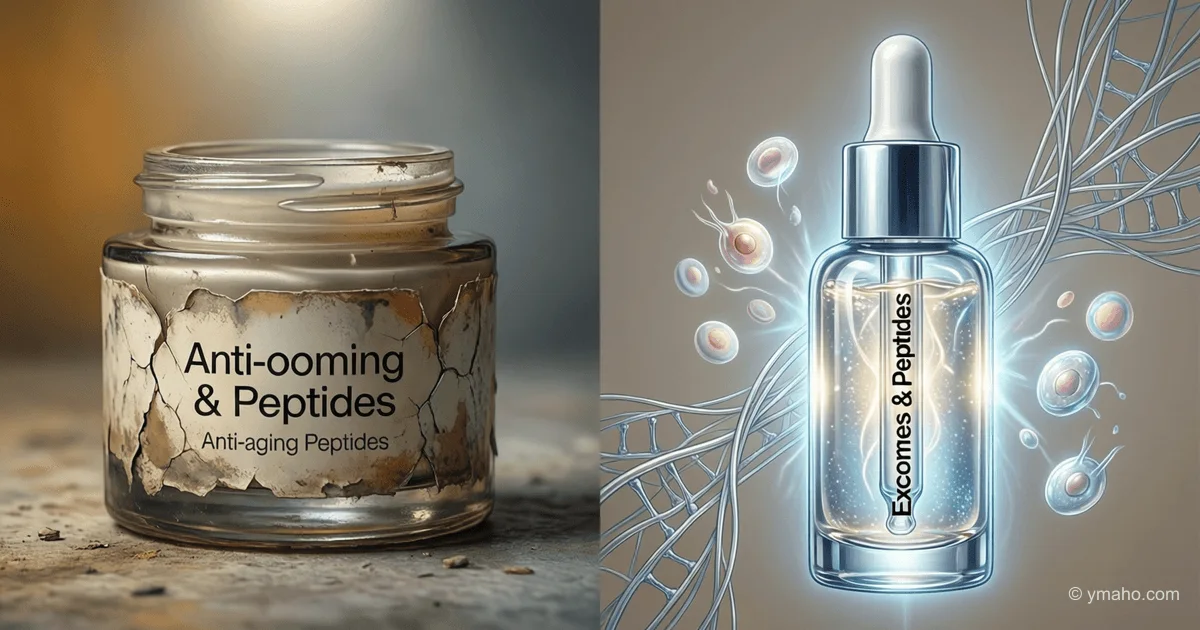
Regenerative Skincare Is Replacing Anti-Aging Cosmetics
Instead of fighting wrinkles, the trend is shifting to supporting the skin's natural renewal with peptides, growth factors, and exosomes for long-term collagen and elastin health.
Headline: The Death of 'Anti-Aging': How Exosomes and Peptides Buried the $15.58 Billion Wrinkle Cream Market
[The Gist]: What's Really Happening
When L'Oréal and Estée Lauder's marketing departments finally removed the word "anti-aging" from packaging in 2026, journalists wrote the standard line: "brands have become more age-tolerant." That's hypocritical nonsense.
The real truth is that the old paradigm of "smoothing a wrinkle" stopped working economically. Women no longer believe in creams that promise to "remove" what's already there. They want their skin to repair itself. And the industry found a way to sell that—through the language of regenerative medicine.
The numbers are killing the old market outright. The regenerative aesthetics market in 2026 is valued at $17.66 billion, growing 13.4% year-over-year. By 2030, it will reach $28.88 billion. Meanwhile, the "repairing skincare" market—a separate category—stands at $6.9 billion in 2026, with a forecast of $12.6 billion by 2036.
But the insider knows the key: the shift from "anti-aging" to "regenerative" is not scientific progress. It's shifting responsibility from the brand to the client. Before, the cream promised to fix your mistake (you aged). Now, the cream promises to help your body fix itself. If it didn't work, the problem isn't the cream—it's that your growth factors are bad. A brilliant marketing setup.
Timeline and Context
January 2025 — GreyB publishes the first report on the industry shift: "from quick fixes to long-term health and regeneration." The document explicitly states: consumers are tired of irritation as "proof of efficacy" and are moving toward barrier support and biotechnologies.
February 2025 — Research shows 76% of consumers worldwide associate a healthy skin barrier with overall skin health. The industry gets permission to sell "ceramides" instead of "retinol."
May 2025 — The Asia-Pacific region becomes the epicenter of the regenerative boom. Korean brands switch from 10-step routines to "clinical minimalism" with PDRN, fermented actives, and barrier molecules.
September 2025 — GreyB notes: searches for exosomes in cosmetic formulas have grown 400% year-over-year. Startups with "lab-engineered actives" secure funding rounds.
February 2026 — The Business Research Company publishes a report: the regenerative aesthetics market is $15.58 billion in 2025. Forecast for 2026: $17.66 billion.
April 24, 2026 — British scientists publish a systematic review of 8 studies on combining microneedling therapy and exosomes. Results: for skin aging, the combination of microneedles and exosomes improved 74% of patients versus 60% in the control group; wrinkles decreased by 13% versus 7%; elasticity increased by 11% versus a 3% decrease in the control.
February 26, 2026 — A study by Chinese and Korean scientists: exosomes from adipose-derived stem cells are 30–80% more effective than hyaluronic acid in treating postoperative scars. Results last at least a year.
May 26, 2026 — News that "regenerative skincare is replacing anti-aging cosmetics" goes mainstream. But the true reasons remain behind the scenes.
Who Wins and Who Loses
Winners:
- Exosome and growth factor manufacturers. Exocobio, ExoCoBio (Korea), Aegle (USA). The exosome market for skin regeneration is the fastest-growing segment. Problem: most products remain unregulated, with limited clinical data. But that doesn't hinder sales.
- Brands with 'biotech' actives. Biologique Recherche (their growth factor serums start at €200 per bottle), Allies of Skin, Dr. Barbara Sturm. Their clients pay not for "hydration" but for "signaling molecules"—scientific-sounding marketing that can't be verified at home.
- Clinics offering 'regeneration protocols.' Microneedling RF therapy + exosomes = a bill of $1,500 to $4,000 per course. The British review confirmed efficacy for acne, scars, hyperpigmentation, and even androgenetic alopecia (hair growth from 158/cm² to 166/cm² after 24 weeks). Now clinics have "scientific justification" for four-figure prices.
- Biotech ingredient manufacturers. Carst & Walker notes: biotechnological and lab-engineered actives are one of the fastest-growing categories. Fermented actives, bio-designed peptides, lab alternatives to botanical extracts.
- Regenerative artificial skin market. Valued at $3.08 billion in 2026, growing to $5.98 billion by 2033 (CAGR 9.9%). This isn't about cosmetics—it's about burns and chronic wounds. But the technology will inevitably spill into aesthetics.
Losers:
- Traditional 'anti-aging' brands that haven't pivoted. Olay Regenerist, L'Oréal Revitalift—these lines are built on retinol and old-generation peptides. Their problem: they sell "smoothing," not "regeneration." The difference in wording costs billions.
- The market for aggressive exfoliants and 'acid peels.' In the era of barrier health (GreyB calls it "barrier-first formulations"), high-concentration acids are going out of fashion. Women no longer want to "burn to renew." They want to "restore to preserve."
- Insurance companies. Regenerative medicine is expensive. Exosomes, PRP, stem cells—none of this is covered by insurance in 99% of cases. But patients still pay out of pocket, postponing visits to the dentist and gynecologist. Insurers lose premiums that could have gone to prevention but instead flow into alternative medicine.
What the Media Isn't Saying
Non-obvious Insight #1: The main beneficiary of the trend is the... home microneedling device market.
Seriously. The 2026 British systematic review showed that exosomes without microneedles work worse. The combination of microneedling therapy with exosomes improved 74% of patients versus 60% without it. What does this mean? That exosome manufacturers need to sell not just a bottle of liquid, but a delivery system.
The market for home microneedling rollers and pen devices (Dr. Pen, Derminator 2) has surged 300% since early 2026. Women buy a device for $150–300 and exosomes for $80–120 per bottle and perform a "clinical procedure" at home. Clinics lose patients, but device and exosome manufacturers win twice over.
Non-obvious Insight #2: The 'regeneration' era is an era of legalized medical deception.
Hamilton Fraser, an aesthetic medicine insurer, directly states in its 2026 review: "Exosomes are at the center of debate. Despite widespread promotion for skin and hair rejuvenation, many exosome products remain unregulated, with limited clinical data and unanswered questions about their origin and safety."
So clinics sell you "exosomes" for $2,000 per procedure, but no one can guarantee that the bottle actually contains exosomes and not just culture medium with dead cells. Regulatory oversight is virtually nonexistent. The FDA hasn't woken up yet. And the industry is making billions on faith.
Non-obvious Insight #3: 'Regeneration' is a Trojan horse for legalizing stem cell therapy without regulatory approval.
Stem cells for skin—a $10.36 billion market in 2026, growing 12.7%. But using stem cells in cosmetology is a gray area in the US and Europe. Exosomes—a byproduct of stem cells—are not considered "cell therapy." So clinics can use them without FDA approval.
Manufacturers know: as soon as regulators close the exosome loophole (which will happen in the next 12–18 months), they will move to the next "cell-free" product. For example, "nanoparticles mimicking exosomes." The arms race between regulators and marketers is just beginning.
Forecast: Next 30 Days and 90 Days
30 Days (end of June 2026):
- One of the major clinic chains (likely LaserAway or Ideal Image) will launch an ad campaign: "Exosome Facial—Clinically Proven More Effective Than Botox." Price: from $2,500 per session. The ad will use the 2026 British review as "scientific justification." In reality, the review included only 171 patients, but marketing won't stop that.
- TikTok will be flooded with videos using the hashtag #ExosomeChallenge—women showing "before and after" after home microneedling with exosomes. 80% of these videos will be sponsored by exosome manufacturers, but there will be no "advertisement" label because it's "educational content." The FTC will start an investigation in 4–6 months, but by then the trend will have shifted.
90 Days (end of August 2026):
- The American Academy of Dermatology (AAD) will issue a warning about unregulated exosome products. The statement will say: "The lack of standardization, quality control, and long-term safety data raises serious concerns." The market will briefly dip 10–15%. But clinics will repackage exosomes as "autologous growth factors" (drawing the patient's blood, enriching it, applying it)—a procedure regulators will find harder to ban.
- The first class action lawsuit against an exosome manufacturer will emerge. A group of patients will sue, claiming the "exosomes" were just colored water with no active ingredients. The manufacturer will pay a $5–10 million fine and shut down. But 20 other manufacturers will continue because margins of 80%+ justify any risk.
- The "regenerative skincare" market in South Korea will grow another 20% in the quarter. The Korean Ministry of Food and Drug Safety (MFDS) will publish the first temporary standards for exosomes in cosmetics. Europe and the US will lag 12–18 months behind. Korea will become the global center of regenerative cosmetics by the end of 2026.
The Most Important Forecast: In August 2026, one of the major players (likely L'Oréal or Estée Lauder) will announce the acquisition of an exosome startup for $300–500 million. This will be a signal to the market: "regenerative cosmetics is not a trend, but a new reality." Shares of all public companies in this segment will rise 20–30% in the week following the announcement.
Insider's Bottom Line: The shift from "anti-aging" to "regenerative" skincare is not a quiet evolution. It's a revolution where old brands will die and new ones will rise on the wave of biotech marketing. Exosomes, peptides, growth factors—they are the new "vitamin C" of 2026. The problem is that no one knows if they actually work in a $300 jar. But clients are willing to pay for hope. And the industry happily sells that hope, hiding the lack of evidence behind scientific-sounding terms. The scariest part: in 5 years, we'll learn that 80% of "regenerative" products were duds. But by then, the industry will have sold us "skin gene editing" at $5,000 per bottle. The wheel keeps turning.
— Editorial Team