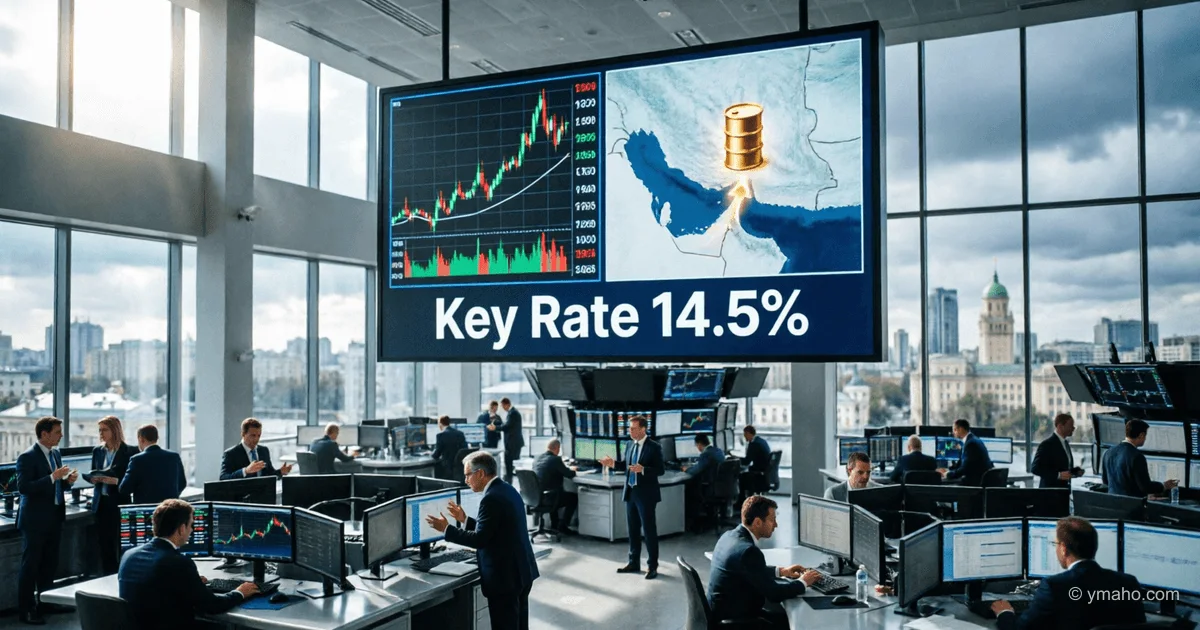
Russian stock market opens with mixed dynamics amid geopolitical tensions
The morning session on the Moscow Exchange started with a slight decline in the index against the backdrop of tensions in the Middle East. Later, the indicator turned to growth despite fears of a pause in the easing of monetary policy by the Central Bank of the Russian Federation.
Introduction
The morning of April 29, 2026, on the Russian stock market began with mixed dynamics, reflecting the complexity of the current macroeconomic and geopolitical environment. The MOEX Index (IMOEX2) opened with a slight decline, then rose 0.3% in the first minutes of trading, reaching 2,704.56 points. The RTS Index showed similar dynamics, also gaining 0.3% to 1,140.64 points.
This moderate optimism, however, is forming against the backdrop of two powerful and opposing forces. On one hand, oil prices continue to remain above $110 per barrel for Brent crude due to the protracted conflict in the Middle East. On the other hand, the domestic market is under pressure from signals from the Bank of Russia about a possible pause in the monetary easing cycle after the recent key rate cut to 14.5%. The market is frozen in anticipation, trying to determine which of these factors will prevail.
It is important to note that the morning rise follows unsuccessful trading on Tuesday, when the MOEX Index fell to 2,695 points (-1.3%), approaching the lower boundary of the target range. Thus, the current dynamics are more of a cautious recovery than a confident breakout. Investors continue to balance between bullish signals from commodity markets and bearish fears related to domestic monetary policy and geopolitical uncertainty.
Event details and timeline
Start of trading. At 10:01 Moscow time, after the opening of the main session, the MOEX and RTS indices recorded a 0.3% gain. By 10:10, analysts at Freedom Finance Global noted that the MOEX Index IMOEX2 was up 0.19% to 2,701 points, while the RTS Index showed a slight decline of 1.16% due to the ruble strengthening against the dollar. By that time, the USD/RUB pair had risen to 75.16 (+0.38%), and the euro had fallen to 87.93 (-0.09%).
Leaders and laggards. Among the leaders in the first minutes were shares of Moscow Credit Bank (MKB), which gained 2.5%. Also in positive territory were PhosAgro (+1%), HeadHunter (+0.9%), Inter RAO (+0.8%), Aeroflot (+0.7%), VTB (+0.7%), and Sistema PJSFC (+0.7%). Shares of Yandex and Novatek rose by 0.6%. Gazprom, NLMK, and Sberbank showed gains of about 0.5%.
At the same time, companies sensitive to interest rate levels are under pressure. The day before, on Tuesday, shares of Magnit fell by 5.1%, Aeroplan by 5%, and Segezha by 4.4%. This reflects investor fears that the monetary easing cycle may be paused.
Oil factor. The key support for the market remains expensive oil. As of 10:01 Moscow time, June Brent futures reached $112.25 per barrel (+0.9% after a 2.8% rise on Tuesday), while WTI traded at $100.56 per barrel (+0.6%). Russian Urals held around $107.40 per barrel (+0.21%) in the morning.
Gas prices also remain high — TTF is around $524.27 per thousand cubic meters. However, after yesterday's strong rise, oil quotes have corrected somewhat, although they remain near multi-month highs.
External background. Signals from global markets were mixed. US exchanges closed lower the day before: the S&P 500 lost 0.51%, the Nasdaq 1.11%. In Asia, positivity prevailed on Wednesday morning: China's Shanghai Composite rose 0.7%, Hong Kong's Hang Seng added 1.4%, and South Korea's Kospi gained 0.8%. Japanese exchanges were closed for a holiday. Futures on US indices traded slightly higher (+0.1-0.4%).
Impact and significance (for the world / industry / society)
Geopolitics as the main driver. The situation in the Middle East remains the main factor determining global energy prices. The conflict around the Strait of Hormuz has been ongoing for almost two months, and negotiations between the US and Iran have reached a deadlock. According to The Wall Street Journal, President Trump has instructed aides to prepare for a prolonged blockade of Iranian ports, implying that high oil prices will persist for an indefinite period.
For the Russian market, this has a dual impact. On one hand, high oil prices directly improve the financial performance of oil and gas companies, which make up a significant portion of the MOEX Index. On the other hand, as analysts at SberCIB note, the market is still pricing in a relatively short-term conflict. However, if the escalation drags on, it could become a powerful driver for further index growth.
The sideways problem.
It is important to understand that the current recovery is occurring against the backdrop of a prolonged stagnation of the Russian stock market. As noted by the publication Monocle, the MOEX Index has been in a sideways trend since the summer of 2024. Despite expensive oil and a gradual reduction in the key rate, the market cannot break through the 3,000-point level.
Analysts highlight several reasons for this stagnation. First, the lack of liquidity from foreign investors who left the market after 2022, and the problem of the overhang of blocked securities. Second, a significant portion of the index (about 40%) is accounted for by Gazprom, Lukoil, and Sber, which are under pressure from various factors — from sanctions to corporate restrictions.
The role of the retail investor.
Paradoxically, the influx of retail investors to the exchange has not yet led to stock market growth. According to data, in March 2026, retail investors brought 270 billion rubles to the market, but only 23.1 billion of that was directed into stocks. Most funds go into bonds and money market funds, which offer more predictable returns.
Dmitry Tselishchev, Managing Director of Ricom-Trust, explains this simply: "Why go to the stock market for 5-10% annual returns when you can place funds at 15-20% in the moment?" Indeed, as long as deposits and bonds offer double-digit yields with minimal risk, capital flows into stocks will be limited.
Sectoral consequences. The mixed dynamics on Wednesday reflect structural changes in investor preferences. Shares of rate-sensitive companies (Magnit, developers) came under pressure after signals from the Central Bank about a possible pause in rate cuts. At the same time, the oil and gas sector receives support from high commodity prices, and IT companies (Yandex, Ozon) continue to attract investors with growth stories despite overall market pessimism.
Reaction of key players
Analysts and forecasts. The professional community generally assesses the current dynamics as a "cautious recovery." Vladimir Chernov, an analyst at Freedom Finance Global, predicts the MOEX Index will move in the range of 2,685–2,735 points on April 29.
According to his assessment, expensive oil and the reporting season could support the market, but caution ahead of results from major issuers and weakness in certain sectors limit growth potential. He also noted that there was no sharp new escalation in the Middle East overnight, but the geopolitical premium in oil prices remains.
Ekaterina Krylova, Managing Expert at PSB, expects the market to fight for the range of 2,680–2,700 points on the MOEX Index, which is the nearest support. She also notes that Sberbank's first-quarter IFRS results could support the market.
Institutional investors. The positions of large players remain cautious. Analysts at BCS World of Investments warned back in late March that uncertainty in the Russian stock market remains high. The key question for investors is the duration of the Middle East conflict. If it enters a protracted phase, high oil prices will boost the index. If the conflict is resolved quickly, a correction is inevitable.
Corporate events. In focus on Wednesday are the results of the largest issuers. Sberbank, DOM.RF, EL5-Energo, RusHydro, Unipro, and SFI are presenting their first-quarter results. The market's attention is particularly drawn to the results of X5 Group, which will be published in the evening. In addition, traditional weekly inflation data will be released in the evening, which could add volatility.
Strategists at SberCIB Investment Research have revised their flagship stock picks, adding Rosneft (as the main beneficiary of high oil prices), Novatek (benefiting from rising gas prices), and Tatneft (a stable dividend story). At the same time, Norilsk Nickel was excluded from the picks due to fears of a decline in demand for platinum group metals amid risks of a global recession.
Ruble and currency factor. The ruble showed mixed dynamics on Wednesday morning: a slight weakening against the dollar (to 75.16) and strengthening against the euro (to 87.93). For exporters, a weaker ruble is a positive factor as it increases ruble revenue from selling foreign currency products. However, the strengthening of the national currency in recent months has restrained the growth of the RTS Index and put pressure on exporters.
Forecast and conclusions
Short-term forecast (until the end of the week). The most likely scenario for the coming days remains the MOEX Index moving in the range of 2,680–2,740 points. Analysts at PSB see the nearest support at 2,680 points, while Freedom Finance Global estimates the upper boundary at 2,735 points.
Key factors that will determine the dynamics include:
- Geopolitics around the Strait of Hormuz. Any signals of progress in US-Iran talks could lead to a sharp correction in oil prices and, consequently, pressure on the Russian market. Conversely, escalation will support oil company stocks.
- Bank of Russia rhetoric. After the rate cut to 14.5% on April 24, the market is closely watching the regulator's signals. A possible pause in the easing cycle will put pressure on rate-sensitive sectors (retail, development) but support the banking sector.
- Reporting season. The publication of financial results from the largest companies could be a catalyst for individual stocks. Management comments on dividend policy will be especially important.
Dividend factor. Analysts at SberCIB note that banks are among the main beneficiaries of the dividend season amid the key rate cut. Sberbank, DOM.RF, and VTB could offer double-digit dividend yields. Among oil companies, Tatneft (projected dividend yield of about 12%) and Lukoil (total yield for 2026 could reach 15% if oil stays above $100) stand out.
Long-term prospects. Despite the current stagnation, analysts at SberCIB maintain a target for the MOEX Index at the end of 2026 of 3,400 points. This implies a growth potential of about 25% from current levels. However, the realization of this forecast depends on three conditions: resolution of geopolitical uncertainty, continuation of the key rate cut cycle, and a real flow of funds from deposits into stocks.
Conclusions for investors. The current situation in the Russian stock market is characterized by high uncertainty and opposing factors. On one hand, expensive oil and high dividends create attractive opportunities for long-term investments. On the other hand, the lack of clarity on geopolitics and the risk of a pause in monetary easing restrain buying activity.
The morning rise on April 29 should be seen as a corrective recovery after the previous decline, not as the start of a sustainable upward trend. As noted by PSB, the market remains "empty" after the disappointing Central Bank meeting, and trading volumes remain low — 65 billion rubles on Tuesday.
Investors are advised to maintain a diversified approach, focusing on companies with strong dividend stories (oil and gas and banking sectors) and defensive assets (gold miners). At the same time, they should be prepared for increased volatility during geopolitical news releases and macroeconomic data publications. The most likely scenario for the coming weeks remains sideways movement with periodic attempts at recovery in the range of 2,680–2,750 points.
— Editorial Team









