S&P Dow Jones Rejects 'Fast Track' for Including SpaceX and OpenAI in Indices
Unlike competitors, S&P Dow Jones Indices decided not to apply accelerated rules for blockbuster IPOs, stating that exceptions should not be granted solely based on market capitalization.
A rift in the index industry: Why S&P's rejection of a 'fast track' for SpaceX and OpenAI is a quiet revolution for passive investors
[The Gist]: What's really happening
On June 4, 2026, S&P Dow Jones Indices (S&P DJI) made a decision that at first glance seems like a mere technical tweak, but in reality is a tectonic shift for the entire passive investing industry. The company officially refused to introduce 'fast-track' rules for including mega-cap IPOs like SpaceX, Anthropic, and OpenAI in the S&P 500 index. This means that even if these companies go public with trillion-dollar valuations, they cannot enter America's main index earlier than 12 months after listing, and they must also meet strict profitability requirements.
Why does this matter for a crypto analyst? Because S&P's refusal mirrors what's happening in the crypto industry at the intersection of DeFi and CeFi. We see the world's largest index provider (managing about $11.8 trillion in assets through ETFs and index funds) siding with market conservatives, stating that 'exceptions should not be granted solely based on market capitalization.' This is a blow to the pure 'cap-weighting' concept and a victory for financial stability principles over the hype factor.
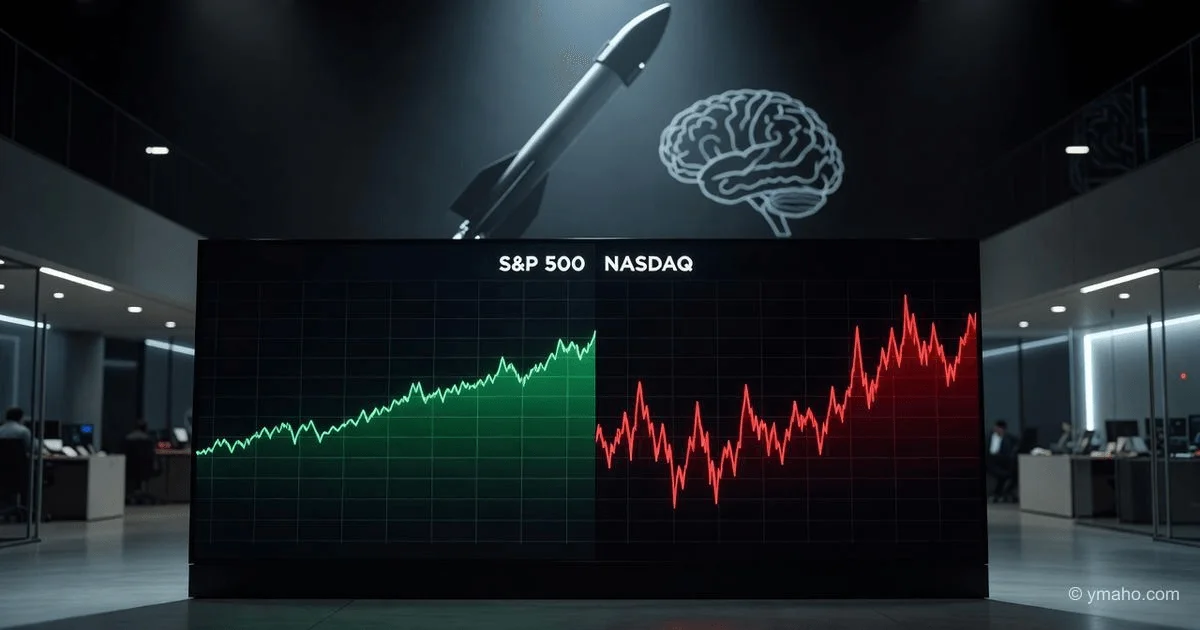
Against this backdrop, S&P's competitors—Nasdaq and FTSE Russell—took a crypto-zigzag path: they radically loosened their rules. Nasdaq cut the 'seasoning period' for giants from three months to 15 trading days, and FTSE Russell to just five days. The index market is splitting into two camps: the 'quality and time-tested' camp (S&P) and the 'reflectivity' camp (Nasdaq). This creates a unique arbitrage situation that no one talks about openly.
Timeline and context
This decision didn't come out of nowhere. It was the culmination of a month-long battle between the pragmatism of stock market giants and the ambitions of private capital. Below is a timeline of events showing the mounting tension.
| Date | Event | Analysis and Implications |
|---|---|---|
| April 30, 2026 | S&P DJI announces consultations: considering reducing the 'seasoning period' from 12 to 6 months for mega-cap companies. | The market prices in an imminent inclusion of SpaceX. A 'liquidity premium' emerges for future shares. |
| May 28, 2026 | Anthropic announces a $65 billion funding round at a $965 billion valuation. | The scale of the threat to indices becomes obvious. One company could distort the entire ETF market. |
| June 4, 2026 | S&P DJI makes final decision: NO fast track. Old rules apply: 12 months + profitability. | Shock for speculators who were preparing for 'popcorn' from indexation. Giant funds will not buy these shares for at least a year. |
| June 2026 | Competitors (Nasdaq, FTSE Russell) move ahead, changing their methodologies. | The 'Great Split' of indices occurs. Now ETF choice depends on the provider's philosophy. |
The most interesting part here is the hidden conflict of interest. S&P, as the 'gold standard,' doesn't need to chase big names to maintain the capitalization of its products. Their business is built on stability and trust. Nasdaq, on the other hand, as the exchange where these companies will list (SpaceX chose Nasdaq, ticker SPCX), is interested in attracting liquidity at any cost, so it caved to the issuers.
Who wins and who loses
This decision sharply divides the market into those who were right and those who will have to revise their strategies.
Winners #1: Traditional ETF providers (Vanguard, State Street). Funds tracking the S&P 500 (e.g., the famous SPY or VOO) will avoid being forced to buy these inflated IPOs at the peak of hype. They won't feed 'blue chips' at inflated prices. According to Bloomberg estimates, the forced purchase volume for SpaceX immediately after the IPO could have been around $14 billion. That money stays with S&P providers or goes into other assets.
Winners #2: Private Equity and Accredited Investors. This is my main non-obvious insight. The longer these giants (SpaceX, OpenAI) stay out of public indices, the longer their shares will trade at a discount to 'fair value' due to the lack of passive demand. This creates a window of opportunity for large private funds to buy shares from retail investors on the secondary market. While the crowd sells off due to the lack of a 'fast rise,' smart money will accumulate positions ahead of the inevitable inclusion in S&P in 12-18 months.
Losers: Retail investors (Retail FOMO) and 'popcorn' traders. Those who planned to buy SpaceX at the IPO and sell a month after index inclusion are now trapped. Without $14 billion in passive inflows in the first year, the price of SpaceX shares will be determined solely by the opinions of active traders and hedge funds. Volatility will be wild, and manipulation will be common. The 'indexation effect' that traders love so much is postponed indefinitely.
What the media isn't saying
They aren't saying the main thing: this decision is a huge blow to the 'AI is a bubble' narrative. SpaceX is unprofitable, OpenAI is unprofitable. In 2025, SpaceX reported a net loss of $4.94 billion. S&P's requirement of four consecutive profitable quarters is nearly an insurmountable barrier for these AI monsters at their current stage of the arms race. In effect, S&P is telling the market: 'Until you start making real money, you won't become a market benchmark.' This cools the bubble and forces investors to demand profits, not just beautiful growth stories.
The second omission: The Free-Float Paradox. SpaceX plans to list only about 3% of its shares in the IPO. That's a minuscule public float. For the S&P 500, this violates the Investable Weight Factor (IWF) rule. Even if they wanted to include SpaceX after a year, such a low float would create representativeness issues. While S&P's competitors have added special exceptions for low-float mega-cap companies, S&P itself remained steadfast, further distancing these giants from the index.
Third: The battle for the future of passive investing. S&P's conservative victory is a win for common sense over hype. If they had caved, they would have sent a signal: 'No matter how bad you are as a business, if you're huge, we'll take you into the index.' Now they've sent a powerful signal to corporations: before claiming 'blue chip' status, you need to become financially mature.
Forecast: Next 30 days and 90 days
Next 30 days (until mid-July 2026): We face a revaluation of ETF products. Investors will start massively comparing ETFs tracking the S&P 500 (VOO, IVV) and ETFs tracking the 'total market' (VTI) or Nasdaq 100 (QQQ). QQQ, which will likely include SpaceX via an accelerated procedure, will start behaving like a high-risk, volatile product on the day of SpaceX's listing. VOO will remain a 'safe haven.' We expect a capital shift from 'dirty' indices (Nasdaq) to 'clean' ones (S&P), at least $5-10 billion, as conservative pension funds want to avoid volatility from the instant inclusion of unprofitable giants.
Next 90 days (until mid-September): The lobbying war will enter a new phase. SpaceX, OpenAI, and their underwriters will start pressuring the SEC and large institutions to convince S&P to reconsider. However, the likelihood of a reversal is extremely low—S&P would risk its reputation. By September, we will see a technical phenomenon: the divergence in returns between S&P 500 ETFs and Nasdaq 100 ETFs will become the largest in 5 years. This will create arbitrage opportunities for hedge funds: short QQQ (because it's 'overheated' by the future inclusion of SpaceX) and long SPY (because it's 'fundamental').
Editorial Forecast
Asset: Nasdaq 100 ETF (QQQ). Direction: Increased volatility with a risk of correction before the SpaceX IPO. In the next 24–72 hours, investors may start taking profits in QQQ, realizing they are overpaying for 'accelerated access' to unprofitable AI companies. Key support level for QQQ is $420, resistance is $445. Confidence level: medium (60%). Main risk: if an exact IPO date for SpaceX is announced earlier than expected, speculative demand for QQQ could temporarily spike, causing a false breakout to the upside. However, fundamentally, S&P's decision creates a bearish backdrop for any ETFs that 'rush' to buy these assets. This forecast is an editorial opinion, not investment advice.
— Editorial Team