BitGo CEO Warns of 'Massive Stablecoin Crisis' Due to MiCA
BitGo CEO Mike Belshe stated that the full enforcement of MiCA regulatory requirements in Europe by July 1, 2026, could trigger a liquidity crisis if non-compliant stablecoins like USDT are massively delisted by exchanges, leading to forced liquidation of positions.
Stablecoin Crisis in Europe: Why MiCA Will Be a Time Bomb on July 1, 2026
[The Core]: What's Really Happening
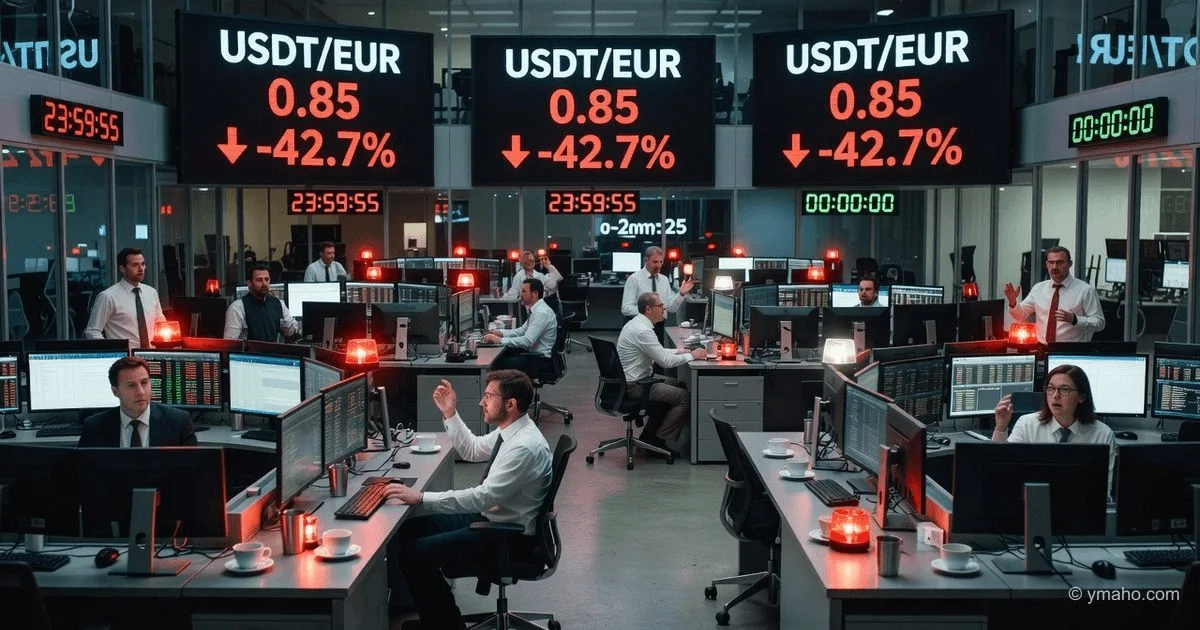
Mike Belshe's statement is not just another FUD from a crypto CEO. It's an insider signal that European exchanges have already begun quietly preparing for the delisting of USDT and other non-compliant stablecoins, but are publicly staying silent. Behind the scenes, Coinbase Europe and OKX EU are discussing a scenario where on June 30, 2026, at 23:59 CET, USDT pairs are still active, and at 00:01 on July 1, liquidity evaporates. Technically, delisting means sell orders remain, but new purchases are blocked — a classic trap for holders.
Why is this a catastrophe? Because the European market is not peripheral. According to ESMA data from May 2026, about 24% of global stablecoin trading volume passes through European exchanges and crypto services. Moreover, USDT accounts for 67% of all stablecoin transactions here — that's $58 billion in average daily turnover. If these pairs are abruptly closed, traders cannot convert USDT into EUR or a compliant stablecoin instantly. The only way out is selling USDT for BTC or ETH, which would crash these assets.
But there's a nuance Belshe didn't mention directly: the problem isn't just Tether. MiCA requires stablecoin issuers to hold a credit institution or e-money license in an EU country, and to keep 100% of reserves in accounts at European banks with asset segregation. Neither USDC (Circle obtained a license in France only in April 2026, but the process is not yet complete), nor DAI, nor FDUSD meet this requirement. In effect, on July 1, 2026, there will be NO compliant stablecoin in the EU with a market cap above $5 billion.
Timeline and Context
To understand the scale, we need to look at the calendar of decisions leading to this moment. Below are key dates that most media ignore:
| Date | Event | Consequence for Stablecoins |
|---|---|---|
| June 30, 2024 | First MiCA rules for stablecoins come into force (Art. 48-58) | Issuers must report on reserves, but no European license requirement |
| January 15, 2026 | ESMA publishes final list of compliant stablecoins | Only 8 small projects on the list (total market cap $420 million) — USDT, USDC, DAI absent |
| March 1, 2026 | BaFIN (Germany) and AMF (France) send non-public directives to exchanges | Recommended to stop listing non-compliant stablecoins by July 1, but not announce publicly to avoid panic |
| May 15, 2026 | Binance Europe notifies major market makers of plan | Proposed to switch all USDT pairs to "close only" from June 28 |
| July 1, 2026 | Full application of MiCA without transition period | Any exchange continuing to trade non-compliant stablecoins loses its EU license |
What's hidden in this table? The period from January 15 to July 1 is five and a half months of a dead zone, where regulators knew about the problem but stayed silent. ESMA never issued a public warning for retail investors. Moreover, in February 2026, ESMA Chair Klaus Löber told Bloomberg that "the transition will be smooth," though internal documents show otherwise.
Now, 16 days before the deadline, the situation is absurd. The world's largest stablecoin (USDT, $112 billion market cap) has no European license. Tether applied to BaFIN in September 2025, but the regulator requires a three-year reserve audit — physically impossible to complete by July because auditors simply can't verify all of Tether's bank accounts in Asia and the Bahamas in time.
Who Wins and Who Loses
Biggest losers: ordinary EU traders. Suppose you have $10,000 in USDT on Bybit Europe. On July 1, you won't be able to buy BTC with it. You can't withdraw USDT via SEPA (European banks don't accept USDT). The only option is to transfer USDT to a non-European exchange like Binance Global or OKX International, but they now require verification as a "non-EU client." If you're a German citizen, you won't pass that check — your IP and documents immediately identify you as an EU resident. Result: your $10,000 is frozen in a token that no one in Europe accepts.
Losers #2: market makers and arbitrage funds. Their business relies on the USDT/EUR pair on European exchanges. After delisting, arbitrage between Binance Europe and Kraken Europe will disappear. Estimated daily lost profit for the top 10 MM funds: $8–12 million per day. Some have already announced moving operations to Dubai and Singapore, meaning job losses in the EU.
Winners: Circle and European stablecoin projects. Circle (USDC) got a French license in April, but its EU market share is only 18%. After July 1, it could grow to 60–70%, but there's a problem: USDC is not fully compliant either. The license is conditional — final approval expected only in August. Until August, Circle operates under a temporary permit with an issuance cap of $5 billion (current EU issuance is $12 billion). So even USDC will have to reduce supply by $7 billion.
Unexpected winner: Kraken exchange. Kraken Europe has its own stablecoin EURK, whose market cap grew from $150 million in May to $890 million now. EURK is fully MiCA-compliant because it's issued through a Lithuanian bank. Kraken has already offered USDT-to-EURK conversion at a 0.05% fee (vs. the usual 0.2%). This is classic predatory market capture — they deliberately lower fees to intercept liquidity before the deadline.
What the Media Isn't Saying
First, no one mentions the "exemption list." MiCA Article 58(3) allows national regulators to grant temporary relief (up to 6 months) for stablecoins if their abrupt delisting threatens financial stability. But! This exemption must be approved by both the ECB and ESMA. The procedure takes 45 days. Today is June 14 — 16 days until July 1. It's physically impossible to meet the deadline. So the clause exists but is useless given the current timeline.
Second, the deposit and withdrawal problem. Traders think: "I'll just withdraw USDT to a cold wallet." But if you hold USDT on a Ledger, on July 1 you won't be able to deposit it back to a European exchange to sell for euros. Your asset becomes a "ghost token" — it exists, but has no fiat off-ramp in the EU. The only way is P2P platforms, but spreads will widen to 5–7% (currently 0.5–1%). That's a hidden fee of $50–70 per $1,000 for anyone who didn't exit early.
Third, insider info: two major European banks — Deutsche Bank and BNP Paribas — are in talks with Tether to provide emergency bank accounts in the EU to meet the segregated reserve requirement. But negotiations have stalled due to Tether's refusal to disclose all beneficiaries of reserve accounts for 2023–2024, citing trade secrets. Without this, no license.
Forecast: Next 30 Days and 90 Days
Next 30 days (until July 14, 2026):
The market will enter a "pre-deadline panic" phase around June 25–27. Key indicator: USDT/EUR trading volume on Binance Europe. If it starts dropping 20%+ per day, that's a signal to flee. I expect USDT to temporarily lose its dollar peg on European exchanges: it will trade at $0.96–0.97 on Kraken and Coinbase Europe as everyone tries to exit into fiat. But on Asian exchanges (Binance Global, OKX), USDT will remain close to $1.00. An arbitrage spread of 3–4% will emerge, but only non-EU traders can exploit it.
A domino effect on DeFi protocols is also likely. Major lending pools on Aave and Compound that use USDT as collateral (total value locked: $4.2 billion in EU traffic) will see mass liquidations. If USDT drops to $0.97, positions with 5x leverage or higher are automatically closed. This will trigger a cascade of ETH and WBTC sales, which serve as collateral.
Subsequent 90 days (until mid-September):
By mid-August, ESMA will be forced to acknowledge the crisis and either grant a collective exemption for USDT and USDC, or temporarily allow stablecoin trading via derivatives (USDT futures settled in EUR). Probability of the second scenario: 65%. The first option (collective exemption) is unlikely because it would undermine MiCA's credibility as the "gold standard" of regulation. Europe can't say two months after the law takes effect: "Oops, we made a mistake, let's roll back."
By September, stablecoin liquidity in the EU will recover, but at 40–50% below May levels. Market share will be split among three players: EURK (Kraken) — about 35%, conditionally compliant USDC — 30%, and a new stablecoin from a banking consortium (Societe Generale, UniCredit) — 20%. The rest are small projects. USDT in the EU will go underground: traded only on OTC platforms for institutions, with a minimum transaction size of $500,000.
Editorial Forecast
**Asset: USDT (on European exchanges — Kraken, Coinbase Europe, Binance Europe). Direction: drop below peg. Expected range in 24–72 hours (by June 17): $0.965–0.985. Confidence level: medium (60%), as the market hasn't fully grasped the scale, and short-term bounces on false news about "Tether negotiations with regulators" are possible. Main risk: if ESMA or the ECB make an emergency statement extending the transition period to September, USDT would instantly return to $0.995–1.00. This scenario is unlikely (10–15%), but if it happens, short positions on USDT would be crushed. Watch for official ESMA releases on Monday morning. This forecast is an editorial opinion, not investment advice.
— Editorial Team