US Inflation Remains Stubborn, Putting the Fed in a Tough Spot
Consumer price index data and a strong employment report indicate persistent inflationary pressure. This reduces the likelihood of a rapid shift to policy easing and sets the stage for keeping rates high for a longer period.
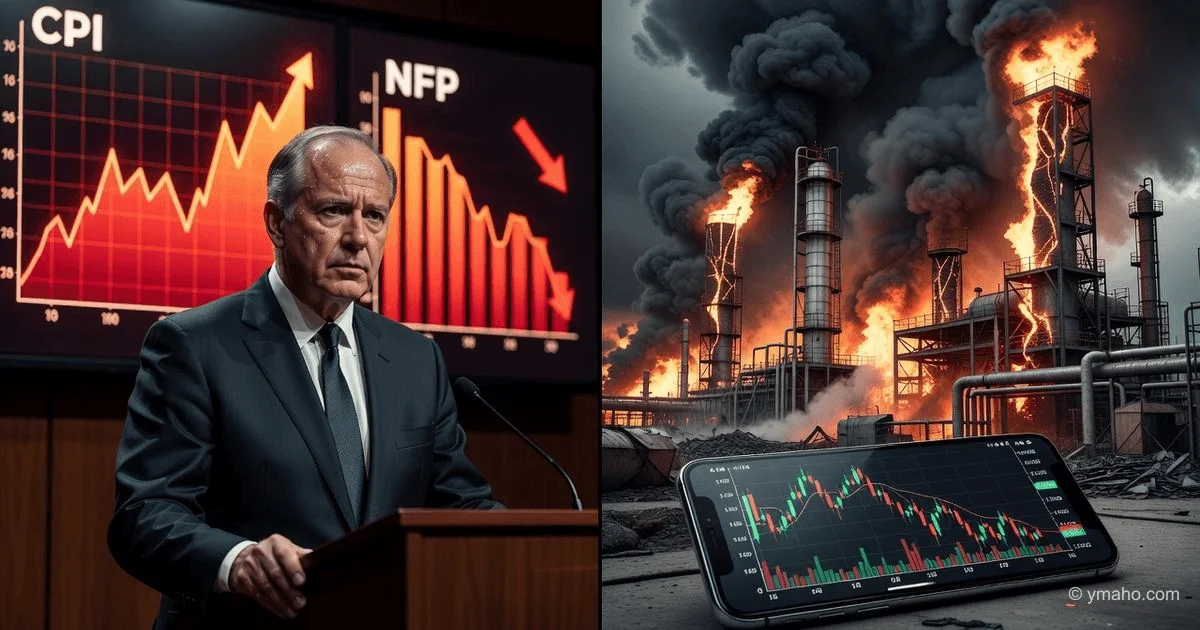
I worked on Wall Street when the word "transitory" inflation was the main mantra used to inflate a bubble in the markets. Today, looking at the CPI (Consumer Price Index) and NFP (Non-Farm Payrolls) reports, I see not just "stubborn inflation." I see the death knell for the era of cheap money.
For five consecutive years, US inflation has been above the Fed's 2% target. This is not "stubbornness." It is a systemic failure. And while the general public discusses basis points, I look at two indicators that never lie: the 10-year Treasury yield (4.55–4.96%) and the yield curve, which has flattened again to +42 basis points (10Y-2Y spread).
Keeping rates high for an extended period is no longer a forecast. It is a death sentence for sectors with long-duration cash flows (read: technology) and a safety passport for commodity traders. I will break down who actually pays for this persistence and why the Fed (Federal Reserve System) is backing itself into a corner with no way out—except through rate hikes.
[The Core]: What Is Really Happening
On the surface, it's a standoff between "hawks" and "doves." In reality, it is the destruction of the "pump and dump" credit model. The strong employment report (NFP showed 172,000 new jobs in May, and the three-month moving average reached 188,000—the highest since March 2024) means the US economy is not just alive. It is overheated.
This nullifies the main argument of easing proponents: "The labor market is cracking." No, it is stable. The April jump in job openings and rising wages are putting pressure on services prices. The Fed cannot start cutting because that would mean inflating the stock market bubble to a size that would lead to a collapse in the 2028 elections.
Insight unavailable to the general public: Goldman Sachs has officially moved its rate cut expectations to 2027. But my source at primary dealers says the bank's internal models are already pricing in one rate hike in the fourth quarter of 2026. This is not the base case, but a "thin tail" of the probability distribution that the market ignores at 0%. If the word "hike" appears in the FOMC (Federal Open Market Committee) minutes on June 17, we will see a flash crash within 20 minutes.
Moreover, the current estimate of the longer-run neutral rate at 3.1% is an artifact of the past. The real neutral rate is now closer to 3.5-4.0% due to the budget deficit (a deficit of more than 6% of GDP that needs to be funded). If the Fed acknowledges this, the Treasury market will crash, and the 10-year yield will soar to 5.5%.
Timeline and Context
Let's look at how we arrived at this "no-options" time crunch. The key here is that inflation expectations have broken out of control.
| Date | Event | Bond Reaction (10Y) | Stock Reaction (S&P 500) |
|---|---|---|---|
| May 2026 | NFP +172k (above forecast) vs. previous 10,000 a year ago | Yield settled above 4.5% | Tech correction (-5.8% in a day) |
| Early June 2026 | False rumors of peace with Iran, then denial | Break of support at 4.96% (10Y), algorithmic selling | Energy rose, Nasdaq fell |
| June 10, 2026 | Official data: CPI again above forecasts | 10Y yield: 4.489% | Yield spread (2s10s) widened to +40 bps |
| June 16, 2026 (expected) | Fed meeting (Warsh) | Rate 3.50-3.75% (hold) | Futures price 98.2% probability of hold |
Why this matters: A tectonic shift occurred on June 9-10. Iran's denial of peace talks led to a Treasury sell-off (falling bond prices) and a sharp spike in yields. Algorithmic systems broke technical levels, triggering a chain reaction of sales. The market realized: the geopolitical premium is back for the long haul.
Who Wins and Who Loses
Let's get to specific pockets. In an environment where inflation is persistent and rates are high, the classic sector rotation becomes not gradual but abrupt.
| Group | Instrument / Sector | Reaction (latest data) | Why? | Forecast (30 days) |
|---|---|---|---|---|
| Winners (Hard Assets) | Energy (XLE), Basic Materials (XLB) | EPS estimates up: +114% (Energy), +47.1% (Materials) | War in Iran + supply disruptions[2][5]. | Rise to highs. |
| Winners (Financials) | Banks (JPM, BAC) | S&P Financials +0.1% (holding) | NIM (Net Interest Margin) expands with high rates. | Positive until loan reports. |
| Losers (Tech/Growth) | Semiconductors (NVDA, AMD, MU), Software | Down 9-13% (Micron -13.3%) in a day | DCF (discounted cash flow) revaluation at high rates. | Pressure persists. |
| Losers (Auto/Discretionary) | Tesla (TSLA), Consumer Discretionary | Slump in demand and margins | Auto loan rates > 10%. | Bearish trend. |
| Vulnerable (Real Estate) | REITs (XLRE) | Under pressure | Commercial real estate revaluation. | Decline. |
Hidden beneficiary: Basic Materials (Chemical industry). Due to the war in Iran and the surge in energy prices, chemical companies like Dow (DOW) and LyondellBasell (LYB) have raised prices for consumers. According to Zacks analytics, their second-quarter EPS estimates have literally doubled in the last 30 days. Dow shares have risen, but the potential is not exhausted.
What the Media Isn't Saying
The main hidden factor is data centers and AI. The market screams about innovation but forgets that training large language models (LLMs) requires enormous amounts of energy. The current 30% spike in inflation is driven by rising electricity tariffs in Texas and Virginia (where capacity is concentrated) and demand for rare earth metals.
The Fed is now fighting inflation caused by a megatrend that cannot be stopped by raising rates. You can raise rates to 10%, but Nvidia and Amazon (AMZN) will still buy land for construction and generators. This makes the Fed's monetary policy asymmetric: it kills the consumer sector (mortgages, credit cards) but does not solve the cost problem of AI infrastructure.
The second point is "hidden" fiscal policy. Kevin Warsh, who will take office as chairman at this meeting (June 16-17), is known as a hardline monetarist. But his hands are guided by the White House apparatus, which needs cheap debt to cover the deficit. I expect Warsh to remove the "dot plot"—the rate forecast graph he hates. Once this anchor is removed, volatility in the dollar and bond markets will skyrocket because traders will have no "fulcrum."
Forecast: Next 30 Days and 90 Days
Next 30 days (until mid-July): We are entering the second-quarter earnings season. The current consensus for the S&P 500 is earnings growth of +21.8% (year-over-year) on revenue of +10.9%. These are excellent numbers. But the market lives in the future. I expect companies to give weak guidance for the third quarter due to high rates. The Nasdaq will continue to retreat. Current technical picture: the dollar index (DXY) is heading toward 100-101—this will continue to put pressure on commodity prices in other currencies but will not ease domestic price pressure in the US.
Next 90 days (by September): Key dilemma: de-escalation of the conflict with Iran or escalation. My base case is a protracted conflict. Oil will remain in the $70-85 per barrel range. This means inflation will not fall below 3%. The Fed will be forced to raise rates again, most likely in November (after the elections). Portfolio for the next 90 days: short semiconductors (especially Micron Technology, MU, and Intel, INTC, which fell 11-13% in a day—they don't have the AI "safety cushion" like NVDA) and long oil and chemicals (DOW, LYB).
Editorial Forecast
Asset: Long-duration US Treasuries (TLT—ETF for 20+ years). Direction: Bond prices down (yields up) in the next 24-72 hours. Key levels: Current 10Y yield around 4.55%-4.96%. Yield ceiling (resistance for bonds) at 5.10%. TLT target decline to $88. Confidence level: Medium (65%). The market is already pricing in a lot of bad news, but a hawkish surprise from Warsh (removing the "dovish bias") will be the last straw. Main risk: If the Fed in its statement for the first time mentions "recession risks" as opposed to inflation (low probability, 10%), it will trigger a powerful bond rally (Flight to Quality). The 10Y yield will crash to 4.20%, and TLT will surge 5% in a day.
This analysis is based on cross-referenced financial market data and is not individual investment advice.
— Editorial Team