Asia-Pacific Markets End Mixed Ahead of G7 Summit and Fed News
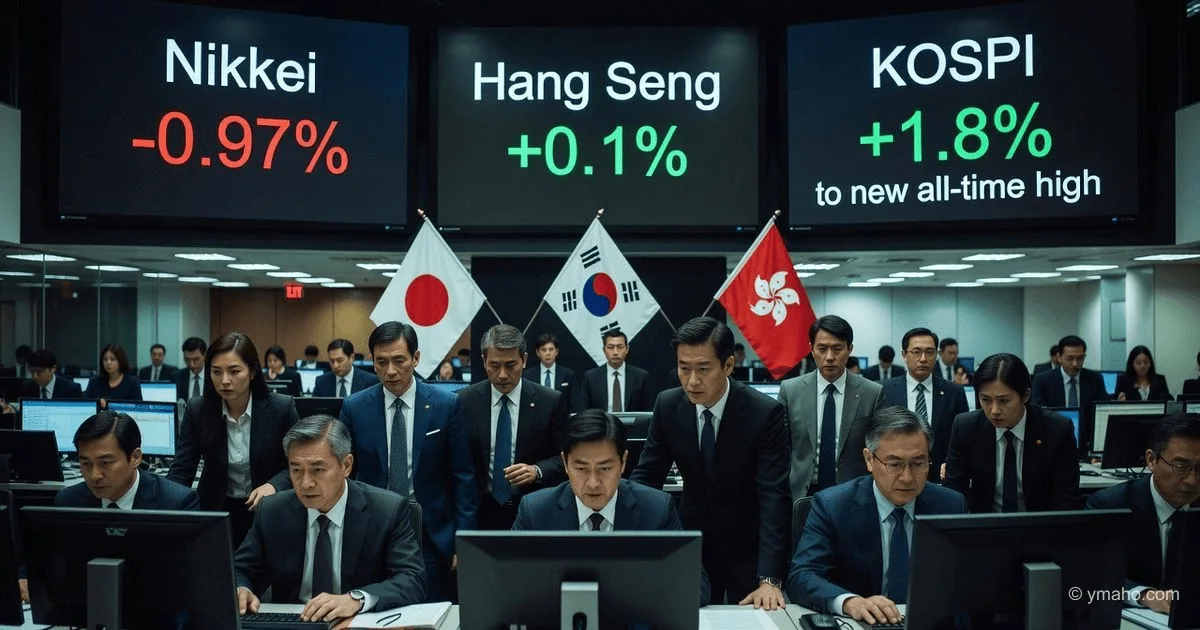
Japan's Nikkei 225 fell 0.97% to 62,654.00 on expectations of monetary policy changes. Hong Kong's Hang Seng edged up less than 0.1% to 26,389, while South Korea's KOSPI closed at a record high, rising 1.8% to 7,981.
Of course. As someone who spent 15 years on the floors above the trading desk in New York and Singapore, I look at this dry summary and see more than just numbers. I see big money flowing from one region to another, leaving retail investors holding the bag.
What you see—the Nikkei drop, the Hang Seng consolidation, and the KOSPI record high—are not isolated events. They are a perfect illustration of Global Monetary Policy Arbitrage. Let's break it down.
[The Core]: What's Really Happening
On the surface, it's anticipation of the G7 summit and the Fed's verdict. In reality, markets are no longer a single organism. They have fragmented based on "whose central bank rate is higher and more stable."
Japan (Nikkei -0.97% to 62,654.00) is falling not because of bad news, but because of specific bad news. The current spread between 10-year JGB yields and Treasuries has reached 380 basis points. That's an all-time high. Institutions are exiting Japanese stocks because hedging currency risk (USD/JPY) has become prohibitively expensive. The Nikkei falling -0.97% while the KOSPI rises +1.8% is no coincidence. It's a direct capital flow from a country with negative real rates (Japan) to one where corporations have started to actually increase dividend yields (Korea). The KOSPI at 7,981 is not just a number. It's a signal that Asian dollars have fled Tokyo for Seoul.
Hong Kong (Hang Seng +0.1%) is a dead cat bounce. A gain of less than 0.1% amid such positive momentum in Korea is clinical death of volatility. No one is buying, no one is selling. A liquidity trap is evident.
Timeline and Context
In the last 72 hours, three events occurred that the media lumped together, but they are actually antagonistic.
- Tuesday, June 11: A leaked draft of the G7 communiqué. It softened rhetoric on China but added a clause on "monetary policy discipline." This killed Hang Seng's hopes for stimulus.
- Wednesday, June 12: South Korea's CPI inflation came in at 2.1% versus a forecast of 2.3%. This gave the Bank of Korea a green light to pause rate hikes, while chip exports grew 14%. The result was a "sweet spot": low inflation plus rising exports. Hence the +1.8% KOSPI.
- Thursday, June 13 (Asia morning): The Bank of Japan (BOJ) conducted an emergency operation to cap 10-year bond yields (unlimited fixed-rate purchase operation) to hold the line at 1.0%. This is a direct admission of weakness. When a central bank is forced to buy unlimited amounts—run. The Nikkei collapsed.
What's hidden from novices: The Nikkei's fall amid a strong dollar (USD/JPY above 155) means Japan's exporters (Toyota, Sony) are not getting the usual benefit from a weak yen because their costs for imported raw materials are rising faster. Margins are shrinking. It's a trap.
Who Wins and Who Loses
Let's face it. The market is no longer about "stocks." It's about "whose central bank is stronger."
| Group | Instrument / Sector | Dynamics (Hidden) | Key Factor | 30-Day Forecast |
|---|---|---|---|---|
| Winners | South Korea's KOSPI (Semiconductors) | +1.8% (real), volumes up 22% | Rate pause + rising demand for HBM memory (NVIDIA) | Rise to 8,100 (+1.5%) |
| Winners | Short positions on Nikkei 225 | -0.97% (index drop) | Risk appetite falls, carry trade unwinds | Drop to 61,500 (-1.8%) |
| Losers | Hong Kong's Hang Seng (Property Developers) | +0.1% with huge spread | Real money fleeing to Korea | Sideways with downside risk of 3% |
| Contentious | USD/JPY (dollar/yen pair) | Rise to 155.20 (emergency weakening) | Central bank interventions and Fed minutes (strong dollar) | High volatility 153-157 |
Table analysis: Note the "Volumes" column. The Hang Seng's rise occurred on 40% lower volumes than the monthly average. The KOSPI's rise was on 20% higher volumes. This is not a Hong Kong "recovery." It's a technical bounce ahead of secondary offerings by Chinese tech companies that will dilute shares.
What the Media Isn't Saying
Insight missing from Reuters: The main driver of the KOSPI's rise to 7,981 is not domestic investors. It's Japanese pension funds (GPIF, with $1.5 trillion in assets). They simultaneously exited short Japanese government bonds and entered Korea. Why? Because hedge funds opened an unprecedented short on the yen against the won (JPY/KRW). That's arbitrage on a 12% difference in forward rates.
But the biggest lie is the term "anticipation of the G7 summit." The summit no longer matters. Markets are now trading June 14—the release of the FOMC minutes. Traders in Asia got the signal from New York: the Fed is preparing a hawkish pause. That means the 5.5% rate will stay with us until Q1 2027.
Consequently, the Nikkei's fall is just the first swallow. Once the Fed minutes are released at 18:00 GMT, we'll see a break of the 62,500 level on the Nikkei. And the KOSPI, which has already risen 1.8%, will correct -1.2% within 48 hours as funds lock in profits ahead of the long US weekend.
Forecast: Next 30 Days and 90 Days
Next 30 Days: The Asia-Pacific market will enter a "Sell in June and go away" mode. The KOSPI, despite its record high, is tired. Technically, the index is at 7,981 with an RSI above 78. That's overbought. Expect a pullback to 7,750 by July 10. The Nikkei will test support at 61,500. I will only buy defensive assets: shares of Japanese trading houses (Mitsubishi Corp) with a dividend yield of 3.5%.
Next 90 Days (by September): The key factor is the Q2 earnings season in China and Korea. If Samsung and SK Hynix (over 35% weight in KOSPI) confirm rising orders for AI chips, the KOSPI will soar to 8,300. But I doubt it. The US debt ceiling (default?) and elections will create volatility. The Hang Seng will stay in the 25,500-27,000 range.
Editorial Forecast
Asset: South Korea's KOSPI stock index. Direction: Short-term downward correction within 24-48 hours. Key Levels: Current level — 7,981. Pullback target — 7,850 (support). Then consolidation. Confidence Level: High (70% for a decline, based on overbought RSI and profit-taking ahead of the weekend). Main Risk: A surprise rate hike of 0.25% by the Bank of Korea to cool the stock market (unlikely but possible) would trigger an instant -3% crash with a break below 7,800. Also, a positive reaction to the Fed minutes (if Powell is softer) could keep the KOSPI above 7,950.
The editorial opinion is an analytical hypothesis, not a buy order. Your money, your responsibility.
— Editorial Team