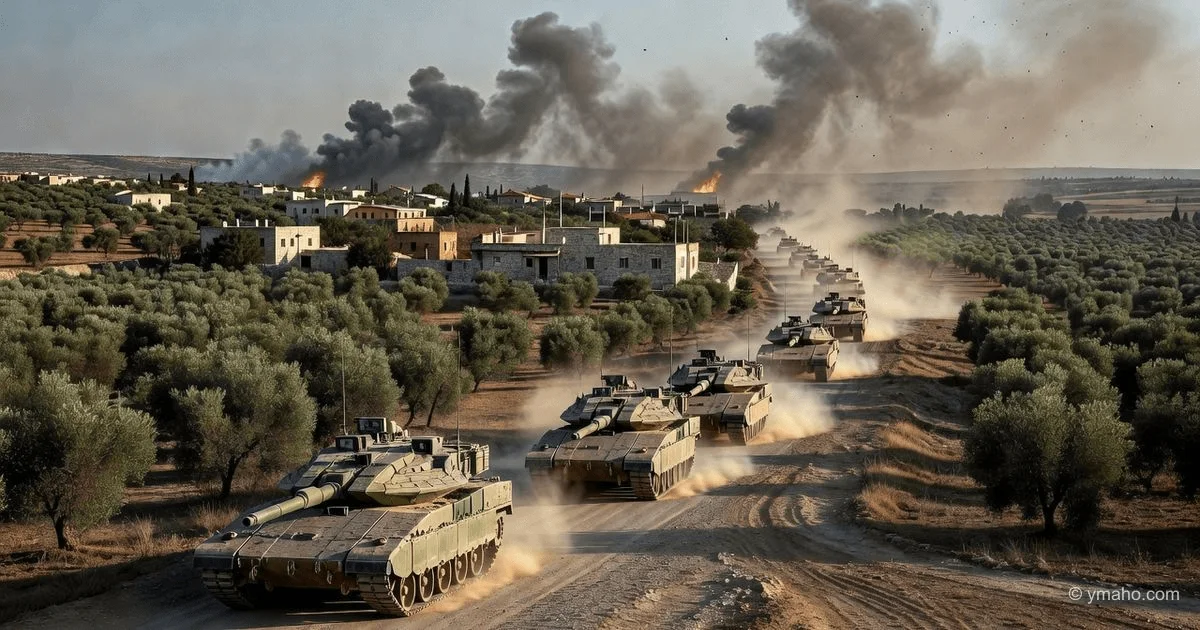
Israel Expands Ground Operation in Lebanon Despite US-Iran Negotiations
The Israel Defense Forces issued evacuation warnings for two dozen towns and villages in southern Lebanon, accompanied by new airstrikes and artillery shelling. Prime Minister Netanyahu stated that Israel will not withdraw troops from occupied territories in Lebanon, Syria, and Gaza, aiming to preserve the ability to act independently against Iran's nuclear program.
Shadow Beneficiary: Why Israel Is Expanding Its Operation in Lebanon Right Now, When the US and Iran Are Almost Ready to Sign a Peace Deal
Author's analysis for institutional investors and hedge funds
The Essence: What Is Really Happening
The official version broadcast by global media sounds logical: Israel is expanding its ground operation in southern Lebanon because Hezbollah continues to shell northern territories despite the ceasefire brokered in April. The IDF issued evacuation orders for two dozen settlements, including the city of Nabatieh, and is conducting airstrikes and artillery strikes. Prime Minister Netanyahu states that Israel will not withdraw troops from occupied territories in Lebanon, Syria, and Gaza.
But the timeline of events over the past week completely exposes this official narrative. Look at the dates: June 11 — Reuters reports that the US and Iran are close to signing a memorandum of understanding, which could be signed as early as Sunday in Geneva. June 12 — Israeli military again strikes southern Lebanon and expands the evacuation zone. This is no coincidence. It is a classic "burning bridges" tactic ahead of signing an agreement unfavorable to you.
The real essence of what is happening: Israel is trying to create irreversible facts on the ground to make any future US-Iran deal that includes a Lebanese settlement politically impossible to implement. Iranian Foreign Minister Abbas Araghchi directly stated on June 12: "Ending the war in Lebanon means Israel's withdrawal from the territories it occupies." Israel responds not with diplomacy but with escalation. Defense Minister Israel Katz wrote on social media platform X: "Israel will not withdraw from security zones in Lebanon, Syria, and Gaza."
A non-obvious insight not found in Reuters or Bloomberg: according to sources in Israeli security services, the IDF has a clear order — by the time the US-Iran memorandum is signed (expected June 14-15), to occupy as much territory in southern Lebanon as possible, in order to then bargain for every square kilometer during a withdrawal. The capture of the strategic Beaufort Ridge — the first significant advance of Israeli forces deep into Lebanon in 20 years — was carried out precisely for this purpose. This is not a military necessity; it is creating bargaining chips for future negotiations that may never happen.
Timeline and Context
The conflict began on February 28, 2026, when the US and Israel launched initial strikes on Iran. In response, Hezbollah opened fire on Israel in solidarity with Iran on March 2. By mid-April, a fragile ceasefire was reached between Israel and Lebanon, but it did not stop hostilities: Hezbollah is not a party to this agreement, and exchanges of fire continued.
The next key stage was the failure of Israel-Lebanon negotiations in Washington at the end of May. Lebanon demanded an immediate ceasefire and withdrawal of Israeli troops; Israel refused and continued to insist on the disarmament of Hezbollah. On June 1, Netanyahu stated that he had ordered the deepening and expansion of control over Hezbollah's territories in Lebanon, and on the same day, Israeli forces captured the Beaufort Ridge.
| Date | Event | Key Player | Result / Status |
|---|---|---|---|
| Feb 28, 2026 | US and Israel strike Iran | US, Israel, Iran | Start of full-scale war |
| Mar 2, 2026 | Hezbollah opens fire on Israel | Hezbollah | Opening of the Lebanese front |
| Apr 16, 2026 | Israel-Lebanon ceasefire announced | US (mediator) | Ceasefire did not stop fighting |
| May 28-31, 2026 | Failure of Washington negotiations | US, Lebanon, Israel | Israel refused to withdraw troops |
| May 31-Jun 1 | Capture of Beaufort Ridge; threats to strike Beirut | Israel | Deepest advance since 2006 |
| Jun 11, 2026 | Leak of imminent US-Iran memorandum signing | US, Iran | Memorandum could be signed June 14-15 |
| Jun 12-13, 2026 | Israel expands strikes on southern Lebanon; evacuation of 20+ towns | Israel | Escalation on eve of signing |
Source: data from Interfax, Xinhua, Haaretz, RNZ, Vesty
Important context explaining Israel's actions: the terms of the forthcoming US-Iran memorandum. According to leaks, the agreement provides for "cessation of hostilities on all fronts, including Lebanon." Iranian sources report that the deal includes lifting oil sanctions, unfreezing billions of dollars in assets, and — most importantly for Israel — the withdrawal of Israeli troops from Lebanese territory. It is this clause that makes the deal unacceptable to Israel. Netanyahu publicly distanced himself from the negotiations, stating that Israel "is not a party to any memorandum of understanding with Iran."
Who Wins and Who Loses
The biggest loser right now is the Trump administration. The White House had hoped to present the signing of the memorandum in Geneva as a foreign policy triumph — "the great settlement of the war with Iran," as Trump himself put it. But Israel's escalation in Lebanon on the day the deal's details are being finalized puts Washington in an absurd position. How can Trump explain to voters that the US "ended the war with Iran" when its closest ally is expanding combat operations in Lebanon, which, under Iranian terms, should be part of the deal? Trump's approval rating has already fallen due to high gas prices. The Lebanese escalation makes the situation even more explosive.
The second loser is Lebanon and its government. Lebanon is trapped: it has no control over Hezbollah, yet it is Lebanese territory that is occupied by Israeli troops. Lebanese President Joseph Aoun called the agreement worked out in Washington "the last chance" for a ceasefire. But Hezbollah has already rejected it, calling it an "illusion" and a "surrender." The Lebanese state finds itself squeezed between Israeli tanks and an Iranian proxy force, with no ability to influence either side.
Who wins — Iran, but not entirely. On one hand, Tehran achieved its main goal: including Lebanon in the agreement and demanding the withdrawal of Israeli troops. On the other hand, Israel's escalation shows that even if the US signs the memorandum, it cannot guarantee Israel's compliance. This is a serious blow to trust in the US as a mediator. Trita Parsi, executive vice president of the Quincy Institute, notes: "Iran's demand to include Lebanon in any ceasefire agreement is essentially a test of Washington's willingness and ability to restrain Israel. If Washington cannot or will not do so, the value of any agreement with the US is highly questionable."
The most interesting beneficiary is Qatar. It was Qatari Prime Minister Mohammed bin Abdulrahman Al Thani who acted as the mediator through which mutual understanding between the US and Iran was reached. Qatar, a small state with enormous gas revenues, positions itself as an indispensable diplomatic player in the region. While the US, Israel, Iran, and Hezbollah exchange strikes and ultimatums, Doha quietly increases its influence, acting as the only party with whom everyone — from Trump to Iran's Supreme Leader — is willing to talk.
What the Media Are Not Saying
The most important insight missing from public reports concerns disagreements within the Israeli leadership over the timing of the escalation. Sources in Yedioth Ahronoth report that the military command insisted on a pause in hostilities until the memorandum was signed, so as not to give the US additional arguments to pressure Israel. Netanyahu and Katz pushed through the opposite decision — to maximize the operation right now. The political logic of this decision is obvious: the more territory Israel occupies before the signing, the more leverage it will have for bargaining. But the military logic is questionable: expanding the front in Lebanon diverts forces from preparing for possible escalation on other fronts, including the Gaza Strip and the West Bank.
The second insight concerns the position of the Lebanese army. Officially, the Lebanese army is not participating in the conflict — Hezbollah is conducting the fighting. But the deeper Israeli forces advance into southern Lebanon, the harder it becomes for the Lebanese army to maintain neutrality. There have already been cases where Lebanese soldiers abandoned their positions under Israeli artillery fire. If Israeli forces cross the Litani River (and Katz has already announced the intention to turn this area into a military zone), the Lebanese army may be forced into direct confrontation. This would change the entire nature of the conflict — from a proxy war between Israel and Iranian proxies to a full-scale interstate war.
The third insight is the hidden coordination between Israel and the US, despite public disagreements. Although the White House publicly called for restraint, Israeli media report that the US approved Israel's requests to expand military activity in Lebanon, including strikes on Beirut. This means the escalation is happening, if not with Washington's blessing, then with its tacit consent. The public message: "We are for peace and are signing a memorandum with Iran." The private message to Netanyahu: "You have 48 more hours to inflict maximum damage." This double game is the main risk to regional stability.
Forecast: Next 30 Days and 90 Days
Next 30 days (until mid-July): Everything will depend on whether the US-Iran memorandum is signed on June 14-15 and whether it includes specific provisions on Lebanon. If the memorandum is signed and Iran agrees to a "freeze" of the Lebanese front in exchange for sanctions relief, Israel will come under unprecedented pressure from the US. Trump cannot afford the deal to fail on the eve of the November midterm elections. Expect Washington to begin exerting direct pressure on Netanyahu — possibly through threats to delay deliveries of aviation munitions. By the end of June, a compromise may be possible: Israel agrees to a phased withdrawal from Lebanon in exchange for maintaining "freedom of action" in response to Hezbollah attacks.
Next 90 days (September 2026): If the memorandum fails due to Israel's position (which is quite likely given the rhetoric of Netanyahu and Katz), we will enter a phase of uncontrolled escalation. Hezbollah, feeling support from Iran, which is no longer bound by the negotiation process, may launch massive rocket attacks on central Israel. Israel, in turn, will strike Beirut — and then, as Netanyahu warned, there will be "no peace" in Lebanon. Brent crude prices in this scenario would exceed $110 per barrel, triggering a new round of global inflation and putting central banks (including the ECB, which just raised rates) in an impossible choice between fighting inflation and supporting a recessionary economy.
Editorial Forecast
Asset: Gold (XAU/USD). Direction: Up in the next 48-72 hours amid escalation in Lebanon and growing doubts about the success of the US-Iran memorandum. Key levels: a break above resistance at $2,450 per troy ounce would open the path to $2,500. Confidence level: Medium (60%). The main risk to the forecast is an unexpected signing of the memorandum in Geneva on June 14-15, which would temporarily reduce the geopolitical premium, but even in that case, gold would remain in the $2,380-2,450 range due to lingering uncertainty. We recommend monitoring official statements from the US State Department and Netanyahu's office on Sunday.
— Editorial Team