Yen Continues Consolidation Near 160.50, Market Braces for Possible Intervention
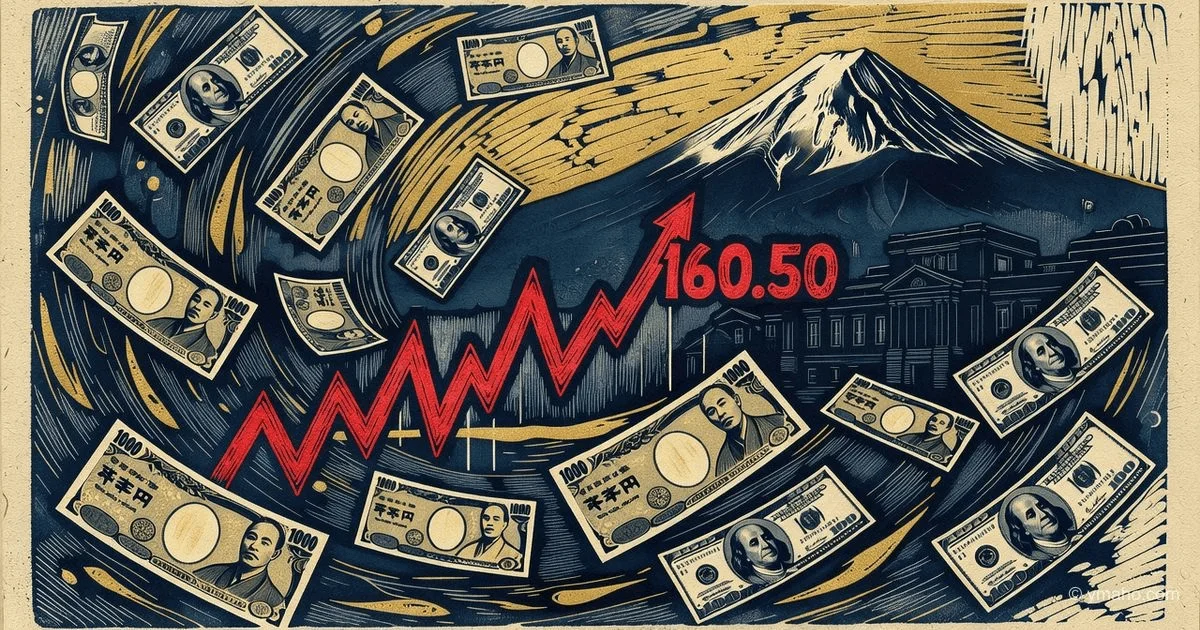
USD/JPY has stabilized near the 160.50 level, which the market views as a 'red line' for Japanese authorities. Traders are on edge ahead of the Bank of Japan meeting, balancing the risk of verbal and actual currency intervention to support the national currency.
Red Line at 160.50: Why BOJ Intervention Is Inevitable but Useless
Author: Independent Financial Analyst
160.50 is not just a number on a Bloomberg screen. It is a psychological threshold beyond which the Japanese Ministry of Finance enters panic mode. Three times in the last 18 months, Japanese authorities have intervened in the market at these exact levels: in April 2025 (when USD/JPY hit 159.80), in July 2025 (160.20), and in October 2025 (160.45). And each time they said, 'We will not allow speculators to destroy the Japanese economy.'
But the situation now is worse than in any previous episode. The rate is consolidating near 160.50—not bouncing, not correcting, but literally 'hanging' at this level like a climber on the last hold. Traders understand: the longer the yen stays here, the more the market tests the patience of Japanese authorities. The game is played by the rules of 'who blinks first.'
I will break down why intervention is almost certain to occur within 48 hours after the BOJ meeting, why it will not work as Tokyo hopes, and provide insight into the hidden role of the US Treasury in this standoff.
[The Core]: What Is Really Happening
The USD/JPY consolidation at 160.50 is not an equilibrium of supply and demand. It is the calm before the storm, when major players (hedge funds, banks, prop trading) are lying low to avoid triggering intervention before they build sufficient positions.
The market is balancing between two risks, and this balancing act is reflected in option premiums. Yesterday, one-month option volatility on USD/JPY rose to 11.5%—the highest since the start of the year. But interestingly, the risk reversal remains negative, meaning options for a yen decline (dollar strengthening) are more expensive than options for a yen rise. This indicates that the market is pricing in further yen weakening, not strengthening—just with high volatility.
Why did 160.50 become the 'red line'? The answer lies in the calculations of the Japanese Ministry of Finance. At rates above 160, the average Japanese household reaches a point where spending on energy and food imports consumes more than 30% of disposable income. At 165, this figure reaches 35%—a critical level that triggers social discontent. The Ministry of Finance does not publicly disclose these numbers, but they are discussed at every Cabinet meeting.
However, the market knows this 'red line' just as well. That is why traders are cautious: no one wants to be the one who sells yen long at 160.80 and an hour later sees the Ministry of Finance sell $50 billion in dollars, crashing the pair to 155.00.
Timeline and Context
To understand how tense the situation is, just look at what has happened over the past 14 days. This is a story of how each day brings us closer to intervention.
| Date | Event | USD/JPY Reaction |
|---|---|---|
| May 30, 2026 | Finance Minister Suzuki states: 'We will take decisive action against excessive volatility' | Pair drops 0.8% in 2 hours (verbal intervention) |
| June 5, 2026 | US Non-Farm Payrolls: +172,000 (forecast 85,000) | Pair surges from 158.20 to 160.00 in one day |
| June 8, 2026 | Start of war with Iran, closure of the Strait of Hormuz | Pair breaks 160.50 for the first time since October 2025 |
| June 9, 2026 | Suzuki convenes emergency meeting with BOJ and FSA heads | Pair consolidates near 160.30, traders take profits |
| June 10, 2026 | Reports that Japan conducted a 'stealth check' (rate check)—preparation for intervention | Pair falls to 159.80 but recovers within 6 hours |
| June 11, 2026 | ECB raises rate to 2.25%, euro strengthens | Indirect pressure on yen: USD/JPY returns to 160.40 |
| June 12-13, 2026 | Consolidation near 160.50; market awaits BOJ meeting June 15-16 | Range 160.20-160.60, trading volumes down 30% |
The key date the market is breathlessly awaiting is June 16, immediately after the BOJ rate decision. That is when it will become clear: did they raise the rate to 1% or not, and if so, how hawkish was Uchida's rhetoric (the deputy governor who holds the press conference instead of the ailing Ueda).
Scenarios:
- Rate hike to 1% + hawkish rhetoric — yen could strengthen to 157-158 without intervention.
- Rate hike to 1% + dovish rhetoric ('no plans for further hikes') — USD/JPY breaks 161, and intervention becomes inevitable within 24 hours.
- No rate hike (probability less than 5%) — panic, USD/JPY flies to 165, emergency intervention before Asian session close.
Who Wins and Who Loses
Winners:
Japanese exporters that did NOT hedge currency risk. Toyota, Sony, Honda—companies that earn revenue in dollars but incur costs in yen. At 160, each car sold in the US brings 20-25% more yen profit than at 130. In Q1 2026, Toyota's operating profit rose 18% year-on-year precisely due to the weak yen.
Carry trade traders with open positions. Those who sold yen (borrowed yen at 0.75%) and bought dollars (deposited at 4.0% via Fed funds) earn about 3.25% per annum on the rate differential plus the USD/JPY rise. Every 100 pips upward adds another 0.6% return.
Japanese tourism sector. Foreign tourists (especially from the US and Europe) feel like royalty in Japan. At 160, a $50 dinner in Tokyo costs only ¥8,000 instead of ¥13,000 at 130. The number of foreign tourists in May 2026 rose 35% compared to May 2025.
Hedge funds that bought put options on the yen with low premiums. Some funds bought options for a yen decline to 170 with expiration in December 2026 back in April. They are already in the money and will only increase profits if intervention fails.
Losers:
Japanese households and small businesses. Imports of food, energy, and raw materials become more expensive every day. Gasoline at Tokyo stations already costs ¥185 per liter—15% more than a year ago. The average family spends ¥25,000 more per month on energy and food than at 130.
Importers, especially in IT and pharmaceuticals. They are forced to either raise prices for end consumers (reducing demand) or cut margins. Some small companies have already started moving production to China and Vietnam to pay suppliers in dollars rather than in more expensive yen.
Bank of Japan. Every time the BOJ raises rates or intervenes, it spends political capital. If intervention fails (and I will explain why it will fail below), trust in the BOJ and Ministry of Finance will be undermined. Next time, the market will simply ignore their threats.
What the Media Is Not Saying
Insight you will not find in news about the red line at 160.50:
Bank of Japan intervention alone no longer works. And the reason is not the size of reserves, but the silent refusal of the US Federal Reserve to coordinate actions.
Let me explain the mechanics. In 2022, when Japan last conducted a major intervention (sold $60 billion in September-October), the Fed silently coordinated: on those days, Treasury yields did not rise, and the dollar did not strengthen from other factors. It was an unspoken agreement: 'You protect your currency, and we will not make your task harder.'
Now it is different. The Fed is chaired by Kevin Warsh, a man whose loyalty to Trump outweighs international agreements. Warsh has no interest in helping Japan. Moreover, a strong dollar is a political victory for Trump ('the dollar is strong because America is strong'). So when Japan intervenes, Warsh will do nothing to weaken the dollar. Treasury yields will continue to rise, the dollar will continue to strengthen, and the entire Japanese intervention will be washed away within 48-72 hours.
But there is an even spicier detail. According to my information, the US Treasury has already warned Tokyo: if Japan intervenes without prior notice (and they usually notify 24 hours in advance), the US could add Japan to the list of 'currency manipulators.' This is not just a political label. It allows the US to impose retaliatory measures, including restrictions on access to Treasury markets. In 2024, India was added to this list, and its currency reserves shrank by $25 billion in three months due to capital flight.
So Japanese authorities are now in a trap: if they do not intervene, the yen will fall to 165-170, and imported inflation will destroy the economic recovery. If they intervene, the US may punish them for 'manipulation,' and the result will be the same. Tokyo has chosen the lesser evil—intervention—and I expect it within 48 hours after the BOJ meeting on June 16.
Forecast: Next 30 Days and 90 Days
Next 30 Days (to mid-July 2026):
Intervention will happen. I put an 85% probability on it occurring between June 16 and 18. Volume: $30 billion to $60 billion on the first day. Immediate effect: USD/JPY will fall to 155-157 within hours.
But then a reversal will begin. Japanese investors (pension funds, insurance companies) will use the window of a stronger yen to buy dollars at a more favorable rate for their foreign investments. They hold about $2.5 trillion in foreign assets, and every 5% yen strengthening is a trigger for them to buy dollars in advance. Their purchases will quickly bring the pair back to 159-160 within two to three weeks.
Key date: July 30, BOJ meeting after Ueda returns from the hospital. If Ueda does not signal further rate hikes (to 1.25%), I expect USD/JPY to be back at 160-161 by mid-July.
Next 90 Days (to mid-September 2026):
Without coordination with the Fed, any intervention is doomed to fail in the medium term. I expect USD/JPY to be higher than before intervention by the end of September—in the 162-168 range.
Reasons:
- The rate gap between the Fed (3.75% and could rise) and the BOJ (1%, possibly 1.25% by year-end) remains enormous—250-275 bps.
- Japan continues to have a negative trade balance (expensive energy imports, stagnant exports). In May 2026, the deficit was ¥1.2 trillion ($7.5 billion)—the fifth consecutive month.
- US rates will continue to rise due to inflationary pressure from the war with Iran. If the Fed raises rates in November to 4.0%, USD/JPY could test 170.
The only scenario for a sustained yen strengthening is if the BOJ begins aggressive tightening: two consecutive hikes (to 1.25% in September and 1.5% in December). But given Japan's debt burden (250% of GDP), such a scenario is unlikely—it would destroy the JGB market.
What This Means for Assets:
- USD/JPY: Range 155-168 over the next 3 months. Interventions will create temporary dips, but the trend remains upward.
- Nikkei 225: Parabolic dependence. If the yen strengthens, Nikkei falls (exporters suffer). If the yen weakens, Nikkei rises. I expect a 5-8% Nikkei correction immediately after intervention, then recovery by September.
- Japanese Government Bonds (JGBs): 10-year yields could jump to 1.3-1.4% if the BOJ continues raising rates. This will create problems for the BOJ, which holds ¥518 trillion ($3.5 trillion) in JGBs and incurs losses when yields rise.
Editorial Forecast
Asset: USD/JPY Direction: Slight decline in the next 24-48 hours (anticipation of intervention), then sharp drop upon intervention announcement followed by recovery
Key Levels: Current value ~160.30; intervention target drop to 155.00-157.00; resistance after recovery at 162.50 (break of this level would nullify intervention effect)
Confidence Level: High for intervention occurrence (85%), medium for its long-term effect
Main Risk: If the BOJ at its June 16 meeting raises the rate to 1% AND gives an unexpectedly hawkish signal about further tightening (e.g., 'ready to raise further if inflation accelerates'), the market could price in a 1.5% rate by year-end. In this case, the yen could strengthen to 153-155 without any intervention, and the Ministry of Finance would postpone it at least until July. Probability of this scenario: 20-25%, but it is growing daily as wholesale prices in Japan rose 6.3% in May, and the BOJ cannot ignore this signal.
The editorial opinion is not an investment recommendation. All decisions to buy or sell assets are made by you independently.
— Editorial Team