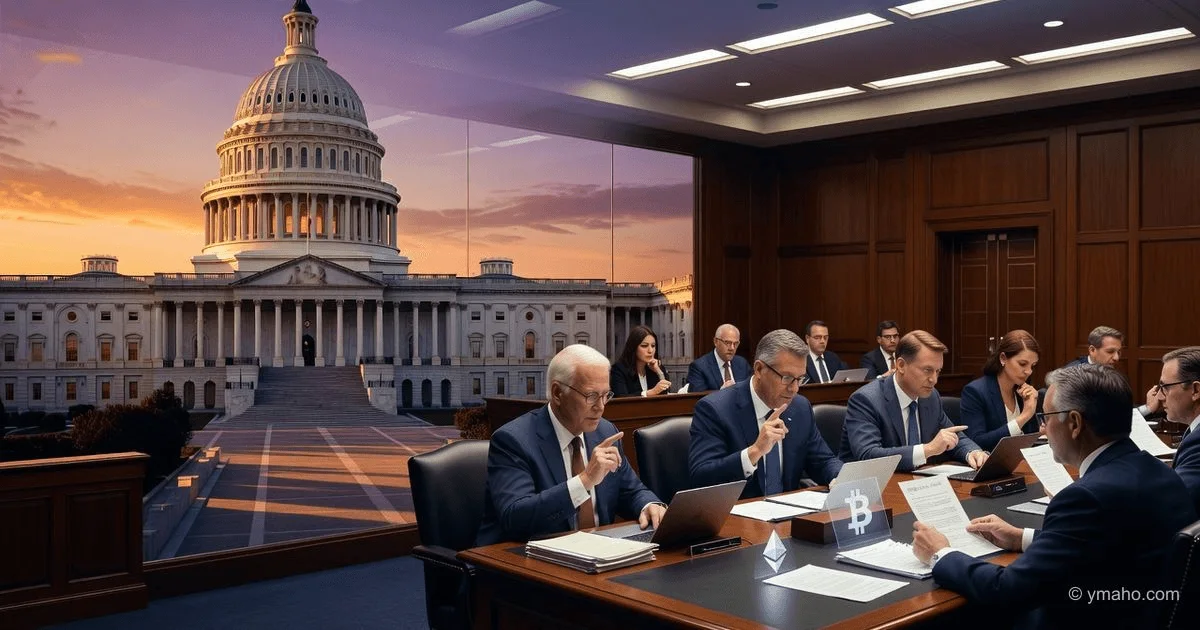
U.S. Senate Advances CLARITY Act, Bill Passes Key Committee
The digital stock bill CLARITY Act was approved by the Senate Banking Committee. The document is expected to be brought to a full Senate vote before July 4, marking a significant step toward comprehensive cryptocurrency regulation in the U.S.
Headline: CLARITY Act Passes Key Senate Committee: Why the Market Celebrates Prematurely
Author: Independent Crypto Analyst (Insider Perspective)
[The Gist]: What's Really Happening
On May 14, 2026, the U.S. Senate Banking Committee approved the CLARITY Act by a vote of 15 to 9. All 13 Republicans supported the bill, joined by Democrats Ruben Gallego and Angela Alsobrooks. On June 1, the document was officially placed on the Senate Legislative Calendar as Calendar No. 423. The White House has set a goal of passing the law by July 4 — a symbolic gift for America's 250th anniversary.
Mainstream media writes about a "breakthrough" and "inevitability of passage." I'll put it differently: committee voting is the easy part. The real battle is just beginning, and it will be bloody. The bill still faces four critical stages before becoming law: a full Senate vote (requiring 60 votes), reconciliation with the House version, approval by both chambers, and the president's signature.
A key nuance missed by Cointelegraph and CoinDesk: forecasts for the law's passage in 2026 are rapidly declining. Galaxy Digital lowered its estimate from 75% immediately after the committee vote to 60% as of June 5. On Polymarket, the probability of CLARITY Act passing by August fell from 62% to 51% in five days. On Kalshi, the drop was even more dramatic — from 39.7% to 22.1%. The market no longer believes in a "holiday gift by July 4."
Timeline and Context
To understand why the euphoria is premature, we need to trace the timeline and assess the real obstacles.
| Date | Event | Significance |
|---|---|---|
| July 2025 | House passes CLARITY Act (294-134) | First major success |
| Sept 2025 – April 2026 | Committee hearings, SEC/CFTC jurisdiction discussions | Compromise building |
| May 14, 2026 | Senate Banking Committee approves bill (15-9) | Key vote, but only the beginning |
| June 1, 2026 | Bill placed on Senate Calendar | Formal step, no vote date set |
| June 5, 2026 | Galaxy Digital lowers forecast from 75% to 60% | Reason: crowded Senate calendar |
| June 5-8, 2026 | Prediction markets show sharp decline | Polymarket: from 62% to 51% |
| By July 4, 2026 (target) | Full Senate vote | Requires 60 votes |
| By August 2026 (realistic) | Possible vote | Per Lummis estimate |
| Late 2026 – early 2027 | Alternative scenario | If bill fails before elections |
Context is critical: the crowded Senate calendar is the main problem. After the committee vote, the Senate lost days battling the administration's "anti-gun" fund. Then on June 5, a procedural attempt to extend Section 702 of the surveillance law (FISA) failed — 47 to 52. The June 12 expiration deadline demands immediate attention. All the while, CLARITY Act waits in line.
Senator Cynthia Lummis, one of the bill's main sponsors, admitted: a vote before July 4 is "possible, but more realistic is before the August recess." And the Senate August recess begins in late July. The window is shrinking.
Who Wins and Who Loses
Winners:
- Bitcoin and Ethereum. The law explicitly classifies them as "digital commodities" regulated by the CFTC, not the SEC. This removes the long-standing threat that Ethereum could be deemed a security. For institutional investors, it's a signal: "it's safe to enter."
- Circle (USDC) and other MiCA-compliant stablecoins. Circle fits perfectly into the CLARITY Act model: 100% reserve in liquid assets, transparency, readiness for regulation. Circle has already filed for an IPO and trades on the exchange. However, paradoxically: Circle shares (CRCL) have fallen 40% from their all-time high of $140 to $80. The market is punishing Circle not for poor fundamentals, but for uncertainty around the law's passage timeline.
- Coinbase, Kraken, other CASPs. The law gives commercial banks "explicit authority" to use blockchain for custody, payments, and lending. But for crypto exchanges, the main thing is clear rules of the game. Committee approval is the first step toward those rules.
Losers:
- Tether (USDT). CLARITY Act effectively bans algorithmic stablecoins for two years (until 2028). Tether is technically not algorithmic, but its opaque reserve model and lack of full audit do not meet CLARITY Act requirements for 1:1 liquid reserves in segregated accounts. USDT is losing ground in the U.S. Its market cap in the eurozone already collapsed after MiCA; CLARITY Act could deliver a second blow.
- U.S. banks that haven't invested in blockchain. The law allows banks to use DLT, but those unprepared will have to catch up. J.P. Morgan and Citi are already in the game (JPM Coin, Citi Token Services). Small regional banks are not. They will have to spend millions on compliance systems and custodial solutions to avoid losing corporate clients to crypto-native competitors.
- Circle (paradoxically, but true). CRCL shares fell 40% precisely due to uncertainty around CLARITY Act. Investors see two scenarios: if the law passes by August — a rally; if delayed until 2027 — further decline. Section 404 of the bill prohibits paying interest on simple stablecoin holdings. This limits Circle's business model as an "issuer earning on reserves." The market is revaluing Circle from an "income-generating asset issuer" to a "payment infrastructure" company — with different multiples.
What the Media Isn't Saying
The most important insight I see as an insider: CLARITY Act is not a "pro-crypto law," but a "compromise that pleases no one."
The banking lobby (American Bankers Association, Bank Policy Institute) is still unhappy. ABA Director Rob Nichols sent letters to senators demanding the bill be blocked. Their main complaint: Section 404, even after compromise, still allows crypto firms to pay "rewards" on stablecoins, which banks consider hidden deposit interest.
The crypto lobby (Coinbase, Circle) is also not thrilled. They had to give up "idle yield" — that same interest on simply holding stablecoins. Coinbase CLO Paul Grewal publicly urged bankers to "accept 'yes' as an answer and stop wasting the Senate's time." But that's a cry of desperation, not triumph.
A second hidden factor is ethical restrictions for officials. The bill contains provisions prohibiting high-ranking government officials from owning or promoting digital assets. This is a direct shot at... Donald Trump, who has a crypto portfolio. And this is no joke. Democrats tie their support precisely to this ethical language. Without a compromise on ethics, the bill won't reach 60 votes.
A third factor is reconciliation with the Agriculture Committee version. The Banking Committee's CLARITY Act must be merged with the Agriculture Committee's text (Digital Commodity Intermediaries Act). This is a technically complex process. Each point of divergence is a potential time bomb. Senator Lummis explicitly says this is one of the stages yet to be completed.
Fourth, the market impact has already manifested, and it's negative. Circle shares fell 40%. Because the market understands: even if the law passes, it will be stricter than expected. And if it doesn't, uncertainty will drag on for years. CRCL trading volume of $20.36 billion on the day of the drop reflects panic among institutions exiting positions.
Forecast: Next 30 Days and 90 Days
30 days (through mid-July 2026):
- CLARITY Act: Probability of passage by July 4 — 30% (was 50% in May). Main obstacles: ethical norms (Trump dispute) and crowded Senate calendar (FISA, budget).
- Bitcoin (BTC) and Ethereum (ETH): Sideways. The law classifies them as commodities, which is positive, but until the vote, the market won't price it in. I expect BTC $62,000 – $68,000.
- Circle (CRCL): Continued volatility. Shares could fall to $70-75 if senators publicly announce a delay. Technically, CRCL is already below the 200-day moving average ($89.33).
- Main risk: If Majority Leader John Thune does not schedule CLARITY Act by end of June, the probability of passage in 2026 drops to 30-40%, and the crypto market could react with a 10-15% drop in a week.
90 days (through mid-September 2026):
- CLARITY Act: Most realistic scenario — Senate vote in September, after summer recess. But by then, the election campaign (November 2026 elections) will begin, and the bill could become a hostage of political games. Galaxy Digital estimates a 60% chance of passage in 2026, but I'd give 50%.
- Circle (CRCL): If the law passes by September — rally to $110-120. If not — drop to $60-65. Range is huge, stakes are high. Mizuho analysts have already set a target of $85 with a "neutral" rating.
- Stablecoins: USDC will strengthen its position as the "CLARITY Act-compliant stablecoin." USDT will continue to lose market share in the U.S. institutional market. Section 404 may be softened in the final version, but that's unlikely.
- Main risk: Failure of CLARITY Act in 2026 due to ethical disagreements or time constraints. If that happens, the next chance is only 2027, and by then Europe (MiCA) and Asia will have seized the initiative. For the U.S. crypto industry, this would be a catastrophe — losing leadership for 2-3 years.
Editorial Forecast
Based on current data, a brief forecast for the asset Circle (CRCL) over the next 24–72 hours:
- Asset: Circle Internet Group (CRCL). Direction: sideways with a downward bias (-1% / -3%).
- Key levels: support $78, resistance $85. CRCL has already priced in the drop from $140 to $80, but there are no catalysts for a reversal. The Senate is silent, prediction markets show a declining probability of passage.
- Confidence level: medium (55%). Shares are already cheap by historical standards, and some bad news is priced in. But there are no growth drivers, and the technical picture remains bearish (below the 200-day moving average).
- Main risk: A public statement by Senate Majority Leader John Thune that CLARITY Act will not be considered until September. This would trigger a new wave of CRCL decline of 10-15% in a single day, as investors shift to the "law delayed until 2027" scenario.
— Editorial Team