Markets Price in Risk of Fed Rate Hike in 2026 Amid Uncertainty Over Regulator's Independence
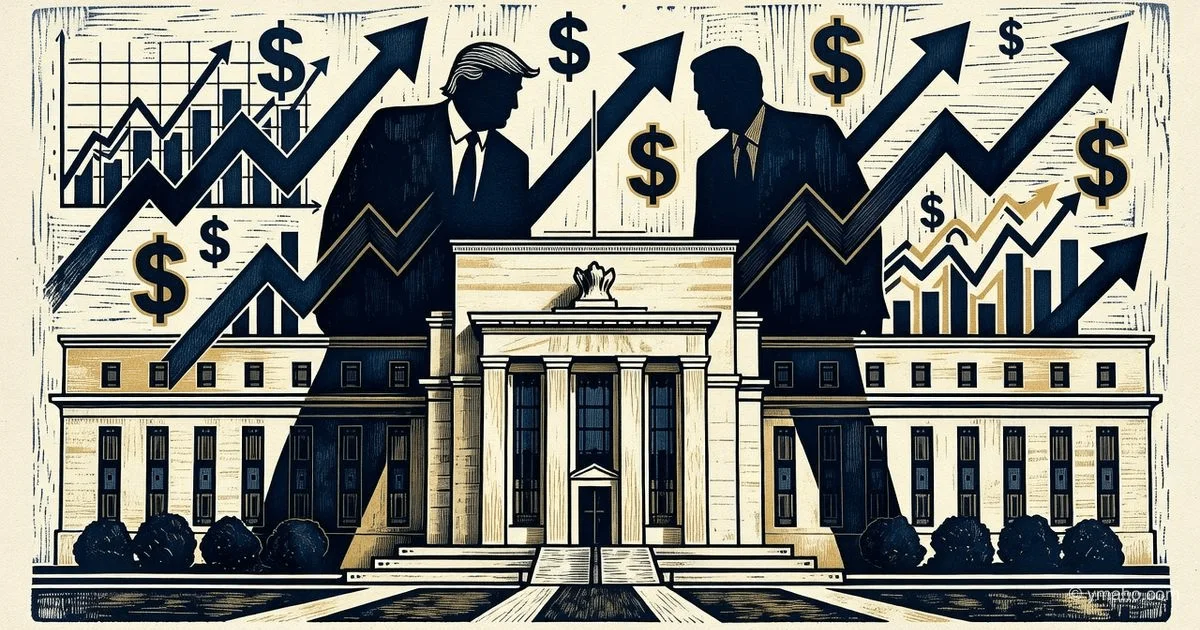
Despite expectations that the Fed will hold rates steady at its June 17 meeting, investors are beginning to price in the risk of a rate hike before year-end. The key uncertainty factor is new Fed Chair Kevin Warsh, whose ties to Donald Trump raise doubts about the regulator's ability to independently fight inflation.
Kevin Warsh and the specter of a rate hike: why markets have stopped believing in Fed independence
Author: independent financial analyst
Markets are a paradoxical thing. They are 99.4% certain that rates will remain unchanged at the June 17 meeting, yet they price in a 63% probability of a hike by October. The official explanation is "uncertainty over the regulator's independence." But inside the industry, we understand: this is not just doubt about the new chair's competence. It is a fundamental reassessment of how trust in the dollar as a reserve currency works when the central bank, for the first time in decades, finds itself in a "whose slave — the president's or the economy's?" situation.
Kevin Warsh is not Jerome Powell. He is not a technocrat who rose from the ranks. He is the husband of an Estée Lauder heiress, a former Trump adviser, and a man whose personal wealth is estimated at around $200 million. It is the combination of his wealth, connections, and lack of experience in public confrontation with the president that creates the situation markets are trying to quantify. Below, I break down the real pricing mechanism, name specific players who will profit from the panic, and offer an insight that completely changes the view on Fed "independence."
[The Gist]: What's Really Happening
At the June 16-17, 2026 meeting, the Fed will most likely leave rates at 3.75%. That's not up for debate. But what is being discussed behind closed doors at hedge funds and desk trading is November 2026. And here, the market shows a crack. According to CME FedWatch, the probability of a rate hike by year-end has reached 58-63%. This is a shocking reversal: as recently as March, the market was pricing in at least one cut.
Why did this happen? Because U.S. inflation is no longer "moderate." The May CPI rose to 4.2% year-over-year — the highest since April 2023. Core CPI (excluding food and energy) stood at 2.9%. And this is despite the fact that the war with Iran has only just begun to fully impact energy prices. A survey of economists by the Federal Reserve Bank of Philadelphia suggests that CPI could reach 6% in Q2 2026.
Trump, naturally, calls these numbers "great" and blames everything on external factors. But markets are not fools. They see a classic spiral: energy shock -> rising transportation costs -> higher service prices -> wage demands. This is the very "second-round effects" scenario that killed the soft landing.
However, the key point not mentioned in the news: this probability of a hike is not tied to economic data in a vacuum. It is tied to the person of Warsh. If Powell had stayed, the market might have believed in his willingness to tolerate higher inflation to avoid a recession. Warsh is an unknown. And unknowns are hedged by pricing in rate hikes.
Timeline and Context
To understand how independence turned from an axiom into a risk, look at the key milestones of the last two months. This is a story of how political appointments met economic reality.
| Date | Event | Market Reaction/Statistics |
|---|---|---|
| May 13, 2026 | Senate confirms Kevin Warsh 54-45 — the narrowest margin in history for a Fed chair | Dollar fluctuates; gold loses 11% in a day on expectations of hawkish policy |
| May 15, 2026 | Warsh officially takes office; Trump holds ceremony at the White House — first time since 1987 | Trump publicly asks him to be "fully independent," but an hour later says: "You'll get rates down, and everyone will be happy" |
| Late May 2026 | April inflation data released: CPI 3.8% | Markets begin revising rate cut expectations |
| Early June 2026 | War with Iran blocks the Strait of Hormuz; energy prices surge | 10-year Treasury yields spike |
| June 10-12, 2026 | May inflation data released: CPI 4.2% YoY, monthly increase 0.5% | Polymarket gives 99.4% chance of rate hold in June; FedWatch shows 63% probability of hike by October |
| June 17, 2026 | First FOMC meeting under Warsh | Dot plot expected to eliminate rate cuts for 2026 |
What remains off-camera: Warsh is 56, with a reputation as a "hawk" from the 2008 crisis, when he criticized Ben Bernanke for easy policy. But he recently advocated for rate cuts to please Trump. This ideological flip-flop is the main cause of market jitters. No one knows which Warsh will wake up in November.
Who Wins and Who Loses
Winners:
Holders of short-term U.S. Treasury bills (T-bills). If the market prices in a rate hike, short-end yields rise immediately. 2-year Treasuries have already gained 35 bps in the last two weeks. Investors who moved to the short end lock in profits and earn yields above inflation.
U.S. banking sector. Large banks (JPMorgan, Bank of America) benefit from rising net interest income when rates rise. Nasdaq analysts note that bank stocks often outperform the market in a rate hike cycle.
Short positions on long-term Treasuries. Those who sold 10- and 30-year bonds before yields rose from 4.0% to 4.5%+ have already made 10-12% on price declines.
Hedge funds playing VIX volatility. Political uncertainty around the Fed is a perfect cocktail for the fear index to rise. VIX has climbed from 13 to 18 over the last three weeks.
Losers:
Issuers of low-rated corporate bonds (high-yield). If the Fed hikes, their borrowing costs soar and default risk increases. High-yield spreads over Treasuries have already widened by 50 bps.
Highly leveraged tech companies. Tesla, Uber, many biotechs — their valuations depend heavily on discounting future cash flows. A rate hike hits them doubly: expensive debt and falling multiples.
Retail investors who bought "hope for rate cuts." Many piled into growth stocks and long-duration bonds expecting Warsh to deliver on Trump's promise. Now they are trapped.
What the Media Isn't Saying
Insight you won't find in headlines:
Markets are pricing in a rate hike not because they believe in Warsh's independence, but because they don't believe in Trump's independence from Warsh. Sounds paradoxical, but the explanation is simple.
Trump publicly stated he wants Warsh to be "fully independent" and "not look at him." But legally and politically, Trump cannot fire Warsh. The Supreme Court in May 2025 made an exception for the Fed, upholding the 1935 precedent protecting heads of independent agencies from presidential removal. Warsh is protected.
However, the flip side of this protection is that Warsh doesn't have to please Trump. He can hike rates even if Trump objects. And here's the insight: markets are actually pricing in a scenario where Warsh deliberately picks a fight with Trump to prove his independence. A rate hike is the easiest way to say, "I'm not a puppet." Trump will be furious, but Warsh cannot be fired.
Thus, the 63% probability of a hike is not so much a reflection of inflation as it is an expectation that Warsh, in his first serious test, will choose reputation with markets over loyalty to the president. Nordea explicitly says: at the June meeting, Warsh will try to build consensus and take a neutral or slightly hawkish stance, strengthening his reputation rather than pandering to Trump's expectations. Deutsche Welle, citing economist Kenneth Rogoff, emphasizes: if markets see independence undermined, they will raise rates themselves through higher bond yields — the opposite of what Trump wants.
What else is hidden: Warsh recently mentioned an alternative inflation measure — the Dallas Fed's "trimmed mean," which shows only 2.3%. This is a technical loophole. If Warsh decides not to hike, he can cite this measure. But if he wants to show independence, he will ignore it and hike.
Forecast: Next 30 Days and 90 Days
Next 30 days (to mid-July 2026):
On June 17, rates will stay at 3.75%. No surprises. But the dot plot will be shocking: Nordea expects it to completely eliminate rate cuts for 2026 and include "some calls for hikes." The market will see this as preparation for tightening.
Reaction: the dollar will strengthen by 1-1.5% within 48 hours of the minutes' release. EUR/USD will fall to 1.065-1.070. Gold, already battered by Warsh's appointment (down 11% in January), will consolidate in the $4,400-$4,700 per ounce range.
Key date: June inflation data release (around July 10-12). If CPI again exceeds 4%, the probability of a hike by October will jump to 75-80%.
Next 90 days (to mid-September 2026):
Most likely scenario (I estimate 60-65%): one 25 bps rate hike in October or November 2026, to 4.00%. Warsh will signal readiness long in advance to minimize shock. The first hint will come at the June 17 press conference.
Alternative scenario (30-35%): the Fed stays put through year-end if inflation slows due to falling energy prices. But with the current Middle East conflict, this is unlikely. Third scenario (5-10%): two hikes (to 4.25%) if inflation accelerates to 5%+.
What this means for assets:
- USD/JPY: will strengthen to 165-170, as the Bank of Japan, expecting a rate hike to 1% in June, may not keep pace with the Fed's dynamics.
- S&P 500: correction of 5-8% by end of Q3, especially in tech and consumer durables.
- Bitcoin: under pressure. Fed rate hikes make the dollar more attractive and raise the opportunity cost of holding crypto assets. Expected to test support at $55,000-$60,000.
- Bonds: continued inverted yield curve. 10-year Treasuries could yield 4.7-4.9% by September.
Editorial Forecast
Asset: DXY (U.S. Dollar Index) Direction: moderate rise in the next 24-72 hours on expectations of hawkish Warsh rhetoric Key levels: current 103.8; resistance at 104.9 (May high), support at 102.5 Confidence level: high Main risk: if Warsh gives an overly "dovish" signal at the June 17 press conference, trying to please Trump, the dollar could fall to 101.5. However, given inflation data, such a move would undermine Fed confidence even more, and the probability of this scenario does not exceed 15%.
The editorial opinion is not an investment recommendation. All decisions to buy or sell assets are yours alone.
— Editorial Team