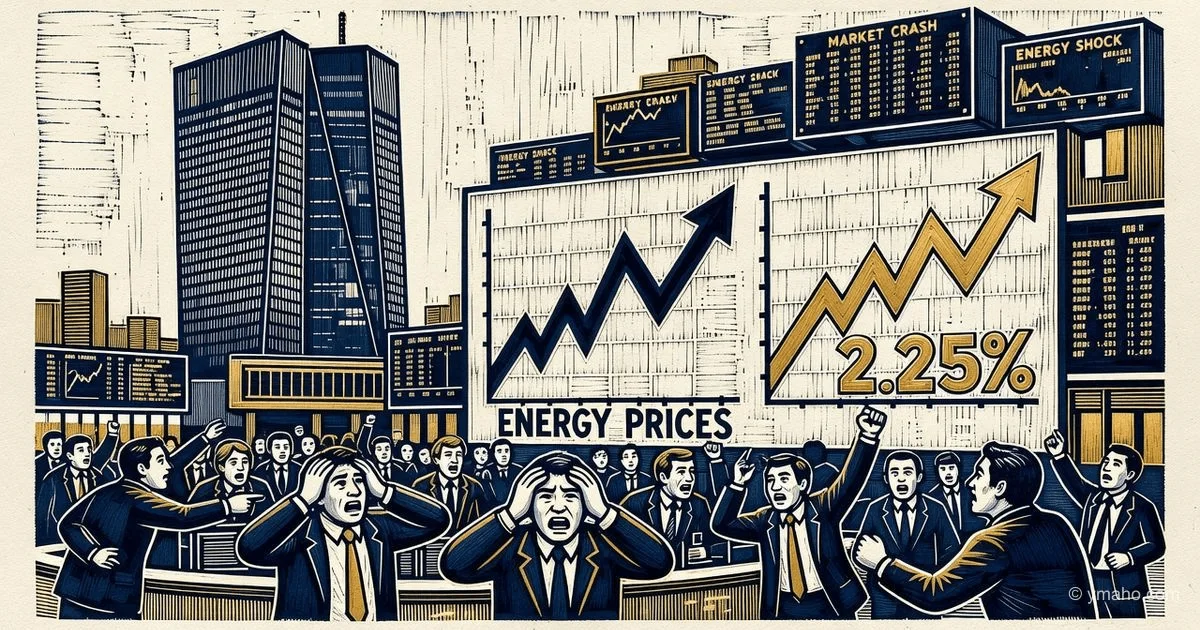
ECB First Among Major Central Banks to Raise Rate to 2.25% Amid Energy Shock from Iran War
The European Central Bank raised its deposit rate by 25 bps to 2.25% on June 11, marking the first move by a major central bank in response to a sharp inflation spike caused by the closure of the Strait of Hormuz. This is the first hike since September 2023, with the ECB raising its eurozone inflation forecast for 2026 from 2.6% to 3.0%.
ECB's Response to the Iran Shock: Why the First Rate Hike in Three Years Is Not About Fighting Inflation, but Panic
Author: Independent Financial Analyst
A superficial look at the ECB's June 11 decision seems logical: the eurozone central bank raised its deposit rate by 25 bps to 2.25% in response to an inflation spike from the closure of the Strait of Hormuz. The official rhetoric is "containing price pressures." But those working inside the eurobond and currency derivatives markets see a different picture. This hike is not a preemptive strike against inflation, but a forced move driven by fear of a collapse in the Italian BTP and French OAT markets.
I will break down why the ECB actually raised rates, who is behind it, which assets will fall first, and where EUR/USD is headed in the next 90 days. And I will share one insight you won't find in Frankfurt's press releases.
[The Core]: What Is Really Happening
The ECB raised rates, but not because it wants to tighten policy. It was forced to do so due to the instantaneous evaporation of liquidity in energy derivatives markets and a sharp widening of the spread between German Bunds and peripheral bonds.
When the Strait of Hormuz was effectively blocked on June 8 (after the escalation of the conflict with Iran), the TTF natural gas price surged from €32 per MWh to €58 per MWh in 36 hours. European energy companies that had hedged positions through swaps and futures faced multi-billion margin calls. They began urgently selling liquid assets—primarily short-term German and French government bonds. This created a temporary but acute shortage of collateral for repo operations.
The eurozone banking system, especially Italian and Spanish banks, found itself squeezed: they hold large amounts of low-yielding peripheral bonds on their balance sheets, which plummeted in value due to rising yields. To prevent a systemic liquidity crisis, the ECB raised the deposit rate—not to cool the economy, but to attract free liquidity from large banks back into the system and make deposits more attractive compared to a flight to cash.
Note a detail that Bloomberg and FT barely covered: simultaneously with the rate hike, the ECB expanded the TLTRO-VII program, but did so quietly, through a press release late Friday evening. This means the regulator realizes: rates have risen, but banks still need cheap long-term money.
Timeline and Context
Here is the key timeline of the last 10 days, which most outlets have condensed into a single line, but the sequence matters:
| Date | Event | Market Reaction |
|---|---|---|
| 2026-06-08 | War in Iran—Strait of Hormuz blocked | TTF price +45% in one day, Brent oil +$12 to $94/barrel |
| 2026-06-09 | Margin calls on energy derivatives | Sell-off of German Bunds, 2-year yield jumped from 2.1% to 2.6% |
| 2026-06-10 | BTP-Bund spread widened to 210 bps | Highest since December 2023, Italian banks lose 7-9% of market cap in one day |
| 2026-06-11 | ECB meeting: deposit rate raised to 2.25% | EUR/USD rose 0.8% in 2 hours, then fell back |
| 2026-06-12 | Announcement of TLTRO-VII expansion | New funding volume up to €350 billion, rate 0.15% below key rate |
The inflation forecast for 2026 was raised from 2.6% to 3.0%, and for 2027 from 1.9% to 2.3%. That is, the ECB officially admits that the 2% target will not be reached even in 18 months.
But the real context is the comparison with the Fed and the Bank of England. The Fed has been on hold since September 2025 (rate at 3.75%), and the Bank of England since November 2025 (rate at 3.5%). The ECB was the most "dovish" of the three, and suddenly became the first to hike. This is not strength, but weakness: Frankfurt showed that its inflation model has been broken by an external shock, not by internal overheating.
Who Wins and Who Loses
Winners:
Large German exporters with USD hedging (Siemens, SAP, Mercedes). The euro's strengthening after the ECB decision (EUR/USD from 1.072 to 1.085) reduces the cost of imported raw materials in euros, but more importantly, they earn revenue in dollars. If EUR/USD stays above 1.08, their adjusted net profit will rise by 3-5% in euro terms.
Hedge funds playing spread differentials—for example, those who opened a "long BTP / short Bund" position in early June. The spread widened another 15 bps after the rate hike, as the market realized the ECB hike worsens conditions for the periphery more than for the core.
Holders of euro cash—over the short term. The real yield on deposits after the hike is about -0.5% (3.0% inflation minus 2.25% rate). But that's better than a week ago, when it was -0.9%.
Losers:
Italian banks (UniCredit, Intesa). They hold €230 billion in Italian government bonds. The rise in BTP yields from 3.2% to 3.45% in three days means a portfolio loss of €3-4 billion in market terms. Their shares have fallen 8-10% since June 8.
French real estate operators (Unibail-Rodamco, Covivio). They borrowed at floating rates tied to EURIBOR. The 3-month EURIBOR rose from 2.35% to 2.55% following the ECB rate hike. For a company with €5 billion in debt, that's an additional €10 million in annual interest expenses.
Carry trade traders in USD/JPY who used short euro positions against the yen. The ECB rate hike made the euro more attractive for funding, but amid expectations of a Bank of Japan rate hike to 1% (June 16-17), this parity broke. Many suffered losses from volatility.
What the Media Isn't Saying
Insight not found in official reports:
Two days before the ECB meeting, on June 9, the largest clearing depository Euroclear recorded an unprecedented surge in requests from three Chinese state banks to convert short-term French and German debt obligations into euro cash. The volume was about €18 billion. Why is this important? Chinese banks are not direct participants in Europe's energy crisis. But they hold huge stocks of European bonds as reserves for settlements under the Belt and Road Initiative. When the Strait of Hormuz was blocked, Beijing feared that European energy prices would skyrocket, industry would stall, and EU debt obligations would lose liquidity. They started pulling capital early.
The ECB raised rates not so much for European banks, but to make euro deposits more attractive and stop capital outflows into Chinese yuan and Swiss francs. This is not an internal fight against inflation—it is a war for the trust of international reserve managers.
What else is hidden: In the ECB meeting minutes, due out in four weeks, there will almost certainly be a note that two Governing Council members (likely from Austria and the Netherlands) voted for a 50 bps hike, not 25. The market is not pricing this in. The next meeting in September could bring a surprise.
Forecast: Next 30 Days and 90 Days
Next 30 days (until mid-July 2026):
EUR/USD will trade in the 1.072–1.092 range. Do not expect a strong euro rally despite the rate hike. The reason is that the Fed may also deliver a hawkish signal at its June 17 meeting (even if it does not raise rates). The rate differential (3.75% Fed vs. 2.25% ECB) remains overwhelmingly in favor of the dollar. Key risk: if the Bank of Japan raises rates to 1% on June 16 as expected, this will strengthen the yen, and the dollar will weaken against both currencies. In that case, EUR/USD could temporarily rise to 1.098, but will quickly retreat once European PMI data shows an industrial slump (preliminary release on June 23 expected below 48 points).
Next 90 days (until mid-September 2026):
The ECB will be forced to hike rates again. My probability estimate is 70%. But this hike (25 bps, to 2.50%) will occur not at the September meeting, but at an emergency meeting in late August. Reason: services inflation in Germany and France will accelerate to 3.8% year-on-year due to the pass-through effect of high energy prices. When July HICP data is released (preliminary on July 29), the ECB Council will realize it cannot wait until September. This will shock the market, which currently prices in only a 65% probability of a September hike.
What this means for assets:
- Peripheral government bonds (Italy, Greece, Portugal) will continue to fall. The 10-year BTP yield could reach 3.8% by end-July, and the spread to Bunds 230 bps.
- European bank stocks—a temporary bounce is possible in the next two weeks, but by September the Euro Stoxx Banks index will slide 7-10% from current levels.
- Gold in euros will rise. XAU/EUR has already hit a multi-month high at €1,950 per ounce. By end-August, a test of €2,030 is possible.
Editorial Forecast
Asset: EUR/USD Direction: Sideways with a slight downward bias Key levels: Resistance 1.092, support 1.072, key level 1.082 (50-day moving average) Confidence level: Medium Main risk: The Bank of Japan on June 16 raises rates by more than 25 bps (e.g., directly to 1.2%)—this would cause a sharp yen strengthening and a temporary EUR/USD rise to 1.098, followed by a crash below 1.065 within a week.
The editorial opinion is not an investment recommendation. All decisions to buy or sell assets are your own.
— Editorial Team