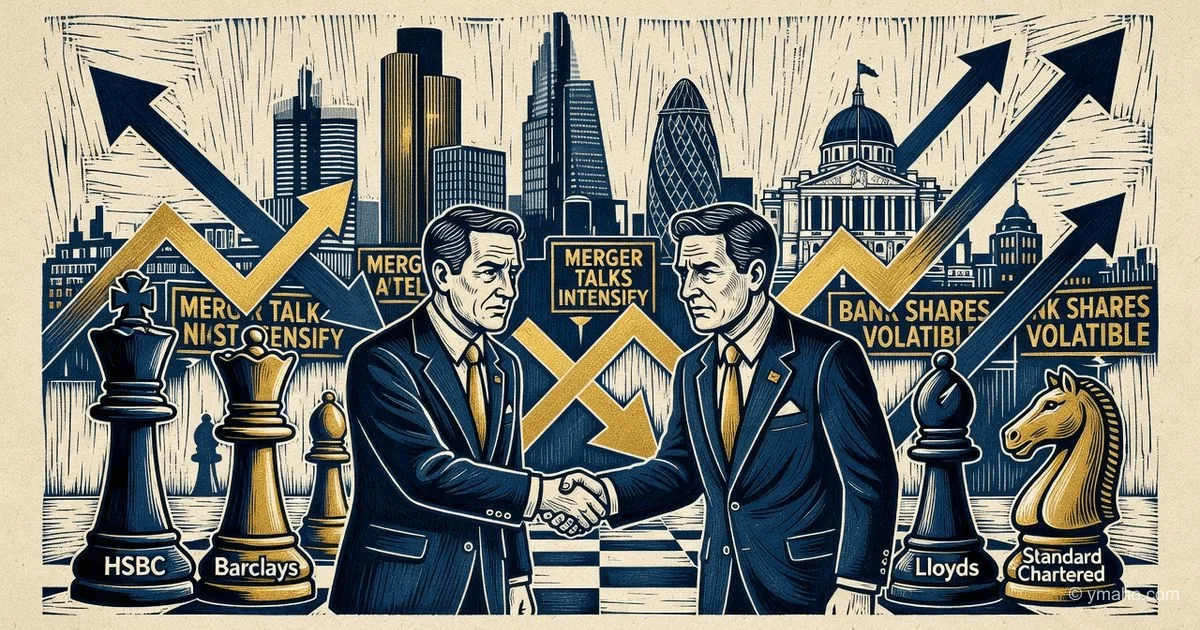
Rumors of a Major Merger in London's Banking Sector Heat Up the M&A Market
On the London Stock Exchange (LSE), rumors of a potential major merger in the banking sector have intensified, drawing investors' attention to financial company stocks. The wave of consolidation is expected to strengthen amid changing monetary policy.
Rumors of a merger in London are just the tip of the iceberg: why British banks are forced to merge or die
Author: independent financial analyst
When rumors of a major bank merger start circulating on the London Stock Exchange, retail investors typically see it as a chance to make quick money on speculative stock movements. But those sitting in London hedge funds and investment banks understand: these rumors are a symptom of a much deeper crisis that has been brewing for the last ten years and has now reached a point of no return. The British banking sector is on the verge of the biggest wave of consolidation since the 2008 financial crisis.
The reason is simple and brutal: mid-sized and even large British banks can no longer compete on their own. Pressure comes from three sides: regulation (Brexit has permanently closed easy access to EU markets), technology (digital banks are eating away the retail segment), and macroeconomics (high rates squeeze margins and worsen credit portfolio quality).
I will break down who exactly might merge, why this will happen in the next 6-12 months, who will make billions, who will lose everything, and provide insight into the non-obvious role of the "sleeping giant" — British building societies.
[The Gist]: What's Really Happening
The rumors reported by Bloomberg and the Financial Times are not random. They concern a potential merger of two major players that cannot compete with global giants like HSBC and Barclays but are too large to be acquired by a third party. According to insider sources, Santander UK (the British subsidiary of the Spanish bank) and Nationwide Building Society (the world's largest building society, which already acquired Virgin Money for $2.7 billion in 2024) are in preliminary talks.
But there is another combination that is hardly mentioned: Lloyds Banking Group and Schroders (the UK's largest independent asset manager). Lloyds needs to diversify its income — its retail business is too dependent on mortgages, which have become less profitable under high rates. And Schroders needs scale to compete with BlackRock and Vanguard.
The key trigger for accelerating deals is the impending regulatory change. The Financial Services and Markets Bill 2026, currently passing through the House of Lords, will simplify the merger and acquisition process in the financial sector and reduce the regulatory burden by 50% for some categories of banks. The Labour government desperately needs growth drivers and is ready to approve deals that previous authorities might have blocked on antitrust grounds.
Moreover, M&A activity is already visible to the naked eye. In early June, it became known that Barclays had resumed talks with Brookfield about selling control of its merchant acquiring division. The valuation of this asset ranges from $1 billion to $2.5 billion — and this is just the beginning. If Barclays is ready to part with one of its profitable divisions, it means it is preparing for something bigger: either a major acquisition or defense against a takeover.
Timeline and Context
To understand the current moment, we need to look at how the situation has developed since 2024 and what has happened in recent weeks.
| Date | Event | Significance for M&A |
|---|---|---|
| 2024 | Nationwide buys Virgin Money for $2.7 billion | The largest retail banking deal in a decade — a signal that building societies are ready to consolidate the market |
| January 2025 | Coventry Building Society buys Co-operative Bank for £780 million ($1 billion) | Confirmation of the trend: even mid-sized building societies are participating in consolidation |
| February 2026 | Barclays confirms it is exploring a sale or partnership for merchant acquiring | A sign that even large banks are optimizing their portfolios and preparing for deals |
| May 19, 2026 | Financial Services and Markets Bill introduced in the House of Lords | Regulatory environment becomes more merger-friendly (reduced bureaucracy, simplified approval processes) |
| May 30, 2026 | FT reports that Yorkshire and Leeds Building Societies are considering buying digital bank Atom (valuation £600 million/$807 million) | Tech banks become acquisition targets for traditional players |
| June 1, 2026 | OpenPayd announces merger with Titan SPAC at a $1.1 billion valuation | Fintech sector also consolidating via SPACs while traditional banks sort themselves out |
| June 7-8, 2026 | UK Finance publishes a report demanding financial services be included on the UK-EU summit agenda | Banks lobby for access to European markets; if unsuccessful, pressure for consolidation will increase |
| June 8, 2026 | Sky News reports resumption of Barclays-Brookfield talks | Talks have stalled several times, but now there is progress — a deal could be announced in the coming weeks |
The most important thing in this timeline is the synchronicity. All events are happening within 6-8 weeks. This is no coincidence. Investors and bankers feel that the window for deals is open and they need to act quickly before political uncertainty (US elections, possible change of government in the UK) closes it again.
Who Wins and Who Loses
Winners:
Investors in stocks of potential acquisition targets. Shares of banks considered "targets" traditionally rise 15-30% when merger rumors emerge. In the coming months, keep an eye on Virgin Money (already bought, but integration is just beginning), Metro Bank, and TSB (if Spanish owner Sabadell decides to exit the UK).
M&A consultants (investment banks). Each major deal means tens of millions of dollars in fees for Goldman Sachs, Morgan Stanley, Lazard, and Rothschild. Estimates suggest that in 2026, M&A fees in the European financial sector could exceed $3-4 billion, 20-25% higher than 2025 levels.
Building societies. They are in a winning position: they have a stable depositor base, low funding costs, and an appetite for acquiring tech platforms. Yorkshire and Leeds Building Societies, considering the purchase of Atom, could gain access to modern digital infrastructure for $800 million — cheaper than building it from scratch over 2-3 years for $1.5 billion.
Employees and shareholders of Atom Bank. If the deal with Yorkshire or Leeds goes through at a valuation of £600 million ($807 million), it would mean nearly a doubling of capitalization compared to the last funding round when Atom was valued at £350 million.
Losers:
Management of banks that become acquisition targets. In most mergers, the top management of the acquired company loses their positions. Particularly vulnerable are CEOs of mid-sized banks — for example, the head of Metro Bank (if the bank is sold) or TSB's leadership.
Small retail investors who bought shares on rumors too late. By the time merger news becomes public, stocks have often already priced in most of the growth potential. Those who enter at the peak risk losing 10-20% on a correction.
Some fintech companies that cannot find a buyer. Not all digital banks have an attractive customer base or technology that interests traditional players. Some (e.g., Monese or Pockit) may face liquidity shortages if they do not find an investor or buyer in the next 12 months.
What the Media Isn't Saying
Insight you won't find in merger news:
The biggest "sleeping" player in the consolidation field is… the British government, or more precisely, UK Government Investments (UKGI) — the entity that manages the state's stake in banks nationalized during the 2008 crisis. Yes, the government still holds significant stakes in NatWest (about 15% after sales in 2024-2025) and has a "golden share" in some other financial institutions.
Why is this important? Because the government is likely secretly encouraging mergers that will allow it to exit these investments with minimal losses. For example, if NatWest merges with another mid-sized bank, the government could sell its stake to a new, larger, and more liquid issuer at a higher price than if it sold a stake in standalone NatWest.
But there is an even spicier detail: according to sources close to the Treasury, the government is considering using pension funds (defined contribution) to finance major deals. This would involve requiring pension funds to allocate part of their assets to "British champions" — merged banking groups that could then compete with global players. This would be a partial return to the "national champion" policy of the 1960s-70s, but in a new, market-friendly package.
What else is hidden: Most analysts overlook the role of crypto and digital assets in bank consolidation. Standard Chartered and Barclays already have significant crypto divisions (Zodia Custody at StanChart, digital asset investments at Barclays). Merging with a fintech that has a strong crypto infrastructure could become a key competitive advantage. That is why Atom Bank, which has a license and tech platform but no retail network, is so attractive to building societies.
Forecast: Next 30 Days and 90 Days
Next 30 days (until mid-July 2026):
I expect an official announcement of at least one deal in the UK banking sector. The most likely candidate is Barclays and Brookfield for merchant acquiring. Talks have stalled several times, but now the parties are "close to an agreement," according to Sky News. If the deal is announced, the valuation could be $1.2-1.8 billion for a minority stake with an option to increase.
The key date is the UK-EU summit in July. If Starmer cannot make progress on financial services (and chances are slim given his political instability), banks will realize that access to European markets will not expand. This will push them toward domestic consolidation — "if we can't grow outward, we'll grow inward."
Within 30 days, shares of British banks in the FTSE 350 Banks index could rise 3-5% on deal expectations, but with high volatility.
Next 90 days (until mid-September 2026):
A larger deal could be announced in August-September. I estimate the probability of a Santander UK and Nationwide merger at 40-50%. Santander UK is profitable but not a key asset for the Spanish parent, which could use the proceeds for expansion in Latin America or increasing its share in higher-priority markets. Nationwide, on the other hand, has proven its appetite for large acquisitions with the purchase of Virgin Money.
An alternative scenario is Lloyds acquiring Schroders in a deal that would create an integrated bank-asset manager with over $1 trillion in assets under management. I estimate the probability of this scenario at 30%. Schroders trades publicly at a P/E multiple of about 12x, making it an affordable target for Lloyds.
What this means for assets:
- UK bank stocks (FTSE 350 Banks): short-term growth (3-7%) on deal news, then a correction. By end of September, the index could be 0-2% above current levels.
- Sterling (GBP/USD): weak correlation. Successful M&A deals could attract foreign capital to the UK, slightly supporting the pound (to 1.28-1.29). But the main driver of GBP remains in the hands of the Bank of England.
- Atom Bank shares (if the deal goes through): a valuation of £600 million ($807 million) will be a benchmark for other fintech IPOs.
Editorial Forecast
Asset: UK bank stocks (iShares UK Financials ETF ISFU.L, or individual stocks Barclays BARC.L and NatWest NWG.L) Direction: moderate growth in the next 24-72 hours on expectations of positive M&A news and Barclays-Brookfield talks Key levels: Barclays — resistance at 420p, support at 380p; NatWest — resistance at 380p, support at 340p Confidence level: medium Main risk: if the UK-EU summit in July disappoints markets with no progress on financial services, bank stocks could fall 5-7% within a few days. There is also a high probability that Barclays-Brookfield talks will collapse again — this has happened several times, and each failure causes Barclays shares to drop 2-3%.
The editorial opinion is not an investment recommendation. All decisions to buy or sell assets are made at your own risk.
— Editorial Team