Bank of Japan Prepares for Rate Hike as Yen Weakens Sharply
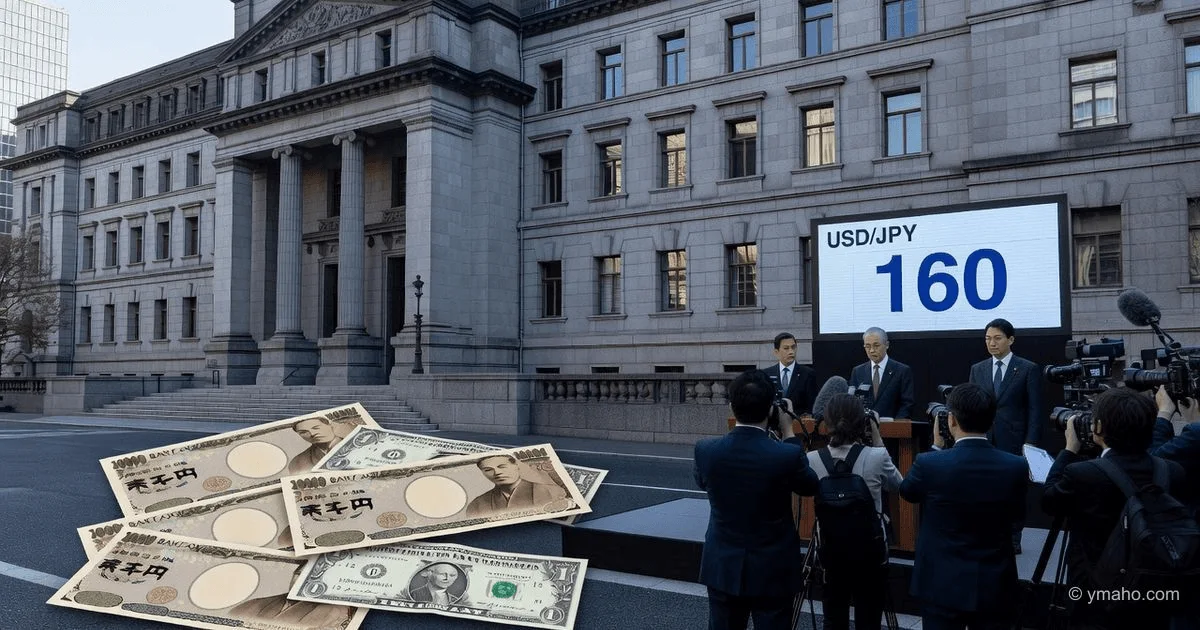
The yen is trading near the psychological level of 160 per dollar, forcing the Bank of Japan to prepare for a rate hike at its June 15-16 meeting. Markets are almost fully pricing in a rate increase to 1% amid a 6.3% rise in the producer price index in May, the fastest pace since March 2023.
Samurai with Two Swords: Why a BOJ Rate Hike Won't Save the Yen
Author's analysis for institutional investors and hedge funds
The Core: What's Really Happening
The official version you see in headlines is almost too simple: producer inflation accelerated to 6.3% in May (the highest since March 2023), the yen collapsed to 160 per dollar, so the Bank of Japan is forced to raise rates to 1% at its June 15-16 meeting. It sounds like a classic monetary response. But anyone who has watched the Japanese government bond (JGB) yield curve over the past three months knows the BOJ is caught in a vise with no elegant way out.
The real essence of what's happening is that the Bank of Japan is fighting a two-front war with no winning scenario. On one hand, it must combat inflation and a falling yen. On the other, it cannot allow a collapse in the JGB market, where the 10-year yield has already reached 2.58% — a level that makes servicing government debt (exceeding 260% of GDP) critically expensive. Raising rates to 1% is an attempt to hit inflation without breaking the bond market. It's like treating cancer with chemotherapy without killing the patient.
Why does this matter? Because the rate hike to 1% itself is a psychological milestone (the highest since 1995), but not an economic solution. Look at the real numbers: even after a hike to 1%, Japan's real interest rate (adjusted for 3.2% inflation) remains negative at minus 2.2%. For comparison, the Fed's real rate is plus 1.3% (4.5% minus 3.2%). A spread of 350 basis points is a chasm the yen cannot escape unless the BOJ starts raising rates more aggressively.
A non-obvious insight missing from Reuters and Bloomberg reports: internal BOJ calculations show the neutral rate (terminal rate) at which monetary policy ceases to be accommodative is in the range of 1.5-2.0%. But the market is already pricing in a terminal rate of around 2.0%. The problem is that if the BOJ actually moves toward 2%, it will crash the JGB market. If it stops at 1.5%, markets will consider it a dovish signal and the yen will fall to 170. The Bank of Japan is doomed to a "goldilocks nightmare" — it needs to hit a perfect point that doesn't exist.
Timeline and Context
The path to today's crisis did not begin in May 2026 with rising producer prices, but much earlier — in December 2025, when the Bank of Japan raised rates to 0.75% for the first time in 30 years. That was a symbolic exit from the era of negative rates. But it was not followed by the aggressive tightening cycle markets expected. The BOJ hesitated — and paid the price.
The next key stage was March-April 2026, when the conflict in the Strait of Hormuz triggered a new surge in energy prices. Japan, which imports virtually 100% of its oil, found itself at the epicenter of a supply shock. May's producer price index data showed a 6.3% rise against a median forecast of 5.5% — a "moment of truth." But the problem is that the BOJ waited for this data instead of acting preemptively.
| Date | Event | Key Indicator | Status / Reaction |
|---|---|---|---|
| December 2025 | BOJ raises rate to 0.75% | 10-year JGB ~2.0% | First hike in 30 years |
| March-April 2026 | Hormuz crisis, oil price surge | Brent $100+ | Supply shock |
| June 10, 2026 | May producer price index release | 6.3% YoY (vs. 5.5% forecast) | Highest since March 2023 |
| June 11, 2026 | Yen reaches 160.5 per dollar | USD/JPY 160.5 | Highest since July 2024 |
| June 15-16, 2026 | BOJ meeting (expected) | Hike to 1.0% (probability ~90%) | 31-year high |
| June 17-18, 2026 | Fed and Bank of England meetings | Pause expected | Risk of policy divergence |
Source: BOJ data, Reuters, CMC Markets
A key detail overlooked even by experienced analysts: Bank of Japan Governor Kazuo Ueda is hospitalized and will not participate in the June 16 meeting. The press conference will be held by Deputy Governor Shinichi Uchida, known for his dovish stance. This changes everything. Uchida is a proponent of gradual tightening. His rhetoric after the meeting could completely negate the effect of the rate hike. Markets are not waiting for the 1% rate (already 90% priced in), but for a signal on future actions. If Uchida says the BOJ will act cautiously and the pause could be lengthy, the yen will collapse to 162-163 within 24 hours.
Who Wins and Who Loses
Biggest winners: Japanese exporters with hedged currency risks. Toyota, Sony, Honda, and Nintendo have lived for decades with a strong yen that ate into their overseas profits. Now, at 160, every billion dollars of US revenue turns into 160 billion yen versus 110 billion a year ago — a 45% increase. Exporters who locked in rates through forward contracts at 120-130 back in 2024 are now reaping super profits. But this won't last forever — their hedges expire within 6-12 months.
Second beneficiary: foreign "turbo-investors" playing the interest rate differential (carry trade). They borrow yen at 0.75-1.0% and invest in dollar assets yielding 4.5-5.0%. A spread of 350-400 basis points is a goldmine. As long as the BOJ does not start raising rates aggressively (to 1.5-2.0%), this trade remains profitable. And the higher USD/JPY goes, the greater their profit. This is a vicious circle: the BOJ raises rates, but too weakly to stop the carry trade, and the yen keeps falling.
Biggest loser: Japan's Ministry of Finance. In July 2024, it spent a record $60 billion on currency interventions to keep the yen from falling to 162. Now the rate is back at 160.5, and the ministry has run out of "ammunition" — its foreign exchange reserves, though huge ($1.3 trillion), are being used massively for interventions, reducing liquidity needed for energy imports. Moreover, in September 2025, the US agreed with Japan on a "framework" for interventions, but this agreement does not imply endless support. Washington could simply refuse coordination if Trump decides a weak yen is good for US exports.
Second loser: Japanese households and small businesses. Import prices for food and energy have risen 25.5% year-on-year. Real wages in Japan have been falling for 24 consecutive months. At the same time, the BOJ is raising rates, making loans for small businesses and mortgages more expensive. Households face a double blow: their purchasing power is falling due to inflation, and the cost of debt servicing is rising due to higher rates.
What the Media Isn't Saying
The most important insight missing from public reports concerns how the Bank of Japan intends to combine rate hikes with bond yield control. According to leaks from Reuters, the BOJ will continue buying JGBs at roughly the current pace in the next fiscal year. This means the BOJ will do two things simultaneously: raise short-term rates and continue printing money to buy long-term bonds. Formally, this does not violate laws — it's called "yield curve control" (YCC) in a new guise. But in essence, it's a schizophrenic policy: you tell the market that money is getting more expensive (rates rising), but at the same time you create artificial demand for long bonds, keeping their yields below market levels.
The second insight concerns the yield curve. A normal curve has short-term rates lower than long-term rates. In Japan, there is an anomaly: 30-year JGBs yield 3.6%, 20-year JGBs yield 3.3%, and the short-term rate is 1.0%. A gap of 260 basis points is one of the steepest among developed economies. This means the market does not believe the BOJ. Investors demand a huge premium for holding long-term Japanese bonds, expecting inflation to remain high and the BOJ to be forced to raise rates more aggressively.
The third insight is political pressure. Prime Minister Sanae Takaichi, who came to power in 2025, has bet on fiscal stimulus. Her government increased spending on defense and social programs, requiring cheap financing. Every 1% rise in 10-year JGB yields increases debt servicing costs by about $10 billion per year. That's why, as yields approached 2.6%, signals came from the government: "slow down the reduction in bond purchases." The BOJ is no longer independent. It is a hostage of fiscal policy.
Forecast: Next 30 Days and 90 Days
Next 30 days (through mid-July): Markets will be disappointed. The rate hike to 1% is already priced in. The key moment is Uchida's press conference on June 16. If he uses dovish rhetoric (which he likely will), the yen will fall to 162-163 within a week. If he hints at further hikes in 2026 (the next meeting is in December, as Nomura forecasts), the yen could retreat to 155-156. My forecast: Uchida will be extremely cautious. He does not want to crash the stock market (the Nikkei 225 is sensitive to a strong yen). So the signal will be dovish, and USD/JPY will break 162 by end of June.
Next 90 days (September 2026): By then, the effects of the June hike will become visible. Producer inflation will likely remain high (5-6% YoY) as energy prices are unlikely to fall amid the ongoing Middle East conflict. The BOJ will face a choice: either accept inflation and a falling yen, or raise rates further — to 1.25-1.5% by December 2026 and to 1.5% by June 2027. The second scenario is more likely, but it will trigger further rises in JGB yields. 10-year bonds could reach 3.0% by autumn, causing a new wave of panic in the debt market. The yen by September will likely be in the 158-165 range, with a risk of breaking to 170 if the Fed raises rates again or signals a longer period of high rates.
Editorial Forecast
Asset: USD/JPY. Direction: up (yen weakening) in the 48-72 hours after the BOJ meeting on June 16. Key levels: a break above resistance at 161.00 opens the path to 162.50 (July 2024 high). Confidence level: medium (65%). Main risk to the forecast: a hawkish surprise from Uchida, pointing to the possibility of a hike to 1.25% by end of 2026; in that case, USD/JPY could fall to 155.00 in one day. We recommend monitoring the tone of the press conference and any mentions of JGB purchase plans — continued aggressive purchases would be a bearish signal for the yen.
— Editorial Team