US Proposes Additional Duties of 10-12.5% on Dozens of Trading Partners
The Trump administration accused 60 countries, including Canada, Mexico, Japan, India, and China, of insufficient action against imports of goods produced using forced labor. In response, the US proposed additional import duties, with public hearings set to begin July 7.
Forced Labor as a Pretext: Why Trump's New Tariffs Are Not a Fight for Rights but a Reconstruction of a Broken Wall
Author's analysis for institutional investors and hedge funds
The Essence: What's Really Happening
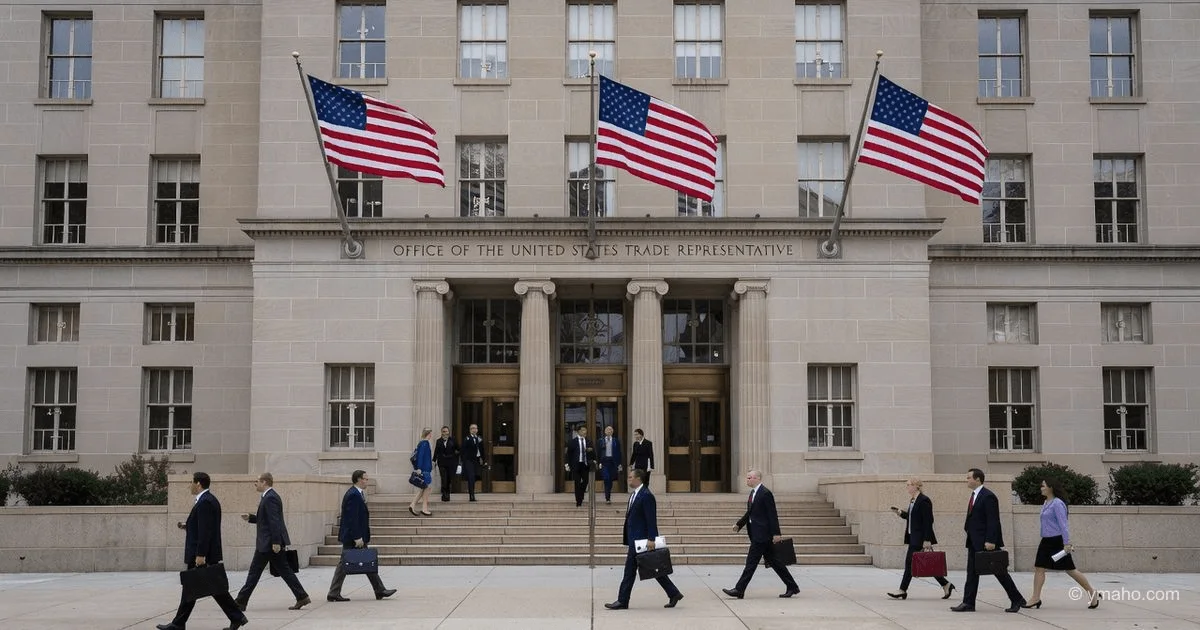
The official narrative looks flawless from a public ethics standpoint: the US is punishing 60 trading partners for failing to combat imports of goods made with forced labor. US Trade Representative Jamieson Greer claims that "American workers are forced to compete on an uneven playing field." It sounds noble until you check the calendar and remember that on July 24, the temporary 10% tax under Section 122 expires—the emergency Plan B after the Supreme Court in February 2026 dismantled the entire IEEPA framework.
The real essence is not a fight against forced labor but a desperate attempt by the White House to patch a hole in the tariff wall that collapsed after the Supreme Court ruling. The Trump administration lost IEEPA—the emergency powers law that allowed global tariffs without congressional oversight. Now it is frantically sifting through remaining legal tools: Section 122 provided a temporary reprieve until July, but no more. Enter Section 301—a 1974 law already used against China in the first trade war and upheld in court challenges. The problem is that no one has ever applied it on such a scale—against 60 countries accounting for 99% of US imports.
Why does this matter? Because the tariff rates—10% and 12.5%—are almost identical to those under IEEPA before the court struck them down. This is no coincidence. It's a copy-paste. The administration is simply looking for a new label for an old product. "Forced labor" is not the reason; it's a legal pretext designed to pass court scrutiny. And while lawyers argue whether an entire country can be penalized for lacking a law on importing forced labor goods, the White House will gain a critical 60-90 days to keep the tariff system afloat.
Timeline and Context
The crisis began on February 28, 2026, when the US Supreme Court issued a ruling that shattered Trump's entire trade architecture. The Court ruled that the president cannot use IEEPA—the International Emergency Economic Powers Act—to impose global tariffs. It was a knockout. Overnight, the legal basis for tariffs on hundreds of billions of dollars vanished.
| Date | Event | Tariff Rate | Legal Basis | Status |
|---|---|---|---|---|
| Apr 2025 – Feb 2026 | IEEPA tariffs ("Liberation Day") | 10–50% | IEEPA | Overturned by Supreme Court |
| Feb–Mar 2026 | Emergency switch to Section 122 | 10% (global) | Section 122 | Temporary (expires July 24) |
| Mar 2026 | Launch of 60 Section 301 investigations | Investigation | Section 301 | Active |
| Jun 2, 2026 | Proposal of forced labor tariffs | 10–12.5% | Section 301 | Proposed, not finalized |
| Jun 22, 2026 | Deadline for hearing requests | — | — | Approaching |
| Jul 6, 2026 | Deadline for written comments | — | — | Approaching |
| Jul 7, 2026 | Public hearings | — | — | Key date |
| Jul 24, 2026 | Section 122 expiration | — | — | Window closes |
Source: USTR and Atlantic Council data
What didn't make it into official briefings: the administration didn't just launch one investigation. There are three, synchronized so that by July 24, the White House has a ready package of new tariffs. First: forced labor (60 countries, rates 10-12.5%). Second: structural excess capacity (16 countries, including China, India, Vietnam; sectors: solar energy, batteries, semiconductors). Third: a separate investigation into Vietnam for intellectual property violations. These are three whips to replace the one lost. And they stack: a Vietnamese importer could face 12.5% (forced labor) + 10-20% (excess capacity) + potential IP sanctions.
Who Wins and Who Loses
Biggest winner: the US Treasury. The Atlantic Council estimates that if the new Section 301 system operates at full capacity, it could generate up to $169 billion annually in additional tariff revenue—even more than the $166 billion under IEEPA. The money comes from US importers, who pass it on to US consumers in prices. But for the budget, it's a massive sum.
Second beneficiary: countries that managed to strike trade deals under IEEPA and landed in the "preferential" 10% category. The UK, Argentina, Bangladesh, Cambodia, El Salvador, Guatemala, Malaysia, and Taiwan received reduced rates because their agreements with the US were recognized as "taking action." The European Union is also in the "preferential" group—10%, not 12.5%. But the EU is in the process of ratifying the Turnberry Agreement, and if tariffs start to stack on existing ones, it could collapse the deal.
Biggest losers: 54 countries without agreements with the US. China, India, Japan, South Korea, Brazil, Vietnam, Australia, Turkey, and dozens of others will get 12.5%. But the real trouble is for those caught in multiple investigations. Vietnam is the absolute record holder: three parallel Section 301 investigations, including a separate one for intellectual property. Brazil got 25% from a separate investigation plus 12.5% for forced labor—total 37.5%. China is the most interesting case: formally it gets 12.5%, but combined with existing Section 301 tariffs from 2018 (25% on thousands of goods) and Section 232 tariffs (steel 25%), the effective rate on certain items could reach 50-60%.
What the Media Isn't Saying
The most important insight missing from Reuters or Bloomberg concerns the legal vulnerability of the entire structure. Section 301 requires proving that foreign government actions are "unreasonable" and "burden" US trade. But USTR admits in its own report: "The European Union has adopted a ban on imports of goods made with forced labor, but the ban only takes effect on December 14, 2027." So the EU is doing exactly what the US asks—passing a law. But it's not yet in force. And USTR says: "Not enough." If a court finds that demanding "immediate entry into force" of a foreign law exceeds US authority, the whole structure collapses.
Second insight: China and Xinjiang. USTR specifically identified 34 product categories linked to forced labor, including Xinjiang cotton, polysilicon for solar panels, and rare earth metals. Yet the list of countries subject to tariffs omits Afghanistan, Belarus, Myanmar, and Mauritania—countries where the US State Department officially documents slavery and human trafficking. Trade expert Edward Alden of the Council on Foreign Relations called this "a cynical attempt" and "just a pretext." Cornell University professor Eswar Prasad adds that the administration is "opportunistically exploiting any rational argument that works legally."
Third insight: exclusions. The list of excluded goods (Annex A) spans 76 pages and includes crude oil, beef, coffee, fruits, vegetables, pharmaceuticals, aircraft parts, and all goods already subject to Section 232 tariffs (steel, aluminum, copper, automobiles). This is no accident. It protects US oil refiners (oil from Canada and Mexico), aircraft manufacturers (Boeing needs parts), pharmaceutical companies (drugs must not get more expensive), and the auto lobby (Detroit can't take another hit). The administration strikes those who can't retaliate and spares those who fund campaigns.
Forecast: Next 30 Days and 90 Days
Next 30 days (through mid-July): Markets are in wait-and-see mode. The deadline for written comments is July 6, public hearings begin July 7. Until then, major importers will hedge currency risks and build up US warehouse inventories to beat potential tariff imposition. The US dollar will continue to strengthen—it's the main beneficiary of any tariff war. By July 15, we'll see the first "leaks" about which countries are preparing retaliatory measures. The EU has already called the tariffs "unjustified," and China speaks of a "tectonic example of protectionism." If Brussels announces counter-tariffs on US textiles, agricultural products, and automobiles, markets will begin pricing in a full-scale trade war 2.0.
Next 90 days (September 2026): The key moment is the fate of Section 122, which expires July 24. If by that day the new Section 301 tariffs are not finalized and in effect, the US will have no legal mechanism for global tariffs. Congress could extend Section 122, but in an election year, that's unlikely—Democrats will demand concessions on other issues. The most likely scenario: by mid-July, USTR will announce "temporary implementation" of Section 301 tariffs with a 30-60 day delayed effective date. This gives the administration negotiating room. By September, we'll see a series of bilateral agreements: countries that agree to "voluntary export restraints" or purchases of US goods will get tariff exemptions. China will remain the primary target—its 12.5% rate will become 25% after the excess capacity investigation concludes.
Editorial Forecast
Asset: US Dollar Index (DXY). Direction: Up in the next 48-72 hours amid escalating trade rhetoric. Key levels: a breakout above resistance at 105.50 opens the path to 106.20. Confidence level: Medium (65%). The main risk to the forecast is an unexpected decision by the European Union or China to impose immediate counter-tariffs, triggering a flight from the dollar into safe-haven assets (gold, Swiss franc). We recommend monitoring official USTR statements on June 22—the deadline for hearing requests—and market reactions to possible announcements of sector-specific exemptions.
— Editorial Team