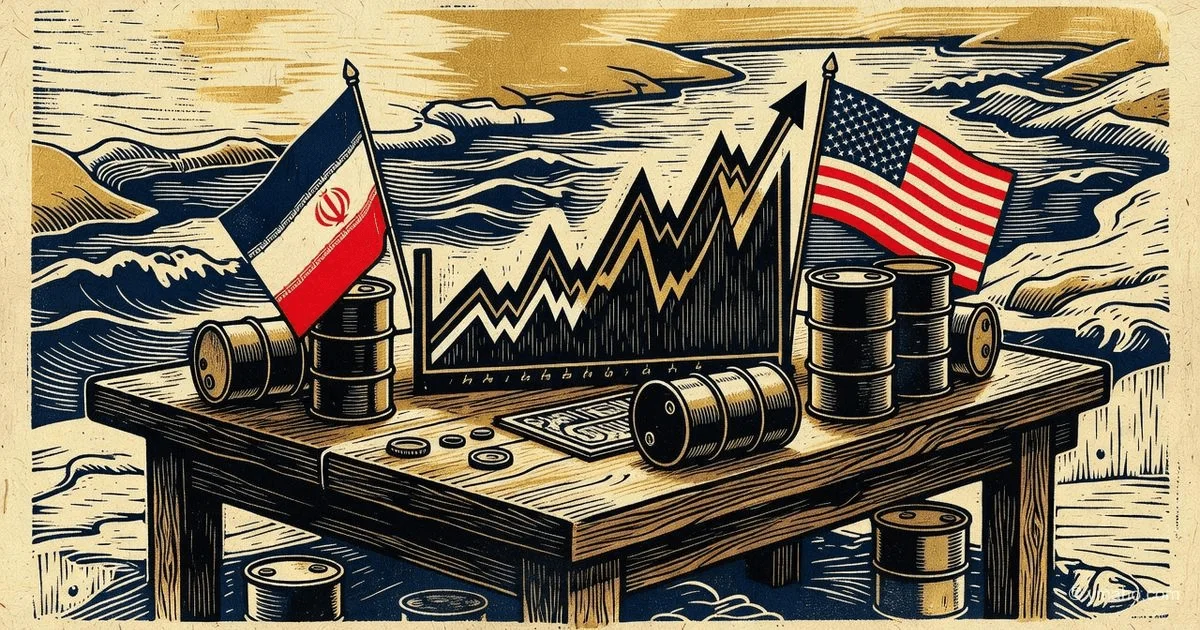
US Stock Index Futures Rise on Hopes for Peace Talks with Iran
US stock indices are showing positive momentum amid reports of progress in peace negotiations between the US and Iran. Investors hope for a swift lifting of restrictions on energy supplies through the Strait of Hormuz, which could ease inflationary pressures and allow the Fed to avoid raising rates.
The Mirage of Peace in Hormuz: Why the Market Is Celebrating Too Early and What It Means for Investors
Author: Independent Financial Analyst
Futures on the S&P 500 and Nasdaq rose 1.5-2% after President Trump announced a "fantastic agreement" with Iran, to be signed next week in Europe. Vice President J.D. Vance will represent the US at the signing ceremony. The Strait of Hormuz, through which 20% of the world's oil passes, will be opened "immediately after the agreement." Oil plunged: WTI fell 3% to $84.80, Brent to $87.40.
The market is celebrating de-escalation. But those sitting in trading rooms who remember the last 72 hours know: we have already gone through this cycle of "negotiations — escalation — negotiations" three times since February 2026. And each time it ended with missile strikes and new rounds of conflict.
I will break down why the current talks may come to nothing, what JPMorgan and Brookings say about the real risks for oil and inflation, and provide insight into which assets will actually benefit from a "peace that isn't."
[The Gist]: What Is Really Happening
The market's joy is understandable. The Strait of Hormuz has been effectively paralyzed since late February 2026: visible tanker traffic is only 15% of pre-war levels. Over three and a half months of conflict, cumulative supply losses of crude oil and condensate from the Middle East have reached 496 million barrels. Iran struck US bases in Bahrain, Jordan, and Kuwait; the US retaliated with strikes on Iranian targets. The US economy felt it: May CPI rose to 4.2% year-on-year — the highest since April 2023 — largely due to a 23.5% surge in energy prices over the year.
But there are three reasons why this "peace" may be an illusion.
First. Trump's peace announcement was made on June 11. Just hours later, Iran shot down a US Apache helicopter patrolling near Hormuz. Trump promised a "strong response," and the US conducted targeted strikes on Iran. Iran retaliated by striking US bases. This is not the behavior of parties preparing to sign a peace treaty.
Second. The negotiation process was derailed by Iran on June 1, when Tehran announced a halt to talks due to alleged violations of a continuing cease-fire. Just recently, on June 9-10, new reports of progress emerged. But an agreement is one thing; implementation is another. The Brookings Institution warns: if the strait does not reopen by the end of June, Brent could reach $120 per barrel. JPMorgan is even more pessimistic: if the current blockade persists, Brent could soar to $120-130, and with a full closure, to $150.
Third and most important insight. What Trump calls a "peace agreement" is actually just a temporary truce, postponing the nuclear issue for later. According to sources familiar with the talks, the agreement involves a temporary relaxation of Iran's control over the Strait of Hormuz and the lifting of the US blockade on Iranian ports. But discussion of Iran's nuclear program has been deferred. This means the fundamental causes of the conflict remain. As soon as oil flows — or if Israel strikes Hezbollah (which could happen at any moment), Iran will threaten to resume hostilities. Peace is as fragile as glass.
Timeline and Context
What we are seeing now is already the fourth episode in 2026 where negotiations give way to escalation, and escalation to negotiations.
| Date | Event | Oil Price (Brent) | Stock Market Reaction |
|---|---|---|---|
| Late February 2026 | War begins; Hormuz closed | $75 → $95 in days | S&P 500 falls 3-4% |
| April 2026 | JPMorgan warns of $15-20 upside if opening delayed to July | $90-95 | Market consolidates |
| June 1, 2026 | Iran halts talks; threatens full closure of Hormuz | $87 → $97 in a day (Brent) | Futures fall 1.5-2% |
| June 1-9, 2026 | Prices fall on hopes for talks | $97 → $90 (Brent) | Stock indices recover |
| June 9-10, 2026 | Trump announces "imminent agreement"; then helicopter shot down, retaliatory strikes | $90 → $94 (bounce) | Volatility; S&P 500 loses 1.1% in a day |
| June 11, 2026 | Trump again speaks of peace next week; oil falls 3% | $94 → $87.40 (Brent) | Futures rise 1.5-2% |
JPMorgan's inventory figures explain why the market is so sensitive to every headline. OECD inventories are under pressure. If the strait does not reopen in the coming weeks, hidden flows (about 2 million barrels per day) and inventories that have sustained the market for the last three months will begin to dwindle. Goldman Sachs has already removed all forecasts for a Fed rate cut in 2026, moving the first cut to June 2027. Fed Governor Lisa Cook stated she is ready to raise rates if inflation data warrants it.
Who Wins and Who Loses
Winners (if peace materializes):
Airlines and transportation companies. American Airlines, Delta, United, FedEx, UPS — their fuel costs account for 20-30% of operating expenses. Every $10 drop in oil price adds $1-2 billion in annual profit for the largest US airlines.
Retail chains and consumer companies. Walmart, Target, Costco — lower gasoline prices mean more disposable income for consumers and lower transportation costs. Analysts expect that a drop in oil to $80-85 could add 0.3-0.5% to retail sales growth in Q3.
Energy importers in Europe and Asia. Germany, Japan, South Korea — countries that import nearly 100% of their oil. Reopening Hormuz could reduce their trade deficit by $5-10 billion per quarter.
Short-term traders who bought call options on the S&P 500 on peace news. Volatility in recent days has created opportunities for speculative profits of 10-15% on intraday moves.
Losers (always, regardless of outcome):
Energy companies (oil majors). Exxon Mobil, Chevron, Shell — their profits are directly tied to oil prices. At $87 Brent, their quarterly profit will be 20-25% lower than at $120 Brent. Energy sector stocks (XLE) fell 3-4% on news of possible peace alone.
Alternative energy producers. SolarEdge, Enphase Energy, First Solar — expensive oil accelerates the transition to green energy. Cheap oil makes their products less competitive. These stocks often have an inverse correlation with oil prices.
Investors who bought oil futures at the panic peak on June 9-10. Those who entered Brent at $94-95 are seeing a 7-8% loss in 48 hours. Stop-losses at $90 were triggered en masse, amplifying the decline.
Russia, Iran, Venezuela. For them, high oil is a source of foreign currency revenue and budget income. Peace that lowers prices is a blow to their economies, which are already under sanctions.
What the Media Isn't Saying
Insight you won't find in headlines about peace in Hormuz:
Even if Hormuz opens tomorrow, oil prices will not return to pre-war levels of $70-75. Here's why: over three months of war, the global oil infrastructure has been reconfigured.
Insurance for tankers transiting Hormuz has increased 5-7 times. Even after the strait reopens, insurance premiums will remain elevated for 2-3 years until the market is convinced of stability. Every barrel of oil passing through Hormuz will carry a "risk premium" of $5-10.
Alternative routes (Saudi Arabia's East-West pipeline, clandestine flows through Yemen and Oman) are operating at capacity. Expanding them would require $10-20 billion in investment and 2-3 years. Even if the strait reopens, these routes won't disappear — they will remain as backups, but their maintenance will add $3-5 to the cost per barrel.
And most importantly: the agreement does not resolve Iran's nuclear issue. It is merely a truce. The next crisis could erupt at any moment — when Israel strikes Hezbollah, when Iran accuses the US of violating the truce, when US elections occur. The market pricing in lasting peace is mistaken.
As for the stock market: the rally on peace hopes may continue for another 2-3 days. But once investors realize that fundamental problems (inflation, Fed rates, national debt) haven't gone away, a correction will return. Allianz Research, in its "upside" scenario (10% probability), assumes that even with successful diplomacy, oil will remain at $75-80, not $60.
Forecast: Next 30 Days and 90 Days
Next 30 days (through mid-July 2026):
The key date is the anticipated signing of the agreement in Europe next week. I estimate the probability that the agreement will actually be signed at 60-65%. However, even if signatures are affixed, implementation will take time. Trump said the strait would open "immediately," but "immediately" in geopolitics means 7-14 days.
Even if signed, oil prices will not fall below $80 on Brent. First, restoring confidence among insurers and traders will take weeks. Second, OECD inventories are at minimal levels, and replenishing them will take time.
If the agreement collapses (e.g., due to another incident in the strait), Brent could return to $95-100 within days, and the S&P 500 could correct 2-3%.
Next 90 days (through mid-September 2026):
A sustainable peace scenario (20-25% probability) would lead to oil in the $75-85 range, US inflation of 3.5-3.8%, and a Fed rate of 3.75% with no hike through year-end. The S&P 500 could rise another 3-5% from current levels.
The base case (55-60% probability) is a resumption of conflict by August-September. This would return oil to $100-120, inflation to 4.5-5.0%, and the Fed to the risk of a rate hike in November. The S&P 500 would fall 5-8% from June highs.
JPMorgan warns: the most dangerous scenario is not a full closure of the strait, but a partial, "nervous" functioning where tankers move but insurance is expensive and risks are high. In this scenario, oil could get stuck in the $90-110 range for many months, creating persistent inflationary pressure.
What this means for assets:
- Oil (Brent, WTI): range $80-110 over the next 3 months. High volatility; every headline will move prices 3-5%.
- S&P 500: any rally on peace news should be sold. The stock market is not pricing in enough escalation risk. I expect the S&P 500 to be 2-4% lower by September.
- Bonds (10-year Treasuries): if peace holds and inflation slows, yields could fall to 4.2-4.3%. But if conflict resumes, yields will return to 4.6-4.8%.
- Gold: peace is bad for gold (no need for safe haven), escalation is good. If talks collapse, XAU/USD could quickly return to $2300-2350.
Editorial Forecast
Asset: Brent crude Direction: sideways with a slight downward bias over the next 24-72 hours (awaiting agreement signing), then high volatility depending on news Key levels: current ~$87.40; resistance $90 (psychological level), support $84 (June 11 low). If agreement signed, possible test of $80-82; if derailed, return to $94-96 Confidence level: low (geopolitics unpredictable) Main risk: another military incident in Hormuz before the agreement is signed. Iran shot down a US helicopter on June 9; the US responded with strikes on June 10. If another such event occurs in the next 72 hours, talks could collapse, and Brent could surge to $95-100 within hours, destroying all positions opened on peace hopes. Probability of this scenario in the next 72 hours: 25-30%, higher than the usual geopolitical backdrop.
The editorial opinion is not an investment recommendation. All decisions to buy or sell assets are made at your own risk.
— Editorial Team