Eurozone GDP Contracts 0.2% in Q1 2026 Amid Stagflation
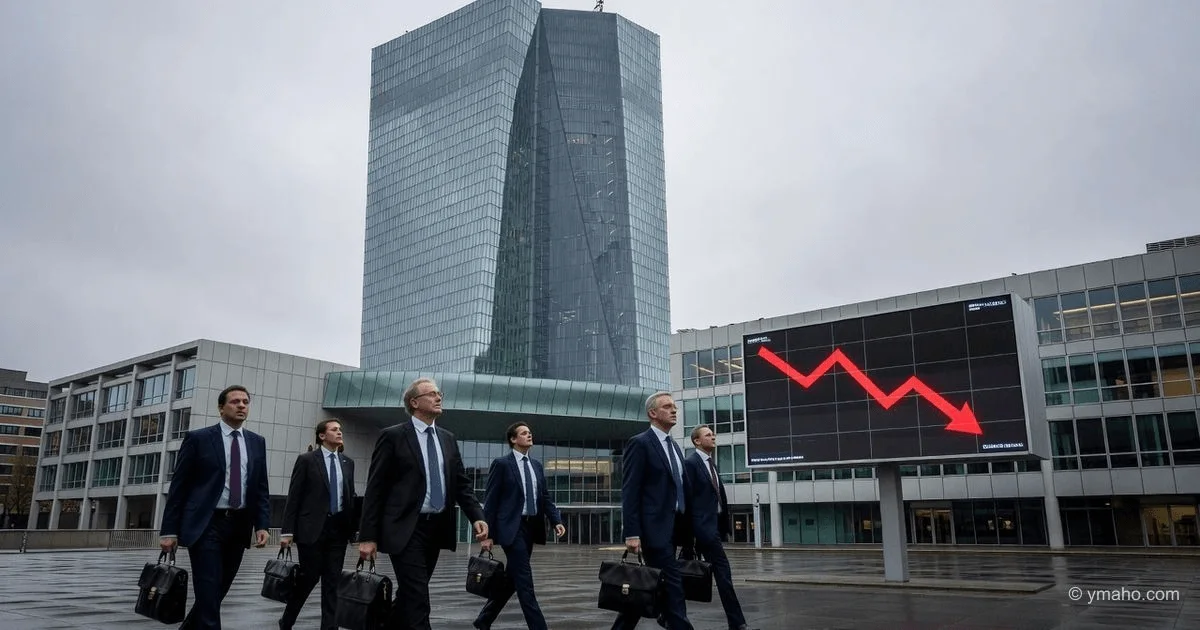
The eurozone economy unexpectedly shrank in the first quarter, while inflation rose to 3.2%, prompting economists to warn of a period of stagflation. The ECB significantly downgraded its 2026 GDP growth forecast to 0.9%, citing the negative impact of high energy prices.
European Stagflation: Why the 0.2% GDP Decline Is Just the Beginning, and the ECB Has Painted Itself into a Corner
Author's analysis for institutional investors and hedge funds
The Core: What's Really Happening
The official version you see in headlines is succinct: the eurozone economy unexpectedly contracted by 0.2% in the first quarter of 2026, inflation accelerated to 3.2%, and the ECB downgraded its 2026 growth forecast to 0.9%. It sounds like a classic stagflation picture—bad but predictable. However, behind these figures lies a much more alarming reality that markets are only beginning to grasp.
The real essence of what's happening is that Europe is facing a perfect storm: the energy shock from the Middle East conflict has compounded structural problems that have gone unaddressed for decades. Energy prices rose 10.9% year-on-year in May, becoming the main driver of inflation. But the problem isn't the rise itself—Europe has weathered worse. The problem is that the eurozone economy was unprepared for a shock of this magnitude precisely now, when its buffer had been exhausted.
Why does this matter? Because the 0.2% GDP decline in Q1 is just a warning. Eurostat revised its preliminary estimate from +0.1% to -0.2%. What changed? Ireland. Its GDP plunged 12.1% quarter-on-quarter instead of the expected 2%. Ireland is not just a small country. It is home to the headquarters of Google, Apple, Meta, and pharmaceutical giants. A 12% drop in its GDP is not a local glitch; it is a systemic signal that corporate Europe has begun scaling back operations or shifting profits to other jurisdictions.
A non-obvious insight not found in official releases: the Irish GDP collapse is no coincidence. It coincided with the US announcement of new tariffs of 10-12.5% on dozens of trading partners, including Ireland as part of the European Union. American multinational corporations using Ireland as a tax bridge to Europe began repatriating profits to the US before the tariffs took effect. The revision of Irish GDP to -12.1% is not a statistical error. It is the first warning shot of a tax and trade war between the US and Europe.
Timeline and Context
The European economy's turn toward recession did not begin in Q1 2026, but on February 28, when the US and Israel struck Iran, triggering a sharp spike in energy prices. By March, it was clear that Europe, which imports most of its energy resources, would suffer the most. But the ECB and the European Commission continued to paint optimistic forecasts, hoping for a quick resolution of the conflict.
The key date is May 20, 2026, when the European Commission published its fresh forecast, acknowledging that Europe was sliding into stagflation. The 2026 GDP growth forecast was cut from 1.3% to 0.9%. The inflation forecast jumped from 1.9% to 3%. That was the moment of truth—Brussels stopped pretending everything was fine.
| Indicator | Q4 2025 | Q1 2026 | Change |
|---|---|---|---|
| Eurozone GDP (q/q) | +0.2% | -0.2% | -0.4 pp |
| Eurozone GDP (y/y) | +1.2% | +0.3% | -0.9 pp |
| Inflation (April) | — | 3.0% | — |
| Inflation (May) | — | 3.2% | +0.2 pp month-on-month |
| Energy prices (May y/y) | — | +10.9% | — |
Source:
The next important milestone was June 2, when May inflation data was released. The consensus forecast was 3.1%, but the actual figure came in at 3.2%. Core inflation (excluding energy and food) rose to 2.5% from 2.2% in April. This means inflationary pressure has begun spreading beyond the energy sector. Services, where price growth reached 3.5%, became the main red flag for the ECB.
Who Wins and Who Loses
The biggest loser is Germany. Europe's largest economy, traditionally the growth locomotive, is teetering on the brink of recession. The 2026 growth forecast for Germany was halved to 0.6%. Industrial production is falling, exports to China are declining, and energy prices are hitting the chemical and metallurgical industries that form the backbone of German exports. Deutsche Bank, one of Europe's systemically important banks, has already begun cutting credit lines for medium-sized businesses in energy-intensive sectors.
The second loser is France. France's GDP contracted by 0.1% in Q1. This is a small decline, but it was the first since 2024. The French economy, less dependent on industrial exports than Germany, still felt the blow through tourism and services. Services inflation in France accelerated to 3.5%, which is particularly painful for low-income households. Political instability in Paris only exacerbates the situation—the government cannot push through necessary reforms.
The biggest winner is the US. Every crisis in Europe strengthens the dollar and drives capital into US assets. While the European economy stagnates and the ECB raises rates, American investors are pulling capital out of Europe and investing in US Treasury bonds yielding around 4.5%. The EUR/USD exchange rate is expected to test the 1.15-1.13 level in the coming months. The Trump administration, which announced new tariffs, is only accelerating this process.
The second winner is China. Although the Chinese economy also suffers from declining European demand, Beijing is using the situation to expand its influence. Chinese companies are buying European assets at discounted prices—from ports in Greece to car manufacturers in Germany. Moreover, the EU, weakened by stagflation, is less able to resist Chinese imports, reducing the effectiveness of any potential trade barriers.
What the Media Isn't Saying
The most important insight missing from most reports concerns the real reason for the ECB's forecast revision. Officially, the ECB downgraded its 2026 GDP growth forecast from 0.9% to 0.8%. But this adjustment does not account for the full scale of the energy shock. In its internal calculations, the ECB is considering a scenario where Brent remains above $100 per barrel through year-end. In that case, eurozone GDP growth could be 0.3-0.5%, and inflation could approach 4%.
The second insight concerns divisions within the ECB. ECB President Christine Lagarde directly told eurozone finance ministers: if countries start subsidizing energy prices for households too generously (through fuel tax cuts), the ECB will respond with higher rates. This public warning conceals a deep conflict. Italy, Greece, and other southern countries demand that energy support spending be excluded from EU budget deficit calculations. Germany and the Netherlands are opposed. Lagarde essentially said, "If you break fiscal discipline, I will raise rates to a level that will break your economy."
The third insight is the time lag. The effect of the ECB's rate hike on June 11 to 2.25% will only be felt in the economy after 12-18 months. That means the decision to fight inflation through monetary tightening will hit the economy just when the energy shock may have subsided (if the conflict is resolved). This is a classic central bank error—fighting a supply shock by suppressing demand. The result: inflation will remain high (because energy prices are determined on global markets), and the economy will enter a recession.
Forecast: Next 30 Days and 90 Days
Next 30 days (through mid-July): We will see a continuation of negative dynamics. Q2 GDP data will be published on July 30. Another contraction of 0.1-0.2% q/q is expected—a formal recession (two consecutive quarters) will become reality. June inflation will likely remain in the 3.0-3.2% range, as energy prices show no signs of easing. The EUR/USD exchange rate could fall below 1.16. Markets will closely watch for signals from the ECB on further rate hikes—the market is already pricing in one or two hikes in the fall.
Next 90 days (September 2026): The key factor is the duration of the Middle East conflict. If the Strait of Hormuz is opened (as part of a potential US-Iran deal) and oil falls to $80-85 per barrel, Europe will have a chance to recover in the second half of 2027. If the conflict drags on and oil remains above $100, Europe faces prolonged stagflation. In this scenario, the ECB will be forced to choose between fighting inflation (high rates, deepening recession) and supporting growth (rate cuts, fueling inflation). Both options are bad. In the long term, the IMF forecasts inflation above 2% until 2028.
Editorial Forecast
Asset: EUR/USD pair. Direction: moderate decline over the next 48-72 hours as the stagflation narrative solidifies. Key levels: test support at 1.1580 with potential to fall to 1.1550. Confidence level: medium (65%). The main risk to the forecast is a sudden de-escalation of the Middle East conflict and a drop in oil prices, which could push EUR/USD back to 1.17-1.18. We recommend monitoring the release of June PMI indices (June 23) and any signals of progress in US-Iran negotiations on reopening the Strait of Hormuz.
— Editorial Team