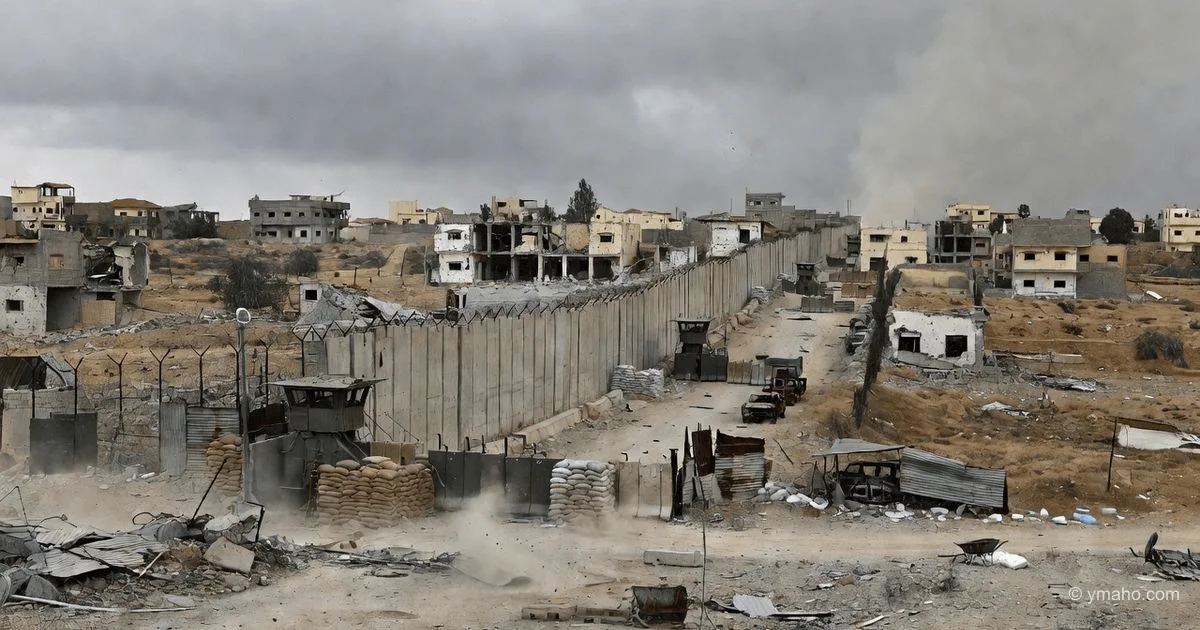
Hamas in Gaza Faces Most Intense Israeli Shelling Since Ceasefire
In May, Israeli forces carried out more than 40 strikes on Hamas and allied groups, roughly 40% more than in April, killing five senior field commanders. At the same time, Israel expanded its control zone in the Strip to about 60% of the territory, putting pressure on the civilian population.
Quiet Annexation: Why Israel's Expansion of Control to 70% of Gaza Is Not a Military Necessity but a Rule Change
Author's analysis for institutional investors and hedge funds
The Bottom Line: What's Really Happening
The official narrative you see in global media revolves around numbers: Israeli forces carried out over 40 strikes on Hamas in May, 40% more than in April, five field commanders eliminated, the control zone expanded to roughly 60% of the Strip. It sounds like an escalation within a protracted conflict. But numbers are deceptive. The reality is far more alarming for the region's long-term stability and far more interesting for those who understand the logic of "created facts."
On May 28, Israeli Prime Minister Benjamin Netanyahu publicly stated at a conference in the Jordan Valley: "Currently, we control 60% of the Gaza Strip. It used to be 50%, now it's 60%. My goal is to reach 70%." And this statement was made not at a closed military briefing but at a public event where participants chanted "we must occupy 100%." Netanyahu's reaction? "We are acting in an orderly manner" — he did not deny that 100% could be the ultimate goal.
Why does this matter? Because the ceasefire agreement signed in October 2025 under US mediation clearly defined a "yellow line" that Israeli forces were not supposed to cross. The truce stipulated that Israel would control about 53% of the territory. In April, the IDF already released maps for international humanitarian organizations showing the control zone at 64%. Now Netanyahu talks about 70%. This is not a military necessity — it is a systematic, phased unilateral rewriting of the ceasefire terms.
Non-obvious insight: Israeli Defense Minister Israel Katz stated on May 27 that the government's ultimate goal is the "voluntary migration" of Palestinians from Gaza. Public activists called this a "long-term ethnic cleansing plan aimed at creating unbearable living conditions in Gaza." When a defense minister speaks openly about depopulating a territory, and the prime minister simultaneously announces the expansion of military control, it is no coincidence. It is a coordinated policy whose goal is to permanently change the demographic and territorial landscape of Gaza.
Timeline and Context
The starting point of today's crisis is October 2025, when a ceasefire agreement between Israel and Hamas was brokered by the US. The terms were clear: Israeli forces would withdraw to the "yellow line," leaving about 53% of the Strip under their control. The rest of Gaza was supposed to remain an area where the Palestinian population could live without constant military threat. The truce also provided for a second phase — further withdrawal of Israeli troops.
But from April 2026, an undeclared rule change began. According to Reuters, Israel started using "Hamas's tightening control" as a pretext to resume military operations. The "yellow line" began turning into an "orange line" — a new control line pushing further west, deeper into territory that, under the agreement, should have remained under Hamas.
| Indicator | October 2025 (ceasefire) | April 2026 | May 2026 | Target (Netanyahu) |
|---|---|---|---|---|
| Territory under Israeli control | ~53% | ~64% | ~60% (official) | 70% |
| Number of strikes on Hamas (May vs April) | — | — | +40% | — |
| Field commanders eliminated (May) | — | — | 5 (including Baha Baroud and Izz ad-Din al-Haddad) | — |
| Palestinian deaths since ceasefire | — | — | 870-929 | — |
| Remaining territory for 2 million Palestinians | ~47% | ~36% | ~40% | ~30% |
Source: IDF data, Anadolu Ajansı, CGTN, RNZ
Key date most analysts overlook: May 15, 2026. On that day, Israeli forces carried out an airstrike on a target in Gaza, which, according to preliminary data, eliminated Izz ad-Din al-Haddad — head of Hamas's military wing and one of the last surviving senior commanders of the movement. It was after this strike that Netanyahu first publicly announced control over 60% of the territory. The strategy is clear: maximum weakening of Hamas's military structure synchronized with maximum expansion of territorial control.
Who Wins and Who Loses
The main short-term winner is Netanyahu's government. Politically, the prime minister, whose coalition is teetering on the brink of collapse, gains a powerful trump card: he can present voters with "concrete results" — territorial gains and elimination of Hamas commanders. In the long term, however, this is a Pyrrhic victory: expanding control without a clear plan for managing the territory and amid international condemnation is a recipe for endless guerrilla warfare.
The second beneficiary is Hamas, paradoxically. Every new strike, every expanded control, every civilian casualty fuels the radicalization of Palestinian society and weakens moderate forces that might compromise with Israel. Hamas has already stated that the ceasefire is "on the verge of collapse" and called on mediators to take a tougher stance. The more Israel publicly and demonstratively violates the ceasefire terms, the more legitimacy Hamas gains in Palestinian eyes as the only force "resisting" the occupation.
The biggest loser is the civilian Palestinian population. According to the Gaza Center for Human Rights, 2 million Palestinians are now effectively squeezed into an area that constitutes less than 10% of Gaza's total area, excluding zones uninhabitable due to destruction, rubble, and military restrictions. This is not a metaphor — it is numbers. Humanitarian organizations are sounding the alarm: on May 29, the Gaza Center warned that Israel's policy constitutes "collective forced displacement," a war crime under the Geneva Convention.
The second loser is the Trump administration. The October 2025 ceasefire agreement is a flagship foreign policy project of the US president. He personally presented it as a "20-point peace plan" that was supposed to bring stability to Gaza. Now this plan is being publicly and demonstratively violated by a US ally. Every Netanyahu statement about expanding control to 70% is a public slap in the face to Trump. If the White House does not react, its credibility as a mediator collapses. If it reacts harshly, it will trigger a crisis in US-Israel relations.
What the Media Leaves Out
The most important insight missing from most reports concerns the precise geography of the new control. Israel is not just "expanding a security zone" — it is deliberately cutting off Palestinian communities from each other. The new "orange line" runs in such a way that it fragments the remaining Palestinian territory into isolated enclaves with no connection between them. The goal is to make any form of Palestinian governance impossible, even at the local level. This is not "territorial control" in the classical sense — it is creating an open-air prison where each sector is isolated from the other.
The second insight concerns Israel's position in the West Bank. While all attention is on Gaza, an equally alarming escalation is occurring in the West Bank. Israeli settlers, with army support, are attacking Palestinian villages — on May 30, reports emerged of an attack on Khirbet al-Marajim, where homes and cars were burned. In Tulkarm and its refugee camps, the Israeli operation has been ongoing for 40 consecutive days. This is synchronized pressure on two fronts — the West Bank and Gaza — with one goal: to make a Palestinian state impossible by fragmenting Palestinian territory into disconnected pieces.
The third insight is the casualty figures that don't make headlines. According to the Gaza Ministry of Health, since the ceasefire took effect in October 2025, Israeli strikes have killed 929 Palestinians and wounded 2,811. The total death toll since the conflict began in October 2023 has exceeded 72,000. For comparison, that is more than the population of a city like Dordrecht (Netherlands) or Green Bay (Wisconsin). These numbers are not just "conflict statistics" — they represent a systematic depopulation of the territory under the cover of "combat operations against Hamas."
Forecast: Next 30 Days and 90 Days
Next 30 days (until mid-July): We will see a reaction from the international community, but it will be symbolic. The European Union will issue a statement of "concern." The UN will convene an emergency session. None of this will stop Netanyahu. The only real deterrent could be the US position, but Trump is in a difficult spot: the midterm elections in November 2026 mean he cannot afford to quarrel with the pro-Israel lobby. Expect that by the end of June, Israeli forces will effectively reach the 70% control target. Hamas, in turn, may attempt a symbolic strike (rocket fire or a tunnel attack) to show it is still alive. This will provoke a new round of retaliatory strikes.
Next 90 days (September 2026): By then, it will become clear whether the "70%" policy is the final goal or just an intermediate step toward 100%, as demanded by Netanyahu's audience at the conference. If international pressure does not intensify (and all signs point to the contrary — the world is preoccupied with the war in Europe and the crisis in the Strait of Hormuz), Israel will continue its westward push. By autumn, the remaining Palestinian territory could shrink to 20-25% of Gaza's original area, making life for 2 million people in that space physically impossible. This will mean either a mass exodus (which Israel will call "voluntary migration") or a humanitarian catastrophe of unprecedented scale. Brent crude oil prices in this scenario could spike to $120 per barrel, as escalation in Gaza will inevitably affect the situation in Lebanon and, through Hezbollah, the Iranian factor.
Editorial Forecast
Asset: Brent crude oil (August futures). Direction: moderate growth over the next 48-72 hours amid escalation in Gaza and the risk of the conflict spreading to other fronts. Key levels: test of resistance at $83.50 with potential breakout to $85.00. Confidence level: medium (60%). The main risk to the forecast is unexpected US diplomatic intervention that temporarily reduces tensions and brings Brent back to $80-82. We recommend monitoring statements from the US special envoy for the Middle East and any signs that the Trump administration is ready to apply real pressure on Israel, rather than just public rhetoric.
— Editorial Team