U.S. Treasury to Impose Sanctions on Iran's Shadow Fleet After Talks Collapse
The U.S. administration is preparing a new sanctions package targeting dozens of vessels and intermediary companies that help Iran export oil in circumvention of existing restrictions. The measures are expected to be announced on Monday if diplomatic efforts to revive nuclear deal talks reach a final deadlock.
Ghost Hunting: Why Sanctions on Iran's Shadow Fleet Are an Admission of Washington's Defeat
Author's analysis for institutional investors and hedge funds
The Essence: What's Really Happening
The official narrative from the U.S. Treasury is straightforward: a new sanctions package is being prepared against dozens of vessels and intermediary companies of Iran's shadow fleet. The measures will be announced on Monday if nuclear deal talks reach a final deadlock. It sounds like another round of "maximum pressure." But the reality is far more cynical: these sanctions are not a weapon, but a crutch for the lame. Washington is striking at the shadow fleet precisely because it cannot stop it by military force.
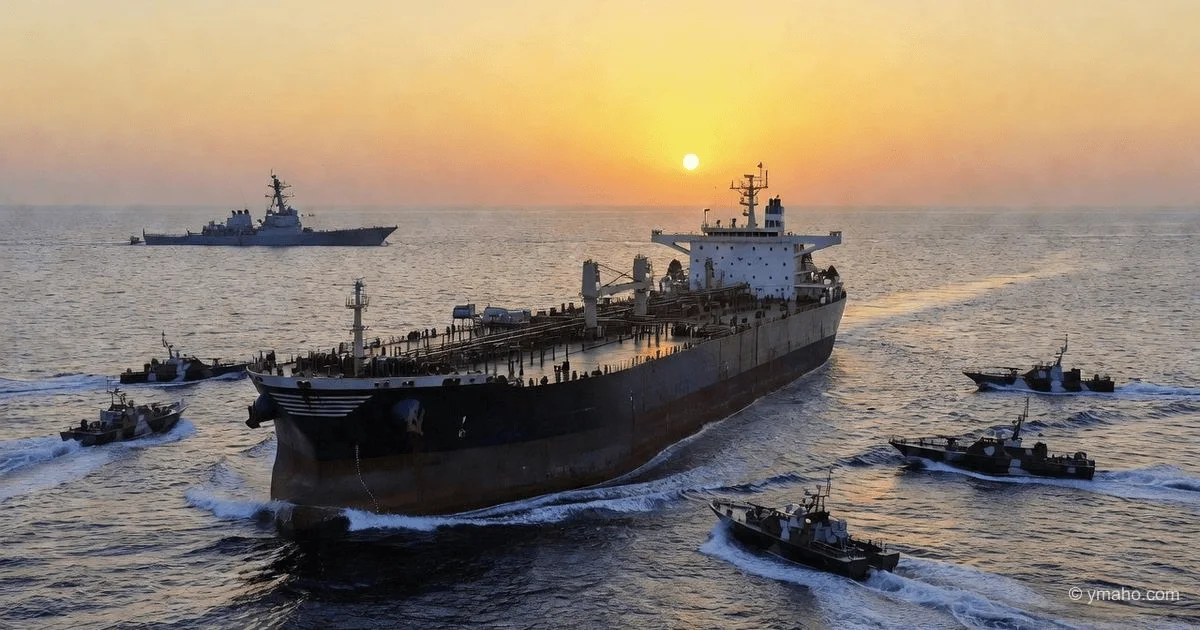
Look at the numbers CENTCOM publishes as achievements. Since April 13, U.S. military forces have diverted 139 commercial vessels linked to Iran and disabled nine "non-compliant" vessels. Nine vessels in two months. The operation involves over 20 warships, two aircraft carriers, three large amphibious ships, and 100 aircraft. And the result is nine disabled tankers. This is not a blockade. It's a theater of military operations with symbolic losses for the enemy.
Why is that? Because Iran's shadow fleet numbers over 500 vessels. They don't sail under the U.S. flag, don't use the dollar for transactions, and don't insure with Lloyd's. Their owners are Chinese, Indian, and Hong Kong companies that don't care about OFAC sanctions. Moreover, Iran continues to export 2.4–2.8 million barrels of oil per day—roughly at pre-war levels—and Tehran's export revenues have doubled due to oil prices above $100 per barrel. Every day, Iran earns about $250 million from oil alone. That's roughly $7.5 billion per month. New sanctions against a dozen vessels are a drop in the ocean.
Non-obvious insight: The Trump administration publicly touts sanctions as an alternative to negotiations, but in reality, sanctions are insurance in case talks fail. The U.S. Treasury is well aware that no major public tanker operator works with Iran anyway due to the risk of secondary sanctions. The shadow fleet by definition consists of companies already under sanctions or operating outside U.S. jurisdiction. New sanctions are a symbolic gesture for domestic audiences and allies: "we're doing something." The real war is over oil flows, and in this war, the U.S. is losing.
Timeline and Context
The history of sanctions pressure on Iran's shadow fleet began long before the current crisis. But the key milestone is April 13, 2026, when the U.S. imposed a naval blockade on Iran. Since then, CENTCOM has been "hunting" vessels attempting to deliver oil to Iran or export it from there.
Below is a timeline of key events showing how the U.S. moved from blockade to targeted strikes, and then to new sanctions:
| Date | Event | Actor | Result / Scale |
|---|---|---|---|
| Apr 13, 2026 | Start of naval blockade of Iran | U.S. (CENTCOM) | De facto ban on entry/exit from Iranian ports |
| Apr 28, 2026 | Iran creates PGSA (Persian Gulf Strait Authority) | Iran | Control over shipping in Hormuz, collection of fees |
| Late May 2026 | U.S. imposes sanctions on PGSA | U.S. (OFAC) | Recognition of PGSA as an IRGC instrument |
| Jun 1–7, 2026 | Tankers Marivex, Lexie, Davina disabled | U.S. | 3 vessels in one week, total 9 in two months |
| Jun 7, 2026 | CENTCOM warning: vessels risk "disabling and destructive fire" | U.S. | Escalation of rhetoric |
| Jun 9–10, 2026 | New round of sanctions against China and Hong Kong | U.S. (OFAC) | 9 individuals and entities |
| Jun 12, 2026 | CENTCOM reports: 139 diverted vessels, 9 disabled | U.S. | Acknowledgment of limited effectiveness |
| Jun 15–16, 2026 | Expected announcement of new sanctions against shadow fleet | U.S. (Treasury) | Dozens of vessels and intermediaries |
Source: CENTCOM data, Reuters, Argus Media, Al-Monitor
A key detail most analysts overlook: on May 28, 2026, even before the escalation of interceptions, Iran created PGSA—the Persian Gulf Strait Authority. This organization, linked to the Islamic Revolutionary Guard Corps (IRGC), began charging fees from vessels transiting the Strait of Hormuz. PGSA claims that over 300 non-Iranian vessels have already applied for safe passage, 42% of which are oil tankers. The U.S. imposed sanctions on PGSA in late May, but that did not stop its operations. In effect, Iran has created a parallel system for managing the strait, legitimizing its authority over it.
Who Wins and Who Loses
The biggest loser is the U.S. administration. Trump set a goal: stop Iranian oil exports and force Tehran to make concessions. Result: Iran exports as much as before the war but earns twice as much due to high prices. The Pentagon spends billions of dollars a day maintaining carrier strike groups off Iran's coast, yet disables an average of one vessel per week. Moreover, Trump's public threats ("We will hit them again, hard") after he himself called off strikes create an impression of chaos and inconsistency.
The second loser is major international shipping companies. They are caught in a trap. Working with Iran is impossible—OFAC secondary sanctions. Not working with Iran means losing market share because China and India continue to buy Iranian oil. "Major shipping companies are usually publicly traded and cannot simply pay Iran for transit. Every financial transaction is closely monitored, and payments are typically made in U.S. dollars," notes one broker.
The biggest winner is China. Beijing continues to buy Iranian oil at a discount of $8–10 per barrel, paying in yuan through banks outside U.S. jurisdiction. Chinese "teapots" (independent refineries) receive 1.4 million barrels per day of Iranian oil—about 12% of China's total imports. Moreover, U.S. sanctions have created an opportunity for China: the fewer Western companies work with Iran, the larger the market share for Chinese intermediaries.
The second winner is Iran, but with caveats. Tehran continues to earn hundreds of millions of dollars a day. However, it pays a high price: its oil infrastructure is under constant threat of strikes, insurance for vessels is virtually unavailable, and the export scheme has become so complex and costly that a significant portion of revenue goes to bribing intermediaries and paying risk premiums. Additionally, Iran's "shadow banking"—a network of shell accounts and companies in Hong Kong, China, Turkey, and Kazakhstan—is becoming increasingly vulnerable to exposure.
What the Media Leaves Out
The first and most important insight concerns the role of India and Indian sailors. On June 7–9, 2026, the U.S. disabled three tankers: Marivex (Palau flag), Lexie, and Davina. These vessels had Indian sailors on board. According to CENTCOM, no one was injured. But this was neither the first nor the last operation in which third-country nationals suffered. India, formally a U.S. ally, remains silent because its refineries also buy discounted Iranian oil. This conflict of interest—India simultaneously an "ally" and a "buyer of sanctioned goods"—receives insufficient coverage in Western media.
The second insight concerns the size of the "shadow fleet." Experts estimate it at over 500 vessels. Additionally, floating storage (tankers anchored at sea) currently holds over 160 million barrels of Iranian oil. That's roughly 10–15 days of global demand. Iran can use these reserves as a "safety cushion": if the U.S. cuts off current supplies, Tehran can simply start selling off accumulated stocks. $100 per barrel × 160 million = $16 billion. That's enough to finance the war and domestic subsidies for several months.
The third insight concerns insurance and payments. Any vessel that pays PGSA fees (the Iranian strait authority) risks OFAC sanctions. But PGSA offers not only dollar payments. According to sources, payments in yuan, cryptocurrencies, or even "barter"—deliveries of military equipment or humanitarian aid instead of money—are possible. This makes it virtually impossible to track and block all transactions. Moreover, some vessels may contact PGSA for passage clearance but not pay the fees—a gray area that OFAC cannot fully control.
Forecast: Next 30 Days and 90 Days
Next 30 days (through mid-July): The new sanctions announced on Monday will have a limited effect. The main buyers of Iranian oil—China and India—will find ways to bypass restrictions, as they have done for years. We may see a temporary 5–10% reduction in supply, but no more. Brent oil prices will likely remain in the $82–88 range, with short-term spikes at each new incident in the Strait of Hormuz. A more important factor will be the outcome of U.S.-Iran negotiations. If they fail completely, the U.S. may move to more aggressive actions—for example, attempting to physically block terminals where Iranian oil is transferred to tankers at sea. This would require a significant expansion of military presence and carries risks of direct confrontation with Chinese warships that may escort tankers.
Next 90 days (September 2026): If the sanctions and blockade regime persists, Iran will come under increasing but not critical pressure. Its exports will likely decline to 1.5–2.0 million barrels per day (from the current 2.4–2.8 million), but will not fall to zero. China, India, and Turkey will continue to buy oil through intermediaries, but costs for all chain participants will rise. Insurance, logistics, and bribery of officials will eat up an increasing share of revenue. By September, oil prices could rise to $90–95 per barrel, reflecting a growing risk premium and shrinking spare capacity worldwide (the UAE and Saudi Arabia cannot or will not fully compensate for Iranian exports). The main risk is unintended escalation: if a U.S. warship sinks a tanker with Chinese sailors on board, it could trigger a diplomatic crisis between the U.S. and China, the consequences of which are incalculable.
Editorial Forecast
Asset: Brent crude oil (September futures). Direction: Moderate growth over the next 48–72 hours amid expectations of new sanctions and uncertainty around negotiations. Key levels: test of resistance at $84.50 with potential breakout to $86.00. Confidence level: Medium (65%). The main risk to the forecast is an unexpected breakthrough in U.S.-Iran talks at the last moment, which could lead to a temporary price drop to $78–80. We recommend monitoring official statements from the U.S. State Department and CENTCOM for any new vessel incidents, as well as the Chinese government's reaction to the expansion of sanctions against Hong Kong companies.
— Editorial Team