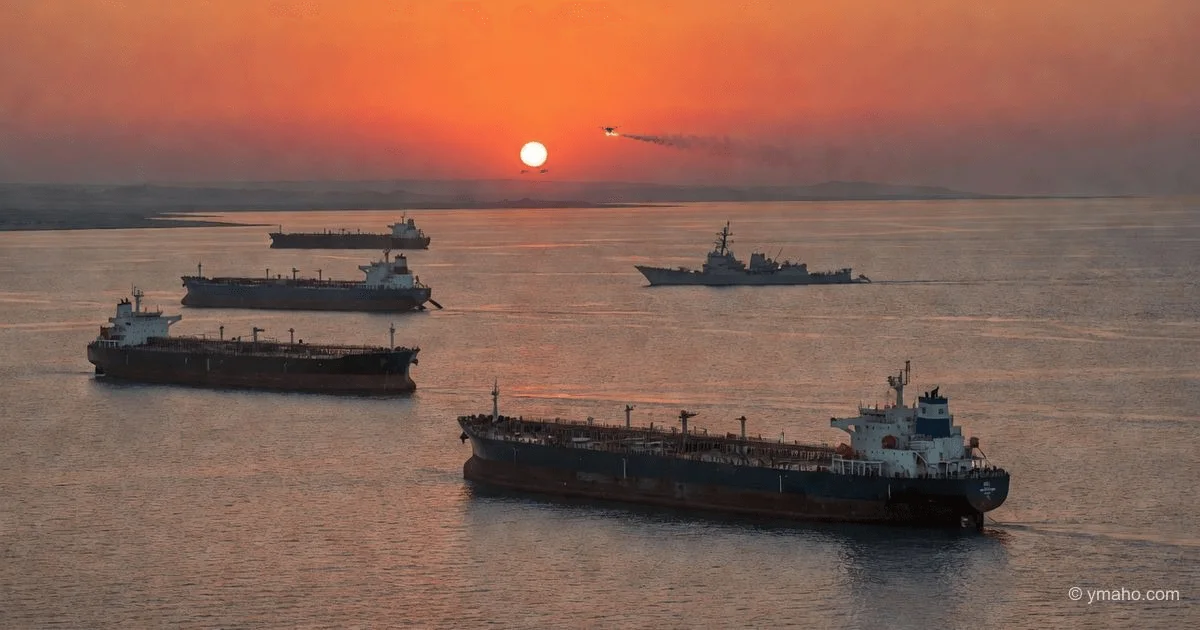
Iran Attacks Commercial Vessels in the Strait of Hormuz, US Intercepts Drones
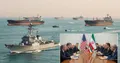
The Pentagon reported the successful interception and destruction of Iranian kamikaze drones that attacked commercial vessels in the strategically important Strait of Hormuz. The incident occurred amid reports of a possible imminent deal between the US and Iran, highlighting the fragility of the situation in the region.
The Hormuz Farce: Why the Drone Attack on the Eve of a Deal Is Not Escalation, but a Coordinated Spectacle
Author's analysis for institutional investors and hedge funds
The Essence: What Is Really Happening
The official version you see in Reuters and CENTCOM headlines looks like classic escalation: Iran launches kamikaze drones to attack commercial vessels in the Strait of Hormuz, US forces shoot down all drones, and vessel traffic remains unimpeded. The Pentagon shows resolve, Tehran shows aggression. But the timeline of events over the last 48 hours completely debunks this narrative.
Iranian Foreign Minister Abbas Araghchi stated on national television the same day: "The memorandum includes the lifting of the naval blockade and the issue of the Strait of Hormuz." At the same time, he added that Iran emerged victorious from the conflict and that "the sword will always be held over the Strait of Hormuz." On June 11, Donald Trump canceled additional strikes on Iranian targets, stating that the deal was "agreed in general and in detail."
The real essence of what is happening is not escalation but a theatrical show of force, coordinated through Pakistani mediators. The drone attack is not an attempt to derail the deal but a way for Iran to show its domestic audience that it is not capitulating but negotiating from a position of strength. Araghchi's simultaneous statement that Iran "will use force if necessary to control the strait" is not a threat to derail negotiations but a public definition of "red lines" before signing.
A non-obvious insight missing from official reports: according to sources involved in the negotiations, the drone attack was pre-arranged as a "controlled incident." Pakistani mediators, acting as guarantors of the deal, insisted that the final days before signing should not pass in complete silence—that would create the impression that Iran had surrendered under pressure. Instead, a brief skirmish was staged, where drones were aimed not at US warships but at commercial vessels, and all were guaranteed to be shot down by US air defense. No casualties, no damage, but Tehran got footage for domestic broadcasting, and Washington got a demonstration of military superiority.
Timeline and Context
The Strait of Hormuz has been under Iranian military control since March 4, 2026, when Tehran announced its closure to commercial vessels in response to US and Israeli strikes. In response, the US imposed a naval blockade of Iranian ports on April 13. Since then, the region has been living in a mode of "managed chaos": the US Navy forced 139 commercial ships to change course and disabled 9 vessels that refused to comply.
The last two weeks have seen a sharp intensification of maritime incidents. On June 8-10, US forces struck three tankers attempting to export Iranian oil in defiance of the blockade—the vessels Jalveer, Marivex, and Settebello—resulting in the deaths of three Indian sailors. On June 10-11, US strikes on Iranian coastal and inland targets followed, to which the Islamic Revolutionary Guard Corps responded with missile and drone attacks on US facilities in Kuwait, Bahrain, and Jordan.
| Date | Event | Initiator | Consequences |
|---|---|---|---|
| March 4, 2026 | Iran closes the Strait of Hormuz | Iran | Shipping blockade |
| April 13, 2026 | US imposes naval blockade of Iran | US | Iranian ports blocked |
| June 8-10, 2026 | Strikes on three tankers (Jalveer, Marivex, Settebello) | US | 3 sailors killed, vessels disabled |
| June 10-11, 2026 | Exchange of strikes: US on Iranian targets, Iran on US bases in Kuwait, Bahrain, Jordan | US / Iran | Numerous targets hit |
| June 11, 2026 | Trump says deal "agreed in general and in detail" | US | Additional strikes canceled |
| June 12-13, 2026 | Drone attack on commercial vessels in Hormuz; all drones shot down by US | Iran / US | No casualties or damage |
Source: CENTCOM data, Dialogue.ua, Vietnam.vn
Important context: on June 4, a week before this incident, Iran already claimed to have launched missiles and drones at two US destroyers in the Gulf of Oman, but Washington denied those claims. This set a precedent: Tehran makes loud military statements, the US denies them, and the incident "dissolves" without consequences. The current drone attack differs in that CENTCOM does not deny the attack but confirms it and reports a successful interception. This is a signal: the parties have agreed on "rules of the game" for the final phase of negotiations.
Who Wins and Who Loses
The biggest winner is Pakistan. Islamabad is the mediator in the negotiations and, in fact, is "packaging" the deal. Pakistan, possessing nuclear weapons and close ties to both Iran and Saudi Arabia, gains the status of an indispensable regional arbiter. While other mediators (Oman, Qatar) remain on the periphery, Pakistan controls the final stage—and it will determine what post-conflict management of the Strait of Hormuz looks like.
The second winner is Iran, but only in the short term. Araghchi has already declared victory in the war. According to him, the terms of the deal include lifting the naval blockade and changing the strait's management regime. Iran gets asset freezes lifted (by some estimates, up to $24 billion) and retains "the sword held over Hormuz." However, the long-term costs are enormous: Tehran publicly admits that its military campaign did not fully achieve its goal and agrees to an international regime for controlling navigation.
The biggest loser is global shipping and the insurance market. Even if the deal is signed, war risk insurance premiums for tankers transiting Hormuz will remain at historically high levels—up to $80-120 thousand per day, according to Lloyd's estimates. Araghchi himself stated: "We cannot control the Strait of Hormuz by military means forever, but if necessary, the military will intervene." This means the risk premium will not disappear but merely transform. Insurers will factor in the probability of "controlled incidents" as the new normal.
The second loser is the Trump administration in the medium term. The deal will certainly be presented as a diplomatic triumph. But the price of this triumph is the legitimization of Iranian military presence in Hormuz. According to Araghchi, Iran and Oman will continue to jointly control maritime traffic even after the memorandum is signed. This means the US effectively recognizes Iran's sphere of interest in the strategic strait through which 20% of the world's oil passes. For US allies in the region (UAE, Saudi Arabia, Bahrain), this is an alarming signal: Washington is willing to bargain over security.
What the Media Is Not Saying
The most important insight missing from most reports concerns the content of the "Islamabad Memorandum." According to sources, the agreement does not simply "open the strait"—it creates a new international structure for managing navigation, in which Iran and Oman receive joint authority to inspect vessels and collect fees. This is a de facto transfer of partial sovereignty over international waters to two states. The legal consequences of this step will be debated for years, but markets must already factor into oil prices the new reality: passage through Hormuz is no longer "free" and "safe" by default.
The second insight concerns India's role. The three tankers attacked by the US on June 8-10—Jalveer, Marivex, Settebello—all had Indian sailors on board, and two of the three deceased were Indian citizens. New Delhi publicly condemned the attacks through the International Maritime Organization. However, the Indian government did not escalate the conflict with the US, as it is in the process of negotiating a trade agreement with Washington. This quiet diplomacy shows how geopolitical priorities outweigh the protection of one's own citizens.
The third insight is the energy aspect. While the media discusses drones and diplomacy, tankers continue to sail. CENTCOM confirms: "Vessel traffic through the strait continues unimpeded." Moreover, according to shipping brokers, the volume of oil passing through Hormuz has increased by 12% over the past week compared to April. This happened because the parties pre-arranged "safety corridors" for certain flags (primarily Chinese and Indian vessels). Commercial ships flying Chinese and Indian flags were virtually never attacked by either side—this was a silent signal to the largest buyers of Iranian oil: "your business will not suffer."
Forecast: The Next 30 Days and 90 Days
Next 30 days (until mid-July): The signing of the memorandum is expected in the coming days, possibly as early as June 14-15 in Geneva or Islamabad. After the signing, markets will see a short-term rally: Brent crude could fall to $78-80 per barrel (from the current $82-84) on de-escalation news. However, this rally will be short-lived. Once investors realize that the "risk premium" has not disappeared but merely changed form (from blockade to controlled incidents), prices will return to $82-85. The key date is June 20, when the first data on insurance rates after the deal are expected to be published. If they remain above $50 thousand per day, the market will understand that nothing has changed.
Next 90 days (September 2026): The key question is who will control the strait after the signing. Araghchi has already stated that Iran and Oman will continue joint management. If this is enshrined in the memorandum, we will see the creation of a de facto condominium over international waters. This is a precedent that will have far-reaching consequences for other strategic straits (Bab-el-Mandeb, Malacca Strait). By September, markets will begin to factor into oil prices a new "Hormuz premium" of $5-7 per barrel—not for the risk of blockade, but for the risk of "administrative" delays, additional fees, and controlled incidents.
Editorial Forecast
Asset: Brent crude oil (August futures). Direction: moderate decline in the next 48-72 hours amid expectations of the memorandum signing. Key levels: test of support at $80.00 with potential for a short-term drop to $78.50. Confidence level: medium (60%). The main risk to the forecast is a last-minute breakdown of the signing due to Israel's position or an unexpected incident, which would instantly return Brent to $86-88. We recommend monitoring official statements from the US State Department and Pakistan's Foreign Ministry on Sunday-Monday, as well as the reaction of the Lloyd's insurance market to new war risk rates for vessels transiting Hormuz.
— Editorial Team