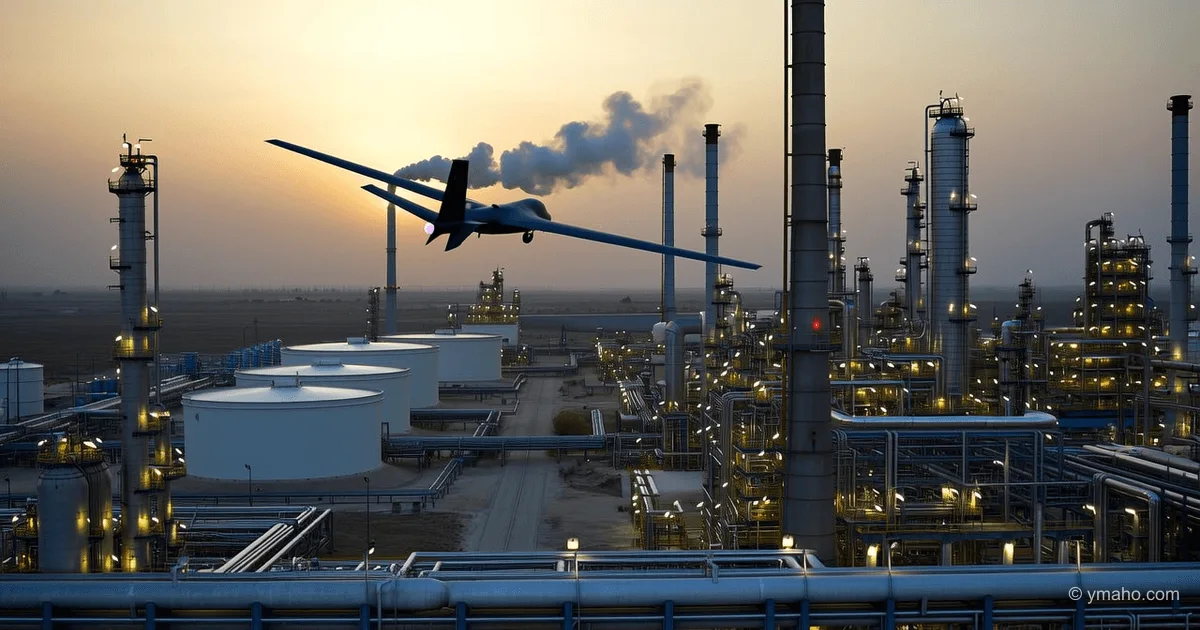
Arab Gulf States Conceal Facts of Secret Strikes on Their Territory
According to sources, the hushed-up drone attacks and mysterious explosions have affected not only the UAE but also Saudi Arabia. The incidents are linked to Iran's growing influence and the hardline camp of Mojtaba Khamenei in the region.
The essence: what is really happening
The hushed-up drone strikes on Saudi Arabia and the UAE are not sporadic incidents but a systematic campaign that I would call "coercion through silence." Iranian proxies and the Islamic Revolutionary Guard Corps itself strike critical infrastructure—oil facilities, airports, military bases—and the Gulf monarchies in response conceal the scale of the damage. The reason for this silence is not cowardice or technical inability to repel attacks, but cold calculation: public acknowledgment of strikes would crash stock markets, trigger an exodus of foreign specialists from the oil sector, and force Riyadh and Abu Dhabi into a military response they desperately seek to avoid. What appears as mysterious explosions at industrial sites is actually a shadow war where the main weapon is not the drones themselves, but the fear of disclosure.
Timeline and context
The history of secret strikes did not begin in May 2026 but much earlier. As early as late March, Saudi military recorded over 105 drone and missile attacks in just one week—from March 25 to 31. That is not a typo: more than a hundred strikes in seven days. Among the targets hit was the Al Qaisumah military airport, where a critical US-made AN/FPS-117 early warning radar was destroyed, creating a dangerous gap in the air defense system of the entire Persian Gulf.
The context of these attacks is a deep transformation of the Iranian regime. After the elimination of Supreme Leader Ali Khamenei on February 28, 2026, his son Mojtaba Khamenei was elevated to the rank of new Supreme Leader. But real power shifted from the clergy to the IRGC. As insiders note, Mojtaba, who was severely wounded in the first bombing and has not appeared in public since, is more of a "signatory" legitimizing the generals' decisions than an independent ruler. It is this transfer of power to uncompromising security forces that explains the audacity of attacks on the Gulf states.
By early May 2026, the campaign of strikes became so intense that Riyadh and Abu Dhabi could no longer ignore it. In response, they did something they had never done before: carried out direct airstrikes on Iranian territory, secretly warning Tehran through diplomatic channels that if the attacks did not stop, further escalation would follow. This worked: the number of attacks on Saudi Arabia dropped sharply, but did not stop completely. Moreover, Saudi and Kuwaiti air forces struck targets of pro-Iranian Shia militias inside Iraq.
Who wins and who loses
Paradoxically, the main beneficiary of the current situation is Iran, or more precisely, the Islamic Revolutionary Guard Corps. By launching strikes and seeing the Arab monarchies hide them out of fear, the IRGC gains a double advantage. On one hand, it demonstrates its military effectiveness to the Iranian population and its proxies. On the other, it systematically undermines trust in the Gulf governments among their own populations and foreign investors. If a state cannot protect its oil facilities and does not even acknowledge an attack, what stability can there be? This question is a time bomb for the Gulf economies.
The losers are primarily Saudi Arabia and the UAE. Each non-public explosion at an oil refinery or military base erodes their reputation as reliable energy suppliers and safe havens for capital. The cost of repairing damaged infrastructure is estimated in the hundreds of millions of dollars, but the damage to the investment climate is disproportionately greater. The US also loses: its allies see that the American "security umbrella" does not prevent strikes but only helps conceal their consequences.
China indirectly loses as well, having invested heavily in the Saudi economy and acted as a mediator in normalizing relations between Riyadh and Tehran in 2023. If the Saudi-Iranian "cold war" turns hot, Beijing risks losing influence on both sides.
What the media are not telling
The first and most explosive insight concerns the true role of Mojtaba Khamenei. Claims that he is merely a puppet of the IRGC are not entirely accurate. According to sources familiar with secret negotiations mediated by Pakistan, Mojtaba personally blocked several peace initiatives proposed by his own diplomats. The IRGC may control the army, but the young Khamenei, driven by a thirst for revenge for his murdered father, consistently rejects any compromise. He is not a passive figure but an active ideologue of war, whose personal trauma has become a factor in regional politics.
The second hidden plot is the real purpose of attacks on the UAE and Saudi Arabia. It is not to inflict maximum physical damage, but a psychological operation and intelligence gathering. Drone strikes that "mysteriously" bypass some air defense systems and hit others allow Iranian forces to map the vulnerabilities of Gulf missile defense. Each attack is a test that reveals how quickly Patriots react, at what altitudes interceptors are effective, and how long it takes to scramble fighters. This information is invaluable in the event of a full-scale conflict.
Forecast: next 30 days and 90 days
On a 30-day horizon (by June 15, 2026), the intensity of secret attacks will likely continue to decline—not due to diplomatic success, but because an unspoken "threshold of tolerance" has been reached. Saudi Arabia and the UAE have proven they are ready to respond with direct strikes on Iran, and Iran has shown it can strike with impunity and put its adversaries in a humiliating position. A fragile equilibrium of "mutually assured humiliation" will be established.
On a 90-day horizon (by August 15, 2026), much will depend on the outcome of US-Iranian negotiations under Pakistani mediation. If the US continues to insist on immediate discussion of the nuclear program, and Iran demands first lifting the blockade of the Strait of Hormuz, talks will reach a deadlock. In that case, the IRGC will reactivate its sleeper cells and proxies for strikes on the Gulf to increase pressure on Washington through its allies. However, if a compromise is found—for example, a phased lifting of sanctions in exchange for a cessation of attacks—the shadow war could enter a "freeze" phase until the end of 2026. In any case, the era when Gulf states could pretend the conflict did not concern them is irrevocably gone. They are full participants in this war, even if officially they are not involved.
— Editorial Team









