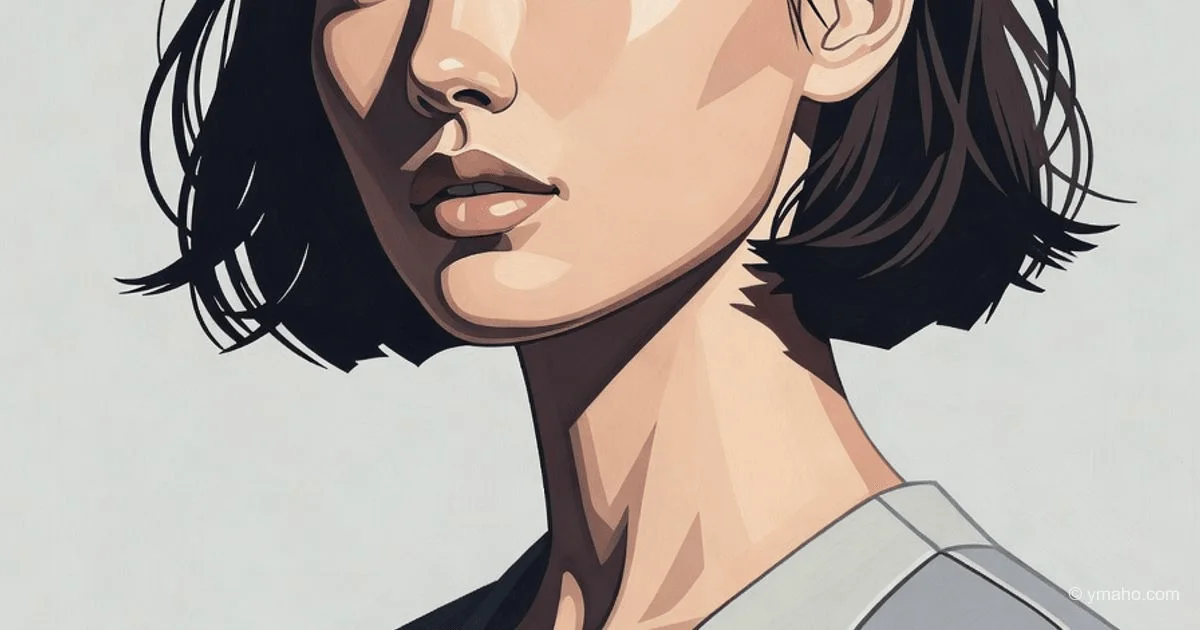
Summer Beauty Trend: The Fringe Focus and Greta Lee's 'Effortless Bob'
Vogue reports the return of bangs, as demonstrated by Greta Lee at the London premiere. Cosmopolitan adds that the season's key haircuts are the 'Italian bob,' 'Bohemian bob,' and 'Bixie,' dominating salons this summer.
Analytical Digest: Greta Lee's Bangs and the Bob Hegemony — A Hidden War for the Consumer's Wallet
The beauty industry is once again experiencing a 'great cutting off.' What Vogue and Cosmopolitan present as yet another seasonal trend for bangs and the Italian bob is actually the culmination of a long cycle of fatigue with 'high-maintenance styling.' We are witnessing not just a change in haircuts, but a shift in mentality: the 2026 client chooses a style that doesn't require hours in front of the mirror or hundreds of dollars on professional styling.
Greta Lee, appearing at the 'Toy Story 5' premiere with new bangs and waist-length hair, set off an avalanche whose consequences will be felt in salons on both sides of the Atlantic. But what remains off-camera is the main point: this 'easy, effortless' look actually requires precision work from a top stylist and costs consumers a pretty penny — even as the hairdressing industry itself stands on the brink of an accessibility crisis.
[The Core]: What's Really Happening
The reality is that the 'effortless bob' and 'bixie' (a hybrid of bob and pixie) are not a fashion statement but an engineering solution to the problem of thinning hair. Dermatologists and trichologists have been sounding the alarm for years: the aftermath of COVID, stress, and the popularity of aggressive diets have led to widespread hair shaft thinning in women aged 25-40. Long, heavy hair visually exacerbates the problem by revealing transparency in the lengths. Short haircuts, on the other hand, create the illusion of volume and density.
But there's also a political subtext. Notice the 'Birkin Bangs' — Jane Birkin's fringe, which is returning right now. This isn't just 70s aesthetics. It's a manifesto against the 'slicked-back glamour' of Instagram influencers from 2020-2023. Greta Lee's sharp, geometric 'micro bangs,' which she also showcased at the Met Gala 2024, symbolize a rejection of 'convenient' femininity in favor of an intellectual, slightly avant-garde architecture. This is a haircut rebellion: either you wear the 'Italian bob' with soft waves (relaxed luxury), or the short 'bixie' (conscious audacity).
TikTok has picked up this trend, turning it into the meme 'expensive blowout vs. woke up like this.' But the consumer doesn't understand that the 'effortlessness' of the bohemian bob is the most expensive service on the price list. The cost of such 'naturalness' in London or Zurich salons reaches €100 and above, and this price ceiling is about to crack.
Timeline and Context
The path to the 2026 fringe didn't start yesterday. Let's trace the market logic that fashion commentators ignore:
- 2022-2023 (The 'Copenhagen Girl' Era): Dictatorship of long, smooth, glossy-styled hair. Total perfectionism. Clients spend $200–300 a month on hair botox and keratin treatments.
- 2024 (The Tipping Point): Met Gala. Greta Lee appears with a choppy pixie and micro bangs. Pam Anderson and Ayo Edebiri follow suit. It's seen as eccentric. But Google Trends records a 340% increase in searches for 'how to cut your own bangs' (inflationary factor: people start saving money).
- Late 2025 (The Economic Trigger): Budget crisis in Britain. In autumn 2025, the government announces the cancellation of COVID business tax relief. The salon business goes into a tailspin.
- January 2026 (Trend Announcement): The concepts of 'Boho Bob' and 'Cloud Bob' flood forecasts. The main message: 'less product, more shape.'
- May-June 2026 (The Current Moment): Greta Lee legitimizes the trend at the Disney premiere. Bangs become a summer must-have. But prices for coloring and complex haircuts in Europe hit record highs.
Who Wins and Who Loses
Winners: Manufacturers of root volume products and dry texture sprays. Why? Because the 'effortless bob' and 'bixie' require daily 'fluffing.' Consumers who previously bought shampoos for length are now sweeping root volume powders (Aveda, Oribe) and sea salt sprays off Sephora shelves. This is the 'short hair tax' — short hair needs to be washed and styled more often.
Losers: Traditional barbershops and low-end salons. Cutting a 'bixie' and 'micro bangs' is precision work. As professionals note, Greta Lee's fringe is 'science, not art.' It requires a top-stylist level master. While the market is already losing talent: in the UK, for example, the number of hairdressing apprentices is declining so rapidly that the profession could disappear as a mass phenomenon by 2027. Clients flock to rare 'star' stylists, leaving mid-market salons empty.
What the Media Isn't Saying
Insight #1: The Illusion of 'Cheap' Short Hair.
Yes, you'll save on shampoo. But! The cost of a haircut, considering 2025–2026 inflation, has skyrocketed. In November 2025, the UK budget hit salons with tax increases. Salon owners state that to cover staff and rent costs (business tax rose by 110% in some areas), they have to raise prices by 50% above market average.
As of late 2025 – early 2026, a women's haircut at a mid-range salon in Berlin costs around €73, in Zurich up to €101. Moreover, women in Europe pay on average 35% more than men for a haircut of similar duration. 'Bixie' and fringe work are premium-priced services. Following Greta Lee into the salon, you're not paying for a haircut, but for the expertise to 'cut' hair so it styles itself.
Insight #2: The Geopolitics of Bangs.
In summer 2026, the 'Italian bob' dominates. But the key trend influencers are the Korean wave. K-pop idols have been wearing 'Bottleneck Bangs' (short in the center, long on the sides) for several seasons. Western publications have rebranded this as 'Boho Bangs.'
Why is this important? Because Asian manufacturers (primarily Korean and Japanese) have been actively patenting styling products for fixing exactly this type of bangs — light, movable, not glued together. European hairspray giants (Schwarzkopf, L'Oréal) woke up late and are now urgently reformulating, because their 'hard' lacquers don't suit the texture of micro bangs. By the end of 2026, we'll see a wave of collaborations or lawsuits over copying 'air fixation' technologies.
Forecast: The Next 30 Days and 90 Days
Next 30 Days (June 2026):
Media will start buzzing about 'Bangxiety' (anxiety over bangs). The first wave of enthusiasm will be followed by a second: panic from those who cut their hair like Greta Lee but don't want to spend 30 minutes styling every morning. TikTok will be flooded with 'I hate my bangs' videos. In response, salons will launch 'Express Bang Trim for €10' promotions to retain clients. This is the classic cycle: first the shock of novelty, then adaptation.
90 Days (Towards Autumn 2026):
An inevitable differentiation of the trend based on wallet size will occur.
- Premium Segment: Shift from 'micro bangs' to the more versatile 'Birkin Bangs' (eyebrow-length, graduated), which grow out softer and don't require weekly stylist visits. Salons in London and Paris will introduce 'bangs subscription' packages (cut + toning every 3 weeks) starting at $300 per month.
- Mass Market: Disillusionment with short haircuts due to the high cost of maintenance. Consumers will start growing out the 'Cloud Bob' — a longer, less shape-demanding version. Texture sprays (texturizers) will become the #1 bestseller in Europe, because only they can mimic that 'effortlessness' without requiring daily hair washing.
The season's main takeaway: the 'Italian bob' and 'bangs' are a marker of social status. In 2026, a neat, timely trimmed fringe means you have the time and money to maintain yourself amid the cost-of-living crisis. This is the new luxury.
— Editorial Team