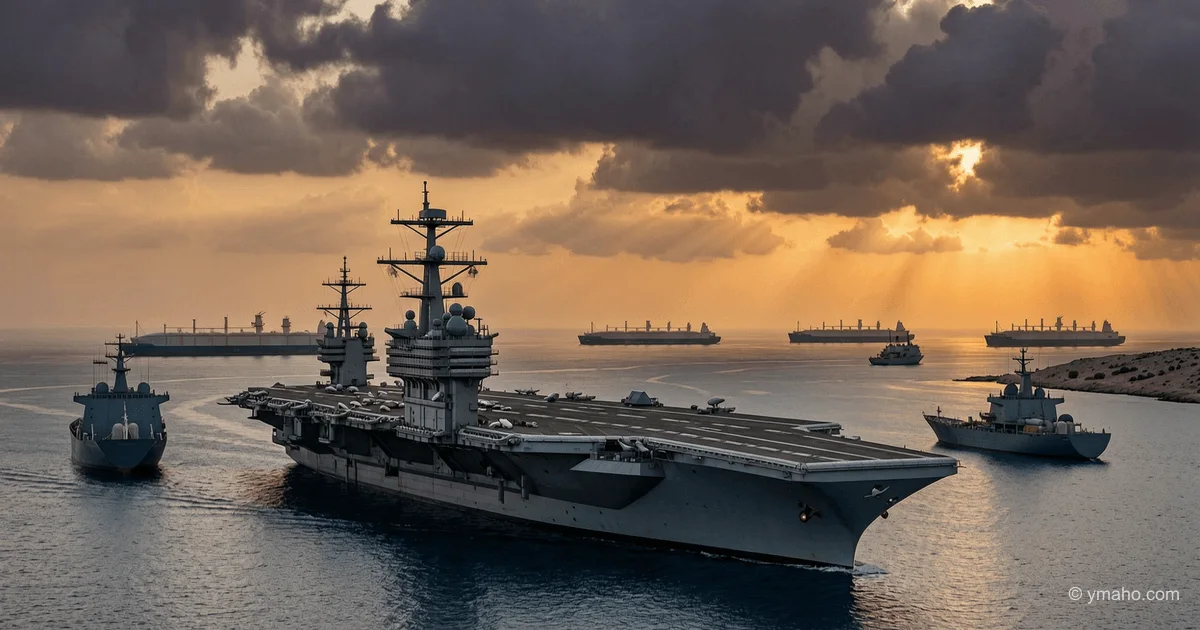
US Administration Suspends 'Project Freedom' Operation for Escorting Ships in the Strait of Hormuz
President Donald Trump announced the suspension of the 'Project Freedom' mission, citing mutual agreement on a temporary halt amid the ongoing blockade of the strait. Experts called the decision a sign of Washington's lack of a clear strategy.
Suspension of 'Project Freedom': Why the US Navy's Main Operation Failed Within a Day and What It Means for the World
The Gist: What's Really Happening
On May 5, 2026, President Donald Trump announced the temporary suspension of 'Project Freedom' — a large-scale US Navy mission to escort civilian vessels through the Strait of Hormuz. The operation, announced just two days earlier on May 3, was meant to showcase American military power and restore freedom of navigation in the planet's key energy corridor.
However, the real story behind the suspension has almost nothing to do with the official version of "great progress in negotiations with Iran" that Trump laid out on Truth Social. The real reason is a humiliating diplomatic failure that the White House is desperately trying to cover up.
Trump announced the start of 'Project Freedom' via social media without prior consultation with key regional allies. According to NBC News, this move "caught Gulf countries off guard" and "angered the Saudi leadership." In response, Riyadh informed Washington that it would not allow US military aircraft to take off from Prince Sultan Air Base and would ban the use of its airspace. Trump's phone call with Crown Prince Mohammed bin Salman did not fix the situation. Only then was the US leader forced to put the operation on hold.
Thus, the "mutual agreement" and "progress in negotiations" cited by Trump are diplomatic cover for a harsh Saudi veto that remained behind the scenes of public statements.
Timeline and Context
Events surrounding 'Project Freedom' unfolded rapidly and exposed deep problems in US strategy in the region.
- February 28 — The US and Israel launch a military operation 'Epic Fury' against Iran. Tehran's response is a de facto blockade of the Strait of Hormuz, through which about 20% of the world's oil supply passes. Shipping nearly stops. Before the war, about 130 vessels passed through the strait daily; since early March, traffic has dropped by more than 93%.
- April 8 — The parties agree to a temporary two-week truce that was supposed to include the resumption of shipping. By April 9, it becomes clear that Iran is not complying. Instead of opening the strait, Tehran imposes a transit fee of $2 million per vessel.
- April 13 — Trump announces a full naval blockade of Iranian ports by US Navy forces. This is the largest operation of its kind since the Korean War.
- May 3 — Trump announces 'Project Freedom' on Truth Social without consulting allies. The stated goal is to escort commercial vessels stranded in the Persian Gulf.
- May 4 — The first and only full day of the operation. The result is shockingly modest: only two vessels passed through the strait under US escort. For comparison, the pre-war norm was 130 vessels per day. One of the vessels was a US-flagged car carrier operated by the Danish company Maersk.
- May 5 — Saudi Arabia denies the US use of its bases and airspace. Trump announces the suspension of the operation, citing "progress in negotiations" and "requests from Pakistan and other countries."
- May 6 — Official Tehran characterizes the suspension as a victory, stating that Trump "backed down" after "continued failures" in attempts to open the strait.
Who Wins and Who Loses
Iran — the main tactical winner. Tehran not only maintained de facto control over the Strait of Hormuz but also achieved a symbolic victory: the American operation designed to break the blockade was halted within a day of its start. Iranian state media characterize this as Trump's "retreat," and there is a grain of truth in that assessment: Washington publicly admitted it cannot ensure freedom of navigation unilaterally.
The US — the main loser. The failure of 'Project Freedom' exposes structural problems in American strategy: impulsive decision-making without consulting allies, inability to ensure operational effectiveness (two vessels instead of 130), and, most painfully, public discord with a key regional partner — Saudi Arabia. As experts note, 'Project Freedom' did not address the root problem: ship captains and shipping companies refuse transit not because of a lack of escort, but because of the ongoing threat of attacks.
Saudi Arabia — an unexpected beneficiary of relationship restructuring. The ban on base use is a demonstration of Riyadh's growing independence from Washington. The Saudis publicly support Pakistani mediation and make it clear they will not allow their territory to be used for adventures that disregard their national interests.
The shipping industry and the global economy — in limbo. According to the South Korean publication Chosun, about 1,600 vessels remain stranded in the strait and the Persian Gulf. Even if 'Project Freedom' resumes, shipping companies are not ready to take risks: Hapag-Lloyd stated that its risk assessment "remains unchanged" and its vessels "cannot currently pass through the strait." The executive director of the Port of Los Angeles, Gene Seroka, summarized the industry's position: "Only a practically verified peace agreement can restore the shipping industry's trust."
Oil futures reacted to the suspension of 'Project Freedom' with a decline: US crude fell below $100 per barrel. However, this decline is not a reaction to an improved situation, but to a temporary reduction in the risk of direct military confrontation between the US and Iran. The fundamental problem of the strait blockade remains unresolved.
What the Media Isn't Saying
Insight one: the operation was doomed from the start. According to analysts, only two vessels passed through the strait on the first day of 'Project Freedom,' and both were under the US naval flag. This is negligible compared to the pre-war traffic of 130 vessels per day. The key reason is not military weakness, but the refusal of insurance companies to cover risks even with US escort. War risk premiums have soared from 0.2-0.25% of the vessel's value to 7.5-10%, meaning for a tanker worth $138 million, a one-time premium of up to $14 million compared to $345,000 in normal conditions. At such rates, commercial transit through the strait is economically pointless regardless of how many warships escort it.
Insight two: the Saudi move is not emotion, but strategy. Riyadh's decision to deny the US use of bases is not a spontaneous reaction to Trump's rudeness, but a carefully calibrated signal of a reassessment of alliance commitments. Saudi Arabia borders Iran, and in the event of a full-scale war, its oil infrastructure — facilities at Ras Tanura and the Ghawar field — would become primary targets for Iranian missiles. By banning the US from using its bases for operations against Iran, Riyadh is effectively insuring its own territory against retaliatory strikes.
Insight three: 1,600 vessels trapped — and no way out. CNN reports that shipping companies and stranded crews still do not dare to navigate, despite all US assurances. Rocket attacks continue in the area of the 21-mile (approximately 34 km) waterway, despite the truce. Even if 'Project Freedom' resumes in full tomorrow, it will take weeks to normalize logistics chains that are already broken: tankers are in the wrong ports, insurance policies are canceled, supply contracts are disrupted.
Forecast: Next 30 Days and 90 Days
30 days (until early June 2026)
In the coming month, the key factor will be the negotiations that Trump cited as the reason for the suspension. However, given that Iran has already called the suspension a US "retreat," Tehran's negotiating position is strengthened. If an agreement is not reached within two to three weeks, Trump will face a difficult choice: resume the operation without Saudi support (which is practically impossible) or admit failure and seek alternative paths.
Saudi Arabia will likely maintain the ban on base use until it receives guarantees that its interests are taken into account. Without Saudi airspace and Prince Sultan Air Base, the operational radius of 'Project Freedom' is critically reduced. The likelihood of resuming the operation in its previous format is minimal.
Oil markets will continue to trade on the news background of negotiations. If a memorandum of understanding is signed, Brent may temporarily fall below $90 per barrel. However, the fundamental problem — Iran's control over the strait — will remain unresolved, and any incident will quickly return prices to triple digits.
90 days (until late July – early August 2026)
By the end of summer, the contours of a new equilibrium in the Persian Gulf will become clearer. The most likely scenario is de facto recognition of Iranian control over the strait through bilateral agreements with Asian oil consumers. China, India, and possibly Japan will reach agreements with Tehran on guaranteed passage for their tankers. This would mean the end of an era in which freedom of navigation in the Strait of Hormuz was guaranteed by American military power.
For the US, the failure of 'Project Freedom' will be a turning point. The Trump administration, which began the conflict with ambitious goals — to prevent Iran from developing nuclear weapons — will find itself in a position where not only has a nuclear deal not been reached, but the key maritime route has de facto fallen under enemy control. This strategic defeat will have consequences far beyond the Middle East, affecting perceptions of US security guarantees in the Indo-Pacific region and Europe.
The main lesson of 'Project Freedom' for the world community is simple and harsh: unilateral military operations without consultation with allies are doomed to fail, even if backed by the most powerful army on the planet. And the price of this lesson, measured in barrels of oil at $100 and 1,600 stranded vessels, continues to rise with each day of inaction.
— Editorial Team









