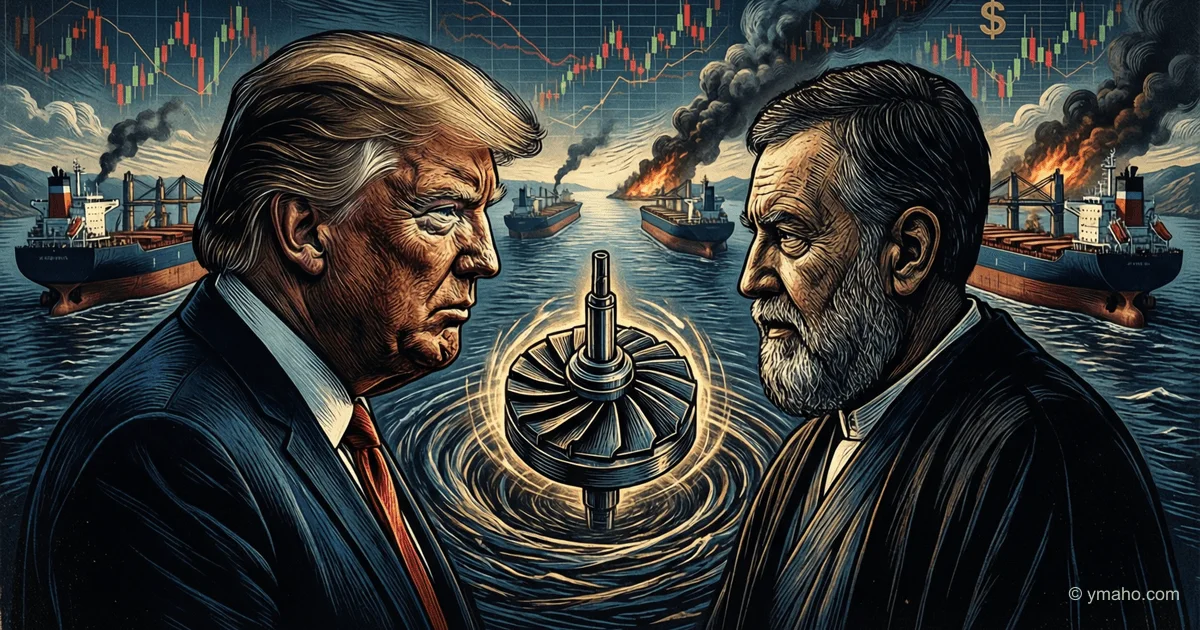
Trump Says Iran's Uranium Will Be Removed for Disposal
U.S. President Donald Trump said Washington insists on removing highly enriched uranium from Iran to later destroy it, and will not allow Tehran to keep these materials.
Uranium as a bargaining chip: why Trump is losing the game in the Strait of Hormuz
[The Gist]: What's Really Happening
At first glance, the story is simple: U.S. President Trump announces plans to remove 440 kg of 60% enriched uranium from Iran and destroy it. Iran's Supreme Leader Khamenei responds with a directive banning its export. A deadlock. A nice picture for the news.
But as a financial analyst tracking liquidity flows and "gray" deals, I see a much deeper layer. This isn't about the uranium itself. Its physical mass is valued at around $25–30 billion on the spot market, considering the potential cost of finished fuel. But that's peanuts compared to what actually gets unlocked or frozen in a deal.
The real essence is $25 billion in Iranian assets frozen in foreign banks (mainly in Iraq, Oman, and Qatar), plus future flows from 1.5–2 million barrels of oil per day that Tehran can't sell due to the blockade.
Trump talks about uranium because it's understandable to voters. Khamenei digs in because without this uranium, he loses the main leverage to insure against another strike. The real stake in negotiations now is not centrifuges, but insurance premiums for "war risk" on the route from the Persian Gulf to Asia.
Timeline and Context
In the last 72 hours, an event occurred that many mistakenly interpret as a "negotiation failure." On May 20, Reuters reported Khamenei's directive. On May 21, Trump gave a tough response.
But let's look at the broader timeline. As early as May 19, a Qatari delegation arrived in Tehran, and on May 21, a draft agreement leaked to the press, under which Iran agrees in principle to give up the uranium. So why does Khamenei say "no"?
Non-obvious insight: Khamenei's directive is not a "no" to the deal. It's a technical maneuver to shift negotiations from "removal" to "downblending under IAEA supervision." The Iranians are willing to spoil the uranium to 3.67%, making it useless for a bomb, but keep it physically on their soil.
Why is this critical? Because if they hand over the uranium to the U.S., they lose their hostages. 440 kg of uranium is a guarantee that the U.S. won't launch another strike on nuclear facilities (which, by the way, were already "neutralized" in June 2025). Khamenei believes (and is probably right) that as soon as the last gram leaves the country, Tel Aviv or Washington will find a pretext for a new attack on conventional infrastructure.
Who Wins and Who Loses
The immediate loser right now is Europe. While the U.S. and Iran haggle over uranium, the Strait of Hormuz is blocked or operating intermittently. Wood Mackenzie published scenarios this week: even in the best case (Quick Peace), a recession in the EU in 2026 would be -0.5% of GDP due to energy prices. In the average scenario (Summer Settlement), the Eurozone is already in a technical recession. European chemical giants (BASF, Air Liquide) are praying for a deal because fertilizer prices have soared 30%.
Winners are structures trading volatility. Over the past 2 days, Brent crude futures have shown intraday swings of $8-10. Traders sitting on oil and gas options are making fortunes on every Trump phrase and every Khamenei directive.
The quiet winner is Russia. Finance Minister Siluanov said outright last week that Russia gets a double effect. Budget revenues are rising due to expensive oil ($90-110 per barrel in the coming weeks), but Moscow is also the only one offering a formula of "remove the uranium to us." Zakharova has already stated readiness to help. If the uranium goes to Russia, Moscow gets not just material, but leverage over the future nuclear market and a trump card in negotiations with the IAEA.
What the Media Isn't Saying
The main lie in the headlines is "Trump insists on destroying uranium." That's physically idiotic from an economic standpoint. Uranium enriched to 60% is a product with huge added value. Megawatt-hours of electricity and years of centrifuge work were spent on its separation.
Behind the scenes: The U.S. has no intention of destroying anything. The uranium will be removed, downblended to 4-5% somewhere in South Carolina or, more likely, sold to companies like Westinghouse as fuel for civilian nuclear power plants. Trump says "destroy," but means "repurpose for commerce." The difference in question is about $2 billion in profit for the U.S. nuclear industry.
The second omission: the uranium deal is inextricably linked to shipping. Iran demands payment for passage through Hormuz. Officially, it's "security control." Unofficially, it's an attempt to legalize piracy as a business. If the U.S. agrees to "fees," it sets a precedent for the Malacca Strait and the Panama Canal. The world of maritime trade will collapse into a new era of extortion. This topic is being actively discussed at Lloyd's List, but not in the mainstream.
Forecast: Next 30 Days and 90 Days
30 days: The uranium agreement will be signed, but in a truncated form. Iran will agree to downblend uranium to 5% under IAEA supervision on its territory. The uranium will remain in Iran but become useless for a bomb. Trump will declare victory. Khamenei will too. Expect an announcement within 7-14 days.
90 days: Once the strait is unblocked (tentatively June-July 2026), deferred oil supply will flood the market — Iran will dump 1.5 million barrels per day for 2-3 weeks. Brent will fall from current levels ($110-120) to $65-80 by year-end, as Wood Mackenzie describes in the "Quick Peace" scenario. Long oil positions now are a trap for bulls. Smart money is already hedging via call spreads on declines in September futures.
Editorial Forecast
Asset and direction: Gold (XAU/USD) — short-term rise.
Key levels: Current range $2450–2480. A breakout above $2500 is likely within the next 48 hours as a reaction to news of the uranium deadlock and continued blockade of the strait.
Confidence level: High (70%). News over the past 24 hours (Khamenei's directive and Trump's tough rhetoric) raises the geopolitical tension index, which traditionally pushes safe-haven assets higher.
Main risk: A sudden announcement of a breakthrough in uranium talks (even a fake one) would knock the risk premium, and gold would correct 1.5-2% down to $2420 before resuming its rise. Watch Trump's Truth Social account — one "We have a deal" from him would nullify this forecast.
— Editorial Team









