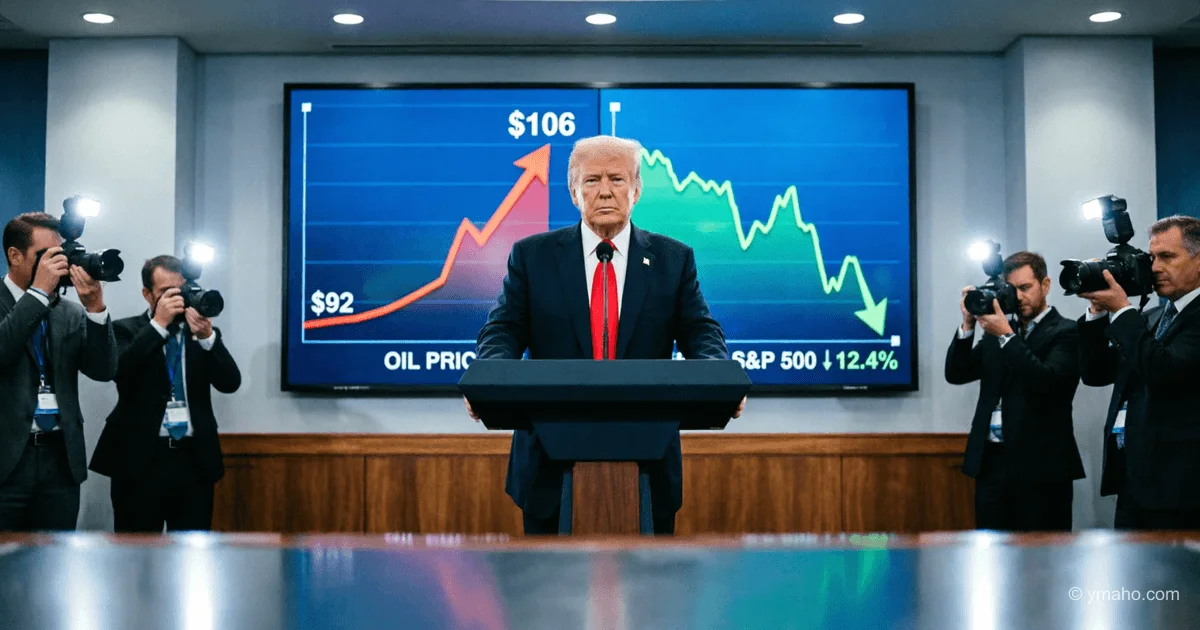
Trump Says He's in No Rush to End War with Iran, Global Stock Indices Fall Amid New Oil Price Surge
U.S. President Donald Trump stated he has no intention of rushing to end the conflict in the Persian Gulf, signaling that the military operation could drag on. This statement triggered a global sell-off in stock markets and a new surge in Brent crude prices above $106 per barrel amid fears of supply shortages from the region.
Analytical Article: "The Protracted Pause" — Why Markets Aren't Celebrating Trump's Ceasefire with Iran
Donald Trump's statement that he is "in no rush to end the war with Iran," made amid the announcement of an extension of the ceasefire, came as an unexpected signal to global markets. On one hand, investors received a reprieve from worst-case scenarios (immediate resumption of massive bombings and a full-scale ground invasion). On the other, the U.S. president made it clear that the military operation could be prolonged, and the blockade of the Strait of Hormuz, which cuts off up to 20% of global oil transit, remains in place. This dual message led to a global sell-off in stock markets and a new surge in Brent crude prices above $106 per barrel. Markets found themselves trapped: the immediate threat of escalation receded, but the root causes of the crisis remain.
Event Details and Timeline
The key event occurred on April 21–22, 2026, when the previous two-week ceasefire between the U.S. and Iran expired. Just hours before its expiration, Trump announced an indefinite extension of the pause in hostilities. However, this decision came with a tough caveat: the ceasefire would be extended only if Iran and Pakistan presented a "unified proposal" for a settlement, while Vice President JD Vance's visit to Pakistan for negotiations was postponed due to Iran's refusal.
Simultaneously with diplomatic maneuvers, President Trump emphasized in public statements that he saw no point in rushing to end the conflict. "I'm in no hurry; we have time and resources," he effectively stated, signaling that the current state of "neither war nor peace" suits him.
In response:
- The military blockade remains. The Strait of Hormuz remains effectively closed to free navigation. Iranian boats continue to inspect and fire upon vessels attempting to pass through the strait without coordination.
- Incidents continue. The Pentagon confirmed that clearing mines from the strait could take up to six months due to the scale of mining carried out by the IRGC.
- Oil prices surged. Brent exceeded $106, WTI approached $97, hitting highs not seen since 2022.
Impact and Significance
The situation, which Rabobank analysts have already called a "geopolitical earthquake" comparable to the 1956 Suez Crisis, has three levels of consequences.
For the global economy: Inflationary pressure returns with a vengeance. JPMorgan CEO Jamie Dimon warned shareholders that "sharp oil price increases are often cited as a key cause of the deep recessions of the 1970s and 1980s," and the current scenario could repeat that. Central banks (the Fed and ECB) are forced to delay rate cuts, and in Europe, talk of possible rate hikes has resurfaced.
For the energy industry: The world faces a paradox. OPEC+ is ready to increase production from May (by some estimates, 411–548 thousand barrels per day), but only Saudi Arabia and the UAE have spare capacity. Goldman Sachs experts warn: "You can't keep drawing from reserves indefinitely if the strait is closed." If the blockade drags on for months, Brent could reach $150–200 per barrel.
For the humanitarian sphere: The Center for American Progress (CAP) sounds the alarm: the conflict has already triggered a rise in hunger and medicine shortages in developing countries, exacerbating a situation where 670 million people were already suffering from malnutrition before the war.
Reactions of Key Players
Investors and politicians reacted to Trump's statements in different ways, but none of the parties appear optimistic.
- Financial markets: A paradoxical phenomenon occurred. On one hand, stocks recovered to pre-war levels, with investors hastily closing "geopolitical hedges." On the other, oil continued to rise, and tech stocks (Nasdaq) fell due to fears of high inflation.
- U.S. Senate: The political divide deepens. The Senate rejected a Democratic resolution to withdraw troops (46 to 51), but Democratic leader Chuck Schumer warned: "The longer Trump drags his feet on getting out of this war, the deeper the hole gets and the harder it is to climb out."
- Washington hawks: The Foundation for Defense of Democracies (FDD) published a column titled "Finish the Job." Analysts argue that the current state of "half-war" is the most dangerous, as it gives Iran time to rebuild its nuclear program.
- Iran: Tehran views the pause as an opportunity to regroup, refusing negotiations and demanding first that the naval blockade be lifted.
Forecast and Conclusions
Trump's statement that he is "in no rush" essentially legitimizes a scenario of prolonged tension. Markets that hoped for a quick resolution are beginning to realize: this is not a sprint but a marathon.
My forecast is based on three most likely scenarios:
- Baseline ("New Normal," 60% probability): The strait remains closed for another 4–8 weeks. Oil prices settle in the $100–120 range. The Fed does not cut rates until 2027. The S&P 500 fluctuates within 5–7% of current levels, periodically falling on news of new attacks.
- Negative ("Oil Shock 3.0," 30% probability): Escalation leads to direct strikes on Saudi Arabian infrastructure. Oil prices skyrocket to $150–180. A global recession becomes inevitable.
- Positive (10% probability): A sudden diplomatic breakthrough. However, given Trump's rhetoric and Iran's current stance, this scenario is postponed to the second half of 2026.
Conclusion: The optimism with which markets greeted the ceasefire news proved premature. As a Citi analyst put it, this is merely "residual optimism." Investors should prepare for a "regime of heightened volatility," where safe-haven assets (dollar, gold, commodities) will win, while "expensive" tech companies will sag under the pressure of capital costs. Trump gave markets a reprieve, but not a solution.
— Editorial Team









