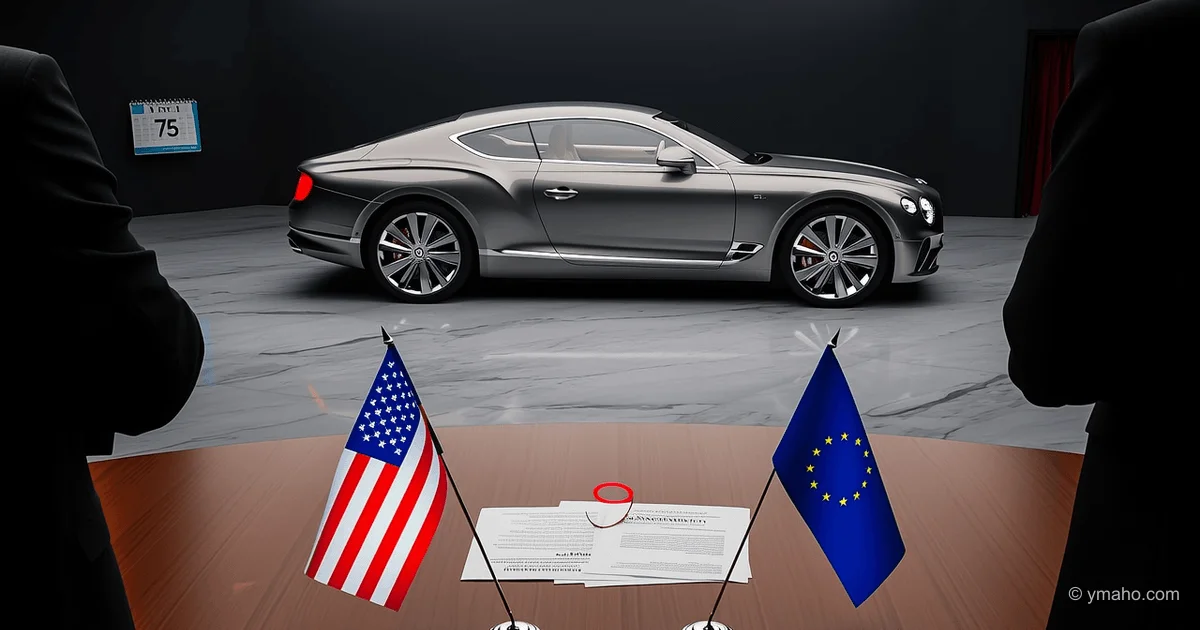
Trump Demands EU Ratify Trade Deal by July 4 or Face Higher Tariffs
U.S. President issues ultimatum to the European Union: if the bilateral trade agreement signed in July 2025 is not ratified by July 4, Washington will impose "significantly higher" tariffs. The administration threatens to raise duties on imports of European cars and trucks to 25%, citing slow bureaucratic procedures in Brussels.
Analytical Note
May 10, 2026
Confidential
The Bottom Line: What's Really Happening
Trump's ultimatum with a July 4 deadline is not just another loud tweet or a standard negotiating tactic. It is an attempt by the administration to circumvent a fundamental legal problem, which I detailed in a previous note on the Court of International Trade ruling. Recall: on May 7, 2026, that court struck down the 10% global tariffs imposed under Section 122 of the Trade Act of 1974, ruling that the administration had misused the law.
Now Trump is pushing for ratification of the agreement signed back in July 2025 at Turnberry, Scotland. That agreement is his only legal anchor. If the EU ratifies the document by July 4, the administration gains a working contractual basis with 15% tariffs on most European goods and zero duties on U.S. exports to Europe. If not, Trump has a political—though legally contestable—basis to impose "significantly higher" tariffs, bypassing the very Section 122 that the court just overturned.
Why July 4? It's not just symbolism of the 250th anniversary of U.S. independence or a flashy date for the press. By July 24, the 150-day period for Section 122 tariffs expires, leaving the administration without a tariff tool in the midst of the election season. The July 4 deadline gives Trump exactly 20 days before that date to either declare victory (the EU ratified) or start imposing new tariffs on a different legal basis. Classic Trump-style brinkmanship—bring everyone to the edge of the cliff and make them jump first, not him.
Timeline and Context
The Turnberry deal was struck on July 27, 2025, under circumstances that can only be described as bizarre: Trump and von der Leyen agreed after a round of golf at the U.S. president's Scottish estate. Under the terms, the U.S. imposes 15% tariffs on most European goods (instead of the previously threatened 30%), and the EU zeroes out duties on U.S. industrial and agricultural goods.
However, ratification immediately stalled. The first pause came in January 2026, when members of the European Parliament's trade committee expressed outrage over Trump's statements on Greenland. The second came in February, after the U.S. Supreme Court first ruled Trump's tariffs illegal, and the administration immediately imposed temporary 10% duties under another law. Brussels saw this as a signal: Washington is unpredictable, and the deal needs safeguards.
On March 26, the European Parliament approved legislation to implement the agreement by 417 votes to 154, but with key reservations. There are two main reservations: first, zero tariffs on U.S. goods take effect only if European steel and aluminum are excluded from Trump's global 50% tariffs on those metals; second, the agreement must automatically suspend if the U.S. takes actions threatening the EU's territorial integrity.
On May 6, 2026, representatives of the European Parliament, the European Commission, and member states held six-hour negotiations on implementing the agreement. No result. This lack of progress triggered Trump's ultimatum. The next round of talks is scheduled for May 19 in Strasbourg.
Meanwhile, last week Trump threatened to raise tariffs on passenger cars and trucks from the EU from the current 15% to 25%, accusing the bloc of "not holding up its end of the deal." U.S. Trade Representative Jamieson Greer put it in numbers: "We've fulfilled 95% of our commitments in nine months... and they've fulfilled 0% in that time."
Winners and Losers
Winners:
- U.S. auto industry and, more broadly, the U.S. industrial sector. Each percentage point of tariff on European cars gives Ford, GM, and Tesla a price advantage in the domestic market. At a 25% tariff, a European car costing $45,000 gets an additional markup of $4,500—a difference that could shift a significant portion of consumers to American equivalents.
- The Trump administration as a political player. The ultimatum accomplishes three tasks: it diverts attention from the legal defeat on Section 122 tariffs; it provides leverage over the EU; and less obviously, it punishes German Chancellor Friedrich Merz for his critical remarks about the war in Iran, according to analysts.
- Major European automakers with plants in the U.S. (BMW, Mercedes-Benz). Their American production capacity allows them to bypass tariffs.
Losers:
- The German economy as a whole. The Kiel Institute for the World Economy (IfW Kiel) estimates short-term losses for Germany's automotive industry at EUR 15 billion, long-term up to EUR 30 billion. These are not abstract figures: in 2025, Germany exported nearly 410,000 cars to the U.S. out of a total of 3.17 million. Every second car sold in the U.S. by German brands is made in Europe and would be subject to tariffs.
- Italy, Slovakia, and Sweden. IfW Kiel's research shows that not only Germans will suffer—the entire European automotive components supply chain will be hit.
- U.S. consumers. Raising tariffs to 25% inevitably translates into retail prices—German cars in the U.S. will cost $4,500–11,000 more depending on the class.
- The European Union as a political project. If the deal is not ratified, the EU will demonstrate an inability to finalize key international agreements.
Mixed position:
- The European auto industry overall. On one hand, tariffs hurt exports. On the other, if the agreement is ratified, European manufacturers gain a predictable environment with 15% tariffs, which is better than volatility.
What the Media Isn't Saying
First non-obvious insight: Trump's ultimatum may be a bluff that he himself doesn't want to follow through on. The reason is not diplomatic but purely electoral. Less than six months remain until the November midterm elections. If Trump imposes 25% tariffs on European cars in July, retail car prices in the U.S. will spike exactly when consumer sentiment is already at a historic low (48.2 points on the Michigan index). The administration would find itself simultaneously fighting Iran over gas prices and the EU over car prices. Two fronts against the American consumer six months before the election—political suicide.
Second point concerns the origin of the European Parliament's reservations. The media presents them as "additional guarantees," but in reality, they are insurance against Trump's unpredictability. The clause on automatic suspension of the agreement if the EU's territorial integrity is threatened is a direct response to Trump's claims on Greenland. The clause on excluding steel and aluminum is a reaction to global 50% tariffs imposed without consultation. European lawmakers are acting rationally: they are ready for a deal but not to sign a blank check to an administration that could impose new tariffs at any moment.
Third: the euro exchange rate, which I analyzed in a previous note, becomes an additional pressure factor. EUR/USD has risen to 1.1775, making European exports more expensive for U.S. buyers even without additional tariffs. A 25% tariff with a strong euro is a double blow that could make European cars uncompetitive in the U.S. almost instantly.
Forecast: Next 30 Days and 90 Days
Next 30 days (until June 10):
- Key date is May 19, talks in Strasbourg. If they end in a compromise, the ratification process could accelerate by the end of June. If not, Trump will begin phased tariff increases without waiting for July 4.
- European automakers will urgently restructure logistics and build up inventories at U.S. warehouses before duties are imposed. This will create a short-term surge in shipments and overload port infrastructure.
- The EU will not impose retaliatory measures until the deadline expires. The public stance—"we are ready for all scenarios"—will remain, but no real steps will follow before July 4.
- The currency market will react with increased volatility in EUR/USD, ranging from 1.16 to 1.19.
Next 90 days (until August 10):
- Scenario A (55% probability): Compromise at the May 19 talks or in the following weeks. The EU ratifies the agreement by the end of June with symbolic guarantees that Trump can sell as a "victory." 15% tariffs remain. The automotive threat is lifted. EUR/USD settles at 1.18–1.20.
- Scenario B (30% probability): Talks drag on. On July 4, Trump raises car tariffs to 25%. The EU imposes retaliatory duties on U.S. goods starting July 15. A chain reaction spreads to other sectors—from steel to agricultural products. The volume of affected trade reaches $200–250 billion. German automakers lose EUR 10–15 billion in market capitalization in a quarter. EUR/USD falls to 1.14 on expectations of a eurozone recession.
- Scenario C (15% probability): Trump uses the July 4 deadline as a bargaining chip in negotiations with Iran. If a Middle East ceasefire is reached by the end of June, he delays car tariffs for another month or two. If not, he makes the EU a "scapegoat" and raises duties. The trade war and the Middle East conflict become intertwined.
Key indicator: the May 19 talks. If after them Bernd Lange (the European Parliament's chief negotiator) announces "substantial progress" rather than "some progress" as on May 6, consider the deal done and the threat of 25% tariffs lifted. If the wording remains the same, prepare for a two-front trade war: with Iran over oil and with Europe over cars. For the U.S. consumer, this means rising prices for both gasoline and cars simultaneously. For Trump, it's an electoral risk he, despite his reputation, does not want to take. That's why I'm betting on a compromise.
— Editorial Team









