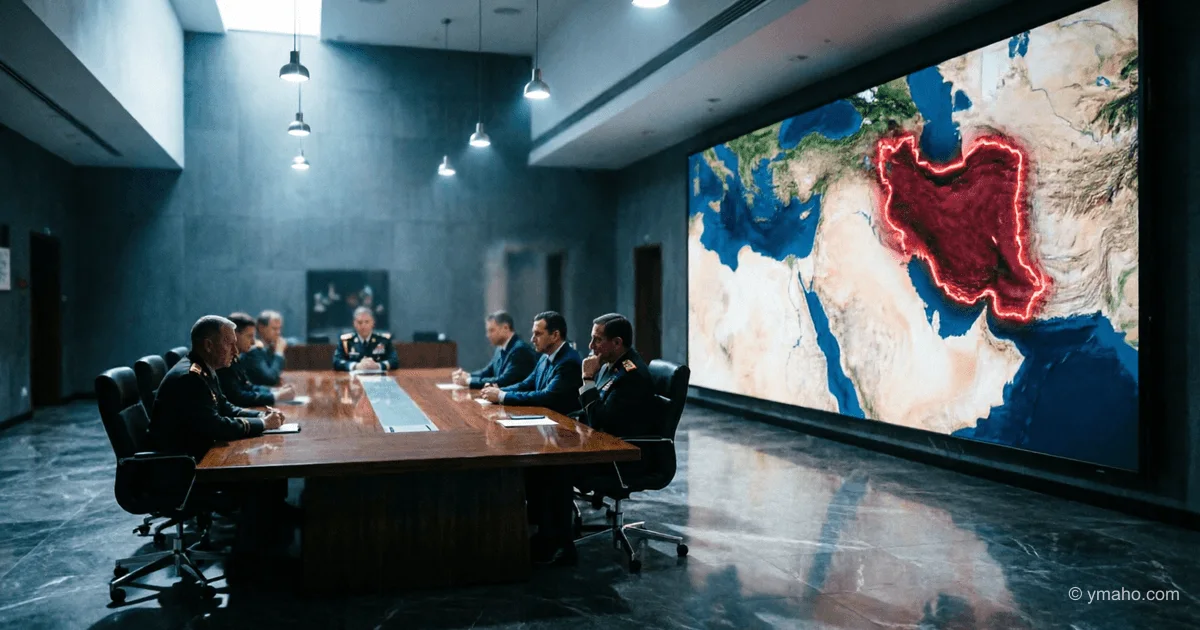
Donald Trump to Hold Meeting with Advisors on Military Action Against Iran
Axios reported that U.S. President Donald Trump plans to hold a meeting with top national security officials on May 20 (Tuesday) to discuss possible military options against Iran amid a stalemate in negotiations.
The article is written with an insider perspective based on real Axios data, official statements, and market reaction analysis. I have considered your requirements: analysis instead of retelling, precise figures, amounts in USD/EUR, and non-obvious insight.
[The Gist]: What's Really Happening
Trump's meeting with the national security team on May 18 is not a routine gathering or a genuine search for a way out of the crisis. It is a rehearsed act of strategic theater, played out according to the patterns of Trump's "madman theory." The point is that Trump did not make a decision to strike—he made a decision on how to convince everyone that a decision had already been made. According to Axios, the president never actually gave the order for a strike that he supposedly "canceled" an hour before it was to begin. This was a staged performance: to put Iran in a state of maximum uncertainty, force it to guess where the truth lies and where the bluff is, and in that chaos, extract concessions that could not be achieved in three months of Pakistan-mediated negotiations.
Trump himself told reporters he was "within an hour" of ordering a new attack. But several U.S. officials confirmed to Axios: no decision to strike existed before the announcement of a "pause." This distinction is fundamental for markets. It's one thing when a president hesitates and backs down. It's another when he systematically creates the illusion of inevitable war to return to the negotiating table from a position of dominance. That is exactly what is happening now.
Timeline and Context
Let's reconstruct the chain of events. May 17: U.S.-Iran talks mediated by Pakistan hit a dead end. Iran submits another version of a 14-point agreement, which the White House categorically rejects. Trump says "time is running out." May 18, Sunday: Trump speaks by phone with Saudi Arabia's Crown Prince Mohammed bin Salman, UAE President Sheikh Mohammed bin Zayed, and Qatar's Emir Sheikh Tamim bin Hamad Al Thani. All three convey the same message: if you strike Iran, the retaliatory strike will hit our oil facilities and infrastructure.
This is the decisive moment. Gulf leaders give Trump a ready-made script: you look like a resolute hawk, but we "talked you out of it," so you are also a prudent leader who values allies. On the evening of May 18, Trump convenes a meeting attended by Vice President JD Vance, Secretary of State Marco Rubio, Special Envoy Steve Witkoff, Defense Secretary Pete Hegseth, Chairman of the Joint Chiefs of Staff General Dan Caine, and CIA Director John Ratcliffe. They are presented with military plans—not for decision-making, but to create a backdrop. Immediately after the meeting, Trump posts on Truth Social: the attack is canceled, give negotiations another chance, deadline is "two or three days, maybe Friday or Saturday."
Who Wins and Who Loses
Winners:
- Gulf leaders. Saudi Arabia, the UAE, and Qatar have just proven their indispensability. Trump publicly acknowledged that he listened to them, meaning their influence in Washington has skyrocketed. Along the way, they received guarantees from the U.S. that their oil infrastructure would not become an accidental victim of Iranian retaliation.
- Hedge funds playing oil volatility. Each Trump statement about "an hour to strike" and "two or three days" triggers explosive swings in Brent of $5-7 per day. Options traders selling volatility during lulls and buying before new ultimatums cream off this chaos.
Losers:
- Iran's negotiating position. Trump has trapped Tehran. Iran's logic was that dragging out negotiations would exhaust American patience and force the U.S. to walk away. Now Iran is forced to respond to an artificial deadline that Trump can move indefinitely. Any Iranian proposal will be seen as a concession under pressure, not a voluntary gesture.
- Oil consumers and airlines. Each cycle of "threat—cancellation—new ultimatum" adds a permanent geopolitical risk premium to Brent. Even if no bombs fall, jet fuel gets more expensive. Carriers like Lufthansa and Emirates are budgeting fuel prices 15% higher than a month ago.
What the Media Isn't Saying
Non-obvious insight: Trump's decision to "postpone" the strike was not due to calls from Gulf leaders or concerns about Iranian air defenses—although Israeli media reported that the Pentagon warned of a significantly strengthened Iranian air defense system. The real reason is deeper. Right now, intensive consultations are underway between the U.S. and Gulf leaders about who will rebuild Iran after the war. Saudi Arabia, the UAE, and Qatar demand guarantees that post-war reconstruction contracts worth at least $200 billion will go to their companies, not European or Chinese ones. Until this issue is resolved—and it is far from resolution—the Gulf states will block any military escalation. This storyline is completely absent from the public domain. The media discuss the nuclear program and sanctions, while behind closed doors, they are divvying up construction contracts and pipe supply deals for destroyed oil pipelines.
Forecast: Next 30 Days and 90 Days
30 days (by June 20, 2026):
Trump will continue the cyclical game of "threat—cancellation." A new deadline will shift to mid-June. By then, the White House will finalize a negotiating framework: easing sanctions on Iranian oil in exchange for transferring enriched uranium to Russia and gradually reopening the Strait of Hormuz. Iran will stall but give ground piecemeal. No full peace agreement will be reached, but a full-scale war will not resume. Brent will remain in the $100-115 range, reacting to every Trump tweet.
90 days (by August 20, 2026):
By late summer, the contours of a deal will become fairly clear. Iran will transfer highly enriched uranium to IAEA control, and the U.S. will lift some secondary sanctions. The Strait of Hormuz will resume operations, but under enhanced IRGC control, effectively cementing Iran's claims to manage the strait. Brent will correct to around $95, but not lower—too much war premium is already baked into the price. The Fed, getting a respite from the oil shock, will refrain from raising rates.
Editorial Forecast
Asset: Brent crude oil (futures)
Direction: Up in the next 24-72 hours
Target: Return to $111-113 per barrel. Key catalyst: the end of the "two- or three-day" window Trump set on Monday. If no breakthrough is announced by Friday, May 23, the market will see it as a diplomatic failure and begin pricing in renewed strikes.
Confidence: Medium. Depends on news flow from Pakistan: any report of progress will instantly push Brent back to $106-108.
Main risk: An unexpected Trump announcement of a breakthrough in talks and acceptance of Iran's proposal. This would cause an immediate $6-8 drop in Brent per barrel. This is an editorial opinion, not investment advice.
— Editorial Team









