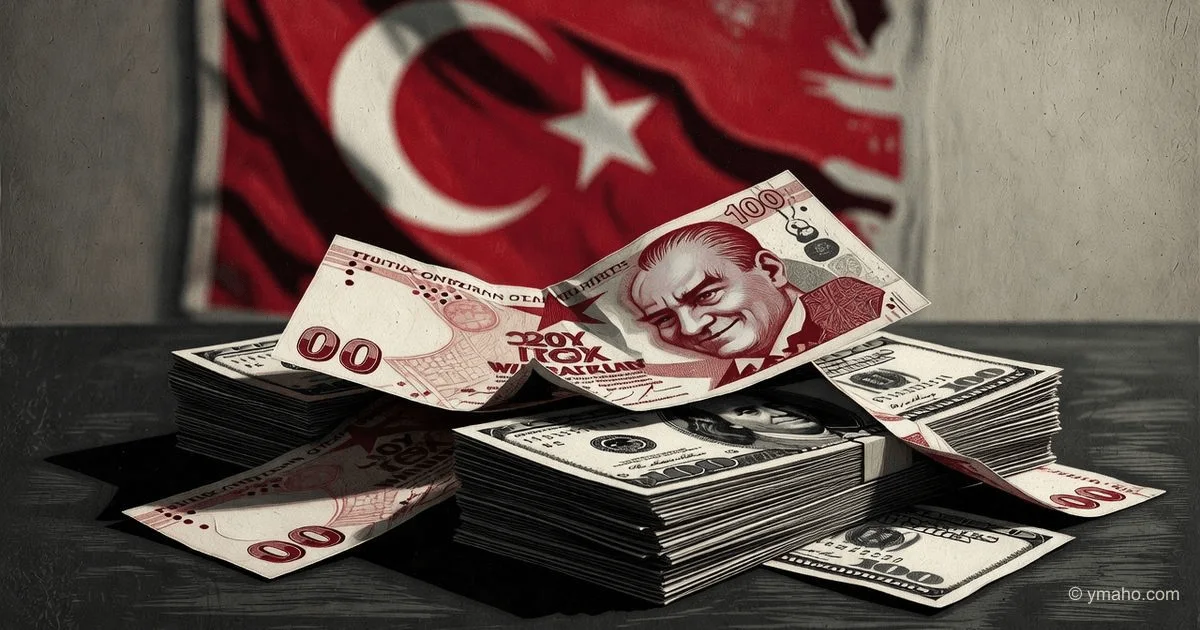
Turkish Lira Hits Record Low, Exceeds 46 per Dollar
Turkey's central bank has exhausted reserves to support the currency amid rising inflation and political uncertainty. The lira lost 8% in a week.
Turkish lira crashes above 46 per dollar: why reserves are depleted and the crisis is just beginning
[The Gist]: What's Really Happening
The official version you see in headlines says: "Turkish lira hits record low, exceeding 46 per dollar, central bank exhausts reserves, lira loses 8% in a week." That's true, but just the tip of the iceberg. In reality, Turkey is one step away from a full-blown currency crisis, comparable to Argentina's 2001 or Turkey's 2018, but with one key difference: Ankara no longer has a "safety cushion" of friendly lenders from the Persian Gulf.
The numbers that most outlets don't highlight as critical signals speak for themselves. In three months, Turkey burned through its gold and foreign exchange reserves at an alarming rate: holdings of US Treasuries fell from $16 billion to less than $1.8 billion — that's "almost a complete sell-off." Every week, the central bank spends $6-8 billion on interventions, and at the current pace, regular reserves will be exhausted within two months. Even the gold reserve of 700 tons, of which 120 tons were sold in the last two weeks, will only provide a delay of 3-4 months.
An insider fact you won't see in official statements: according to Jefferies International, the Trump administration is considering providing Turkey with a currency swap under the "Argentine model" — up to $20 billion — in exchange for political concessions before the elections. This is not aid, it's a deal, and its price for Turkey may be higher than default. But even if this swap materializes, it will only delay the inevitable by 3-4 months.
Timeline and Context
The lira's decline since the start of the year has not been linear but stepwise — each new round of geopolitical tension or economic data has pushed the currency to a new low. Below is a timeline of key events in recent months, showing how reserve depletion and political instability are pushing Turkey toward the abyss.
| Date | Event | USD/TRY Rate | What Was Overlooked |
|---|---|---|---|
| January 2026 | Start of year, relative stability | ~38.00 | Reserves were already shrinking, but it was hidden |
| March 2026 | Turkey sells US Treasury bonds | ~40.00 | US Treasuries holdings fell to $5 billion |
| April 2026 | Escalation in the Middle East, oil > $100 | ~42.50 | Energy bill rose by $2 billion per month |
| May 2026 | Rate breaks 45.74, BIST100 falls 6% in a day | ~45.74 | Record capital outflow: $14.8 billion in a month |
| Early June 2026 | USD/TRY exceeds 46.00, lira loses 8% in a week | ~46.08 | 10-year Turkish bond yield reaches 35.65% |
| June 15-16, 2026 (expected) | CBRT rate meeting | 46.00+ | Market prices in possible hike but doubts |
What's particularly important: official inflation in Turkey accelerated to 32.61% annually in May 2026, while the central bank keeps the rate at 37%. This creates a positive real rate of about 4-5%, but the market doesn't believe the math — inflation has been accelerating for two consecutive months, and the Central Bank of Turkey has already raised its year-end 2026 inflation forecast from 16% to 26%. This is an admission that policy isn't working.
Note the hidden factor that the market is only beginning to realize: the lira carry trade no longer works. Bank of New York Mellon directly warned that a mass exit from carry positions in MENA currencies (including Turkey) is putting additional pressure on the lira. Investors who for years borrowed in yen and invested in lira are now fleeing, creating a vicious circle.
Who Wins and Who Loses
The direct losers are obvious — Turkish households and small businesses. With the rate at 46 per dollar and import inflation significantly exceeding the official 32%, the real purchasing power of the lira domestically has fallen by 50-60% over the past two years. Turkey's credit risk, measured by 5-year CDS, has soared to 253-260 basis points, implying a market-estimated default probability of nearly 20%.
Also on the losing side are Turkey's international creditors, especially European banks holding significant amounts of Turkish sovereign and corporate bonds. Spain's BBVA and Santander, Italy's UniCredit — each has exposure to Turkey ranging from €3 to €8 billion. In case of default or forced restructuring, these banks would have to write off billions, creating secondary effects for the entire European banking system.
But there are also winners — and this is the less obvious part of the picture. Private investment funds specializing in distressed assets are already preparing for a "fire sale of Turkish assets." Just as Blackstone and Goldman Sachs bought up distressed commercial loans in the US, the same players are forming funds to buy Turkish government bonds at 40-50 cents on the dollar and privatize Turkish state assets (ports, bridges, power plants) at rock-bottom prices. The Turkish elite, in turn, have already transferred significant funds abroad — domestic confidence in the lira is absent.
In the forex market, the lira's fall creates opportunities for speculators, but not for long-term investors. USD/TRY has hit all-time highs, but all technical indicators point to an "overbought" condition: the RSI on the daily chart is at 78.65 — a zone that often precedes a correction. However, a "correction" in the lira's case could mean a pullback from 46.00 to 44.50, not a trend reversal. Short-term volatility will remain high: trading ranges, according to analysts, are 45.82-46.00 in the near term.
What the Media Isn't Saying
The biggest omission concerns the true state of Turkey's reserves. Official figures show that the Central Bank of Turkey (CBRT) still has a positive balance, but these numbers do not account for swap obligations to local banks. According to independent analysts, Turkey's net international reserves (excluding swaps and liabilities) are already negative — possibly in the range of -$10 to -$20 billion. That's why the CBRT has switched to a tactic of "quiet interventions" and gold sales — it can no longer afford public operations that would draw attention to the real situation.
The second hidden factor is political. In Turkey, pressure is mounting for early elections, and Erdogan's administration is considering all possible options to retain power, including external loans on onerous terms. The proposed $20 billion swap with the US is not just a financial operation. It's a lever for Washington to pressure Ankara on NATO issues, relations with Russia, and Middle East policy. Donald Trump, according to sources, is considering such a swap precisely as a pre-election gift to Erdogan in exchange for concessions on Syria and Iran.
The third insight concerns Turkish banks. Bizim Menkul in its report notes that the BIST100 (Istanbul Stock Exchange) fell 1.64% in one day, and the banking index lost 1.42%. But this is just the beginning. Turkish banks hold significant amounts of government bonds on their balance sheets, whose yields have risen to 35-43% depending on maturity. At such yields, the value of these bonds has fallen 20-30% from par. If banks have to recognize these losses at market value (mark-to-market), the capital of several large banks could go negative. Turkey's Ministry of Finance has already banned short selling and relaxed capital requirements to hide the problem.
Forecast: Next 30 Days and 90 Days
Next 30 Days (to mid-July 2026)
The Central Bank of Turkey's meeting is expected on June 23, and it will be a key event. Jefferies analysts believe the CBRT will likely not raise rates in June due to geopolitical uncertainty. However, inflation continues to accelerate, and without a rate hike, the lira could fall another 5-10% within two weeks after the meeting. Base case: USD/TRY will reach 48.00 by mid-July, especially if Brent crude remains above $95 per barrel.
Key risk: if the US announces a currency swap with Turkey (similar to Argentina), the lira could temporarily strengthen to 42.00-43.00. But I estimate the probability of such an announcement in the next 30 days at only 25-30%. Negotiations are ongoing but difficult, and the US side will likely drag its feet to extract maximum concessions.
90 Days (to mid-September 2026)
By September, if no miracle of external support occurs, Turkey will face a choice between default and full-scale currency controls. According to InvestingCube analysts, most investment banks forecast USD/TRY in the range of 48.00-50.00 by end-2026. I believe these forecasts are too optimistic: at the current pace of weakening (8% per week), the rate could reach 55.00-60.00 by September, especially if capital outflows accelerate.
What would this mean for the global economy? The direct effect is limited — Turkey accounts for only about 1% of global GDP. But indirect effects through confidence channels to other emerging markets could be significant. Investors will start asking "who's next?" — and eyes will turn to Egypt, Pakistan, and possibly larger economies like Indonesia or Brazil. A risk-off flight from emerging markets could become the dominant trend of the second half of 2026.
The critical level beyond which catastrophe follows is 50 per dollar. Psychologically, this threshold will signal panic selling by Turkish households, who have so far kept savings in lira (out of inertia or lack of alternatives). At 50, these savings will lose another 10-15% purchasing power, and a "flight to the dollar" will begin domestically — what in Turkey is called "dollarization." When that happens, the central bank can do nothing except impose strict currency controls, which is tantamount to admitting defeat.
Editorial Forecast
Asset — USD/TRY. Direction — continued rise in the next 72 hours, technical indicators show "strong buy" with 12 out of 12 buy signals from moving averages. Key levels: a break above 46.10 opens the way to 46.50-46.80, support is at 45.82. Confidence level — high (80%). Main risk — sudden announcement of a currency swap with the US (25% probability) or an emergency rate hike by the CBRT to 42-45%, which could cause a temporary correction to 44.00. Watch for news from Washington and Ankara in the next 48 hours — any statement about swap negotiations will sharply change the dynamics.
— Editorial Team