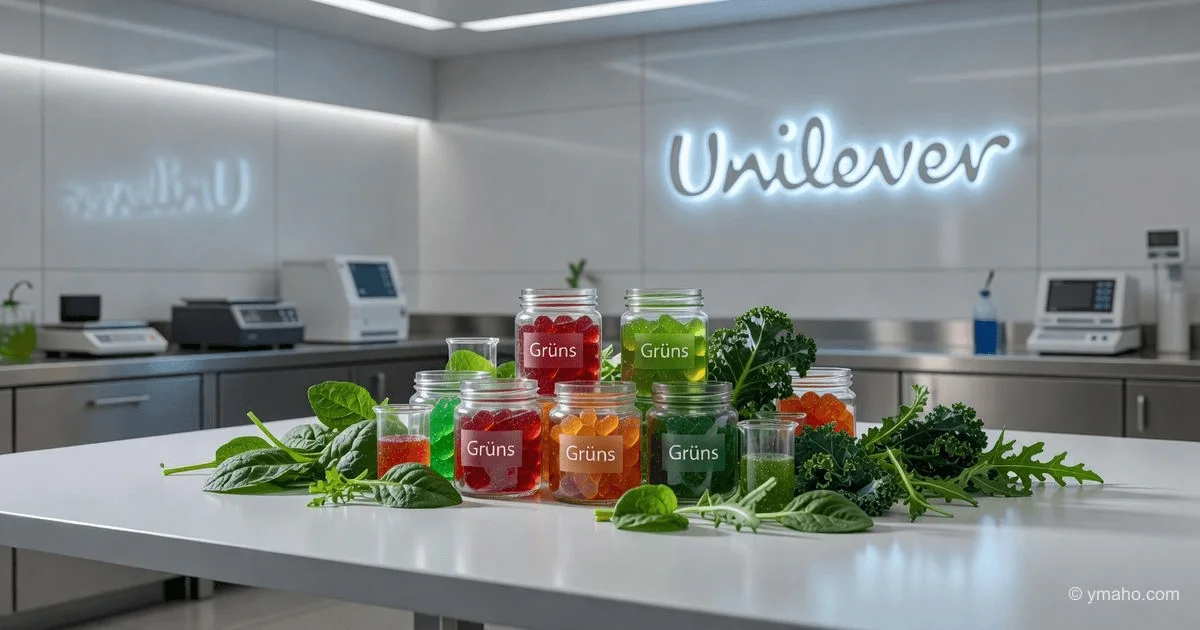
Beauty from Within: Unilever Buys Grüns, Betting Big on Supplements
The "beauty from within" concept is at its peak: Unilever has announced the acquisition of Grüns (superfood sticks). Experts claim the future of beauty is not external correction, but restoring cell signaling and detox through supplements.
While headlines paint an idyllic picture of a marriage of convenience between a consumer goods giant and a bold startup, behind the scenes, the most radical transformation of Unilever's business model in the last hundred years is unfolding. This isn't about gummy bears with superfoods now being sold at retail. It's about one of the world's largest mayonnaise and ice cream manufacturers rapidly exiting the food business to become something between a pharmacist, a beauty salon, and a personal nutritionist for you.
[The Gist]: What's Really Happening
The Grüns acquisition is not a story about an "innovative format" but a cold strategic calculation. Unilever paid $1.2 billion for a brand with annual revenue of about $300 million, giving a multiple of 4x. By FMCG industry standards, this is a high but not insane price, especially considering that Grüns, in just 32 months of existence, reached a daily shipment level of 10 million soft capsules and covered 1 million subscribers.
But look at the context. Just a few weeks earlier, in March 2026, Unilever announced a deal to merge its food business with McCormick & Company, valued at $44.8 billion. This effectively means exiting the food category (except for the Indian division). The company, long associated with Lipton, Knorr, and Hellmann's, is transforming into a nearly pure player in the beauty and personal care industry — a hybrid of L'Oréal and Nestlé Health Science.
Unilever CEO Fernando Fernandez, who has worked at the company for 38 years, has bet on a "simpler, faster, and more focused" structure, where 90% of revenue is generated by brands that are #1 or #2 in their segments. Grüns is not just a purchase; it's a building block in the foundation of the new business architecture.
Timeline and Context
2023 — Hindustan Unilever (the Indian division) buys a controlling stake in OZiva, a nutraceutical brand specializing in beauty and wellness. By February 2026, the company buys the remaining 49% for 824 crore rupees (about $99 million), making OZiva a wholly owned subsidiary. OZiva showed growth of about 130% CAGR over two years, reaching revenue of approximately 480 crore rupees.
March 2026 — The mega-deal with McCormick is announced, signaling Unilever's strategic exit from the food sector. Barclays analysts comment: "the prize of a pure-play home and personal care company will be worth it in the end."
April 9, 2026 — The purchase of Grüns is announced. Founder Chad Janice, a former private equity analyst, built the brand from scratch after observing the inconvenience of traditional supplement forms. He sold not pills, but an experience — grab-and-go gummies that consumers actually want to eat every day.
April 2026 — Unilever releases quarterly results. Despite a net loss of €1.13 billion due to write-offs related to its Russian business, revenue from continuing operations grew 5.7% to €12.1 billion. The Beauty & Wellbeing and Health & Hygiene divisions showed the strongest growth.
Who Wins and Who Loses
Winners:
Unilever — acquires a brand with unique engagement metrics: 95% of users take Grüns 4-6 times a week, 80% daily. This is not an impulse purchase at the supermarket; it's a subscription. A company that for centuries made money on impulse buys like Magnum ice cream is now buying a habit bordering on medical compliance.
Chad Janice, founder of Grüns — raised $45 million in investments and retained about 50% of shares. His stake after the deal is valued at least $450 million. This is one of the fastest and most profitable exits in consumer sector history.
Consumers in the US — Grüns is already the best-selling green superfood supplement on Amazon and in major retail chains. Under Unilever's wing, distribution and marketing budgets will expand exponentially.
Losers:
Traditional pharmacy and mass-market vitamin brands like Centrum and Nature Made. They sold in a "take your pill and forget it" format. Grüns repackages compliance into a bright jar with stickers, turning routine vitamin intake into an act of self-expression.
Independent functional food sellers. When Unilever, with its shelf space at Walmart and distribution in 190 countries, enters this category, small brands will either have to sell out or die.
Skeptics of "beauty from within." This deal is a powerful signal: the largest corporations are betting that the future lies in ingestible beauty. Those who considered this a niche trend risk missing a mainstream shift.
What the Media Isn't Saying
First non-obvious insight: The Grüns acquisition is not vertical integration but a bet on a paradigm shift in consumption. For decades, Unilever sold external solutions — creams, shampoos, soaps like Dove, which is "one-quarter moisturizing cream." Now the company is making a 180-degree turn, with its Wellbeing division CEO stating that what matters is not external correction but "cell signaling and detox" from within. This is a strategic response to the dead end of topical cosmetics: after every cream learned to "stimulate collagen," there are simply no new promises left for the skin externally. The industry is moving inside the body.
Second non-obvious insight: The McCormick deal is not about shedding ballast but acknowledging that packaged food has lost the war to GLP-1 agonists. Analysts directly point out: "increasingly health-conscious consumers and the rise of GLP-1 weight-loss drugs in recent years have eroded demand and investors' faith in packaged food." By selling mayonnaise and ice cream at their peak, Unilever is shifting capital to where the Ozempic consumer seeks salvation — supplements and wellness.
Third omission: The engagement metrics of Grüns that everyone admires are also its Achilles' heel. 80% of users take the product daily, but this means the brand lives in a mode of critical dependence on the quality of each batch. One mistake in the supply chain, one report of ingredient-label mismatch, and 80% of users will know about it the same day. For a traditional pasta sauce, that would be unpleasant; for a wellness brand with a medical aura, it's deadly.
Forecast: Next 30 Days and 90 Days
30 days (by June 7, 2026):
Unilever will begin integrating Grüns into its distribution network outside the US. The first markets will be the UK, Germany, and China — countries with a strong preventive health trend. Simultaneously, Unilever Wellbeing will issue a joint press release with Nutrafol (a previously acquired hair brand), announcing a "beauty from within ecosystem." Development of co-branded sets will begin: Grüns for general wellness plus Nutrafol for hair.
90 days (by August 8, 2026):
A new deal will follow. Given that Unilever received $15.7 billion in cash from the McCormick deal, the company clearly won't stop at Grüns. A likely target is a major brand in the personalized nutrition or hormonal health segment. The women's health & beauty supplements market was valued at $90.62 billion in 2025, with a projected growth to $157.26 billion by 2030 — too tempting a piece to stop at gummy bears.
Meanwhile, competitors — Nestlé Health Science and P&G — will accelerate their own deals in the supplement segment, fearing Unilever will capture the best assets. I expect a flurry of acquisitions in the $500 million to $2 billion range by the end of 2026, after which the ingestible beauty market will finally consolidate around three or four mega-players.
My personal conclusion: The Grüns deal is not about gummy bears. It's about the end of Unilever as a food company and the birth of Unilever as a health & beauty conglomerate that wants to accompany the consumer from the shower to breakfast and beyond — to the vanity table, now not with cream but with a jar of supplements. Whether a company that sold us mayonnaise for centuries can become an authority on cell signaling is an open question. But $1.2 billion is already on the line.
— Editorial Team









