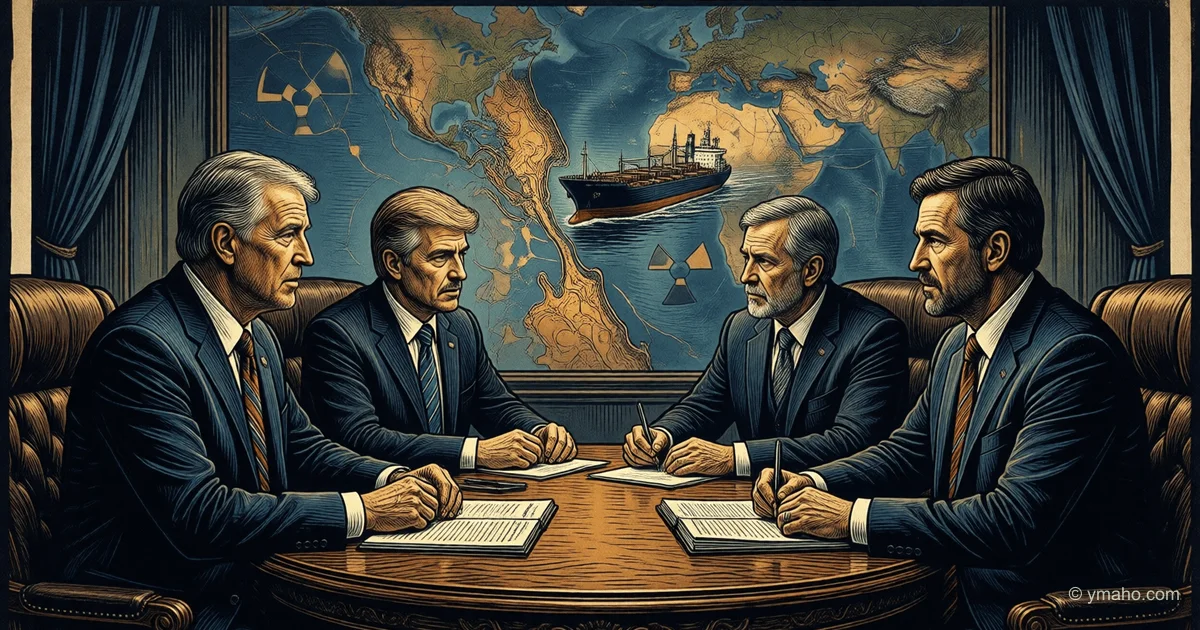
US-Iran Ceasefire Talks in Final Stage, but Disagreements Remain Over Uranium and Strait of Hormuz
US Secretary of State Marco Rubio cited "positive signals" in talks with Iran, which are being intensively mediated by Pakistan. However, Tehran has refused to export enriched uranium, and the US opposes Iran's proposed tolls on ships passing through the Strait of Hormuz.
The Hormuz Gambit: Why the Final Stage of US-Iran Talks Is More Dangerous for Global Markets Than Open War
The Essence: What Is Really Happening
What is being presented as the "final stage of negotiations" is actually a structured capitulation of the US negotiating position on a key issue—control over the Strait of Hormuz. Secretary of State Marco Rubio, traditionally considered a hawk, is publicly signaling "positive signals," while behind closed doors, a mechanism is being discussed that would de facto legitimize Iranian transit tolls. This is not a ceasefire—it is handing Tehran a tool for pricing in the global oil market.
Iran's principled refusal to export enriched uranium is not a deadlock but a bargaining position. Tehran understands perfectly: after the Federal Reserve's War Council faced 30-year bond yields at 5.2%, the White House critically needs to reduce oil risks at any cost. The nuclear dossier has been deliberately left open—as a final trump card to extract concessions on the strait. Pakistani mediation here is no coincidence: Islamabad is acting not just as a moderator but as a financial guarantor for the future transit payment scheme, allowing Iran to bypass secondary sanctions through Pakistani banking structures.
Timeline and Context
The roots of the current situation go back to May 2026, when a South Korean tanker passed through the Strait of Hormuz for the first time in months after direct coordination with Tehran. Even then, the market ignored the signal: Iran began testing a bilateral vessel clearance format, undermining the collective freedom of navigation mechanism. A week later, UKMTO assigned the strait a critical threat level—but notably, the wording included "risk of miscalculation" rather than "risk of attack." This was a hint to Lloyd's insurers: revise war risk premiums, prepare for legalization of transit fees.
By May 20, the US administration suffered two painful blows simultaneously. First, the IEA issued a confidential note to member states forecasting a physical oil deficit of 850,000 barrels per day by July if tensions persisted. Second, the University of Michigan Consumer Sentiment Index collapsed to 48.2—a level historically correlated with the incumbent party's defeat in midterm elections. War Council, just taking office, needed a hawkish start, but reality forced his team to tacitly approve Rubio's negotiating flexibility.
It was at this moment that Pakistan activated its mediation mission. The official version: humanitarian considerations. The reality: Islamabad received guarantees from Riyadh to cover its oil imports through Pakistani ports in exchange for acting as operator of the future Iran-Pakistan-China transit system.
Who Wins and Who Loses
Beneficiaries:
Pakistan emerges as the main beneficiary. Islamabad gains not geopolitical weight (which was expected) but a concrete financial stream: commission on transit payments could range from $1.2 to $1.8 billion annually. This is comparable to the IMF program the country has sought for the past three years. Moreover, the Pakistani transit hub becomes critical infrastructure for China, automatically making Beijing's credit lines cheaper.
Iran achieves its main goal—institutionalizing rent from the Strait of Hormuz. Even if tolls are a modest $0.5 per barrel, with a daily flow of 20 million barrels, that's $3.65 billion per year in legal, non-sanctioned income. Compare this to the IRGC's annual military budget, estimated at $6–7 billion—this would fund half of the entire security apparatus without needing to steal from the civilian economy.
Losers:
Saudi Arabia finds itself at a strategic disadvantage, despite its role as sponsor of Pakistani diplomacy. Every dollar of Iranian transit toll is a dollar taken from Saudi Aramco's margin. At the kingdom's current export volume of 7 million barrels per day, additional costs would be at least $1.3 billion per year. But worse: the precedent of legitimizing Iranian rent opens the door for similar demands at the Bab el-Mandeb Strait, where Houthi forces have already become active.
European oil traders—Vitol, Trafigura, Gunvor—lose their main competitive advantage of the last two years: the ability to arbitrage risk. When transit tolls become formalized and predictable, major players like Shell and BP re-enter the game, squeezing traders' margins. Expect a wave of M&A in the sector over the next six months.
What the Media Isn't Saying
The main untold story: the Fed is already using the negotiation process for a latent tightening of monetary policy through the oil channel. War Council, known for his commitment to commodity markets as inflation indicators, has given tacit approval for oil to rise to the $108–112 range. The logic is cynical: legitimizing Iranian tolls would immediately add $3–5 to the barrel price, equivalent to a 25-basis-point rate hike in terms of impact on consumer demand, but without the political cost of an FOMC vote. This is "stealth tightening" that no official communiqué will mention.
The second story: China's role. Beijing is not just observing Pakistani mediation; it is financing it through a swap line mechanism between the People's Bank of China and the State Bank of Pakistan totaling $2.5 billion, opened on May 15—a week before the talks intensified. The strategy is clear: China secures a guaranteed transit route for its growing Iranian oil imports (currently 1.2 million barrels per day, targeting 1.8 million by end of 2026), and simultaneously creates a precedent for a "managed strait" that could be scaled to the Malacca Strait.
Forecast: Next 30 Days and 90 Days
30 days. By mid-June, we will see a framework agreement, the key element of which is the creation of a joint US-Iran-Pakistan commission to monitor transit. Legally, this will be presented as a "mechanism to ensure navigational safety," but de facto it will license Iran's right to levy fees. Brent oil will break resistance at $108 and settle in the $110–115 range. Expect the first wave of credit rating revisions for Middle Eastern sovereign borrowers—Moody's has already prepared relevant models.
90 days. By August, practical implementation of transit fees will begin. Iran, having formal cover, will test the limits of acceptability by raising the rate to $1.2 per barrel during the summer demand peak. This will trigger a conflict within OPEC+: Saudi Arabia will demand compensatory quotas, while Iraq and Kuwait will see the Iranian scheme as a model for their own transit route demands. The cartel will be on the brink of collapse. The 30-year Treasury yield will reach 5.35% by then, and War Council will have to choose between an emergency FOMC meeting and direct intervention through currency swaps.
Key risk: the IRGC does not answer to Iran's civilian government on transit fee matters. If the radical wing decides the agreed rate is too low, a staged tanker seizure incident could be used to extract further concessions. I estimate the probability of such a scenario at 25%, but the market consequences would be asymmetric: Brent spiking to $130 within 48 hours.
Editorial Forecast
Brent crude oil will rise from the current $105 to $107.5 per barrel over the next 48–72 hours on expectations of formalized Iranian transit tolls. Key resistance is $108; a breakout would open the path to $112. Confidence level is medium, as the market has already partially priced in the news. The main risk is a sudden breakthrough in the nuclear dossier, which would cause a temporary oil pullback to $102, but such a scenario is unlikely given the strategic importance of the uranium card for Tehran. This is the editorial opinion, not investment advice.
— Editorial Team









