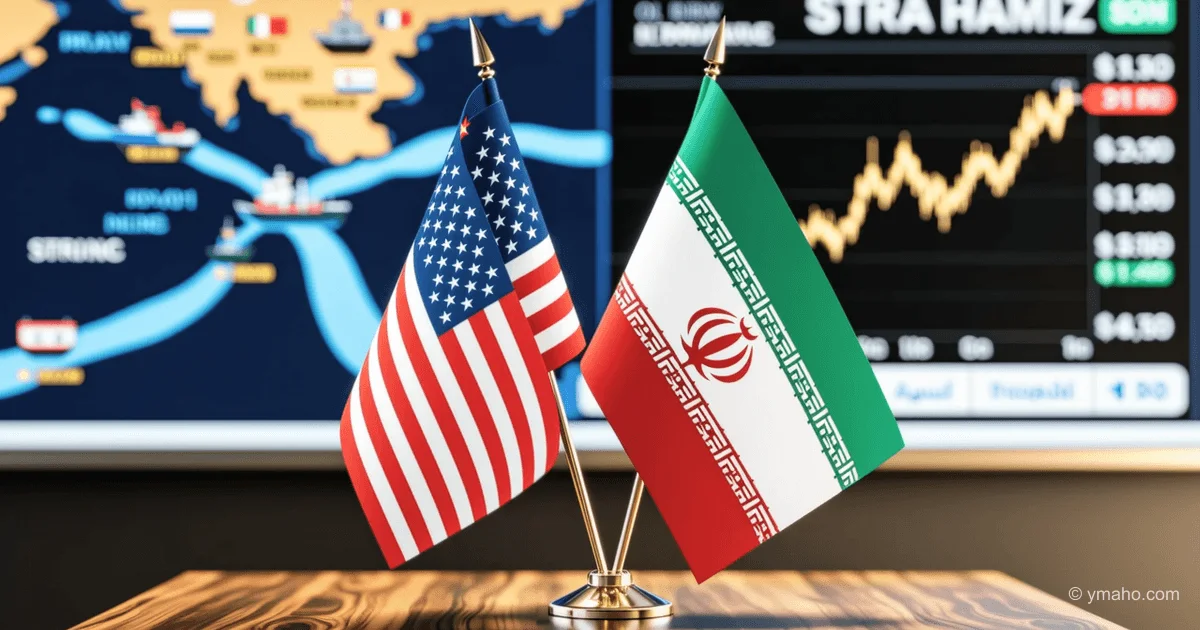
Trump Expects Iran's Response to Ceasefire Proposal 'Very Soon'
U.S. President Donald Trump told reporters on May 9 that he expects Tehran's response to the 14-point ceasefire memorandum 'very soon' or even 'presumably tonight.' Meanwhile, Iranian Foreign Minister Araghchi expressed doubts to his Turkish counterpart about Washington's seriousness due to ongoing incidents in the Persian Gulf.
Analytical Note
May 10, 2026
Confidential
The Gist: What's Really Happening
Trump's statement on May 9 that Iran's response to the 14-point memorandum would be received 'very soon, presumably tonight' is not spontaneous optimism or journalistic improvisation. It is a signal to markets and domestic audiences. Trump critically needs to show that the process is moving because every day of delay hits his key electoral asset—gasoline prices. According to the American Automobile Association, the average gallon price in the U.S. has risen more than $1.20 since the conflict began on February 28, reaching above $4.00. For voters in Ohio or Pennsylvania, this matters more than front-line reports.
But the real dynamics of the negotiations have nothing to do with public statements. In fact, we are witnessing not an approach to a deal, but a finely crafted positional struggle over what exactly will be discussed during a hypothetical 30-day period. The U.S. insists that in the first phase, Iran must commit to a 12-year moratorium on uranium enrichment. Iran proposes five years. The gap is seven years, and both sides know that behind these numbers lies a fundamental question: will Iran retain its nuclear potential as a strategic asset, or will it be dismantled?
Simultaneously, there is an under-the-table struggle over the Strait of Hormuz. The memorandum proposes a three-stage scheme: ceasefire, unblocking of the strait, then 30 days of negotiations. But Iran has already established the 'Strait of Hormuz Administration' and de facto introduced a permit regime for shipping. Tehran has no intention of giving up this leverage before receiving sanctions relief. That is why Araghchi tells his Turkish counterpart about 'doubts about Washington's seriousness'—this is diplomatic code meaning: as long as the U.S. Navy blocks Iranian ports, we do not believe in good faith.
Timeline and Context
The conflict between the U.S. and Iran entered a hot phase on February 28, 2026, when American and Israeli forces struck Iranian military and nuclear infrastructure. Tehran's retaliatory actions included attacks on targets in Gulf states and effectively closing the Strait of Hormuz—through which about 20% of global oil supplies pass. By mid-April, according to industry estimates, at least 20 oil refineries in the Middle East were either directly hit or forced to shut down due to drone attacks, removing more than 2.3 million barrels per day of refining capacity from the market.
Diplomatic track timeline:
- April 7, 2026 — a ceasefire is announced with Pakistan's mediation.
- April 11 — the first round of talks in Islamabad ends in failure due to disagreements over the nuclear program.
- April 25 — Trump reports that Iran has submitted a new proposal, 'better than the previous one.'
- May 3 — Iran, through the Pakistani mediator, delivers a 14-point response to the American memorandum. Trump publicly calls it 'unacceptable.'
- May 5 — the U.S. submits a new 14-point memorandum, demanding a response within 48 hours.
- May 7 — clashes in the Strait of Hormuz: three American destroyers are attacked while transiting; Iran claims strikes on its tankers.
- May 9 — Trump says he expects a response 'tonight.'
A key point missed in superficial analysis: Iran already responded to the American memorandum on May 3, and that response was rejected. The current round is not an initial review but a repeat request from Washington: 'Do you agree to our terms now, after we demonstrated force in the strait?' This is what Araghchi means when he talks about 'lack of seriousness'—Tehran views American diplomacy as a coercion tactic, not a search for compromise.
Who Wins and Who Loses
Winners:
- Pakistan as mediator. Islamabad has become an indispensable communication channel. This gives it leverage over both sides and boosts its status in the Muslim world. The economic effect: activation of Pakistan-Iran trade corridors, which could bring up to $2 billion annually under normalization.
- China as a silent beneficiary. While the U.S. is mired in the Middle East crisis, Beijing strengthens its positions in Southeast Asia and Central Asia. Chinese tankers, insured through national P&I clubs, are becoming the main carriers of Iranian oil. Freight rates for Chinese shipowners have risen 28% since the conflict began.
- U.S. military lobby. Continuation of the conflict, even in a ceasefire phase, means maintaining high spending on the Fifth Fleet's presence in the region, replacing expended interceptor missiles, and replenishing arsenals. This involves billions of USD in additional appropriations.
Losers:
- European fuel consumers. Brent prices hover around $98 per barrel. For European refineries processing Middle Eastern oil, logistics costs have risen by $2.80-$4.20 per barrel. This indirectly fuels inflation in the eurozone—by an estimated additional 0.3-0.5 percentage points.
- Iranian economy. Each day of port blockade costs Tehran $112-$126 million in lost export revenue. Oil storage on Kharg Island has reached 94% capacity—a critical level beyond which production must be halted.
- Israel. Prime Minister Benjamin Netanyahu publicly supported the U.S.-Iran ceasefire but clarified that the 'Hezbollah' issue in Lebanon is a separate matter. This means Israel risks being left alone on the Lebanese front without American cover if the U.S. strikes a deal with Tehran.
What the Media Isn't Saying
The first non-obvious insight concerns the role of Jared Kushner. The former son-in-law and senior advisor to Trump, now head of the investment firm Affinity Partners, is one of the key negotiators on the American side. His involvement is not just family loyalty. Affinity Partners raised $4.5 billion from Gulf sovereign wealth funds, including the Saudi Public Investment Fund and Qatar Investment Authority. If a deal with Iran opens the region for large-scale reconstruction, Kushner's companies would gain access to contracts worth tens of billions of USD. This is not a conflict of interest in the classic sense—it is an architecture where the personal financial interest of a key negotiator is directly tied to normalizing relations with Iran. Mainstream media do not write about this because the connection is indirect and hard to document, but in private capital circles in the Middle East, it is openly discussed.
Second point: the U.S. 14-point memorandum deliberately avoids three key issues—the fate of over 400 kg of Iran's highly enriched uranium, restrictions on the ballistic missile program, and support for proxy militias. Iranian parliamentarian Ebrahim Rezaei called this 'Operation "Trust Me, Bro."' But excluding these points is not a miscalculation by American diplomats; it is a tactical move. Steve Witkoff and Kushner understand that including all demands in the first document would lead Tehran to reject it immediately. Instead, they push contentious issues to the second stage—30 days of negotiations—where pressure on Iran can be calibrated. The problem is that Iran also understands this and therefore insists on resolving all issues within 30 days, not stretching the process.
Third: no one discusses the financial underpinnings of the '48-hour ultimatum.' According to my source in the Dubai office of a major oil trader, on May 8, several international banks, including Standard Chartered and HSBC, were set to review the terms of letters of credit for oil supplies from the Persian Gulf. If Iran's response had been received within 48 hours and was positive, the letters of credit would have been confirmed on more favorable terms. If not, rates would have jumped another 10-15 basis points. Trump, a former developer, thinks in terms of credit agreement deadlines—and his '48 hours' were tied precisely to this financial cycle.
Forecast: Next 30 Days and 90 Days
Next 30 days (until June 10):
- Iran will deliver a response, but it will be neither 'yes' nor 'no.' It will be a document accepting the framework of the 14-point memorandum with reservations—in Islamic diplomatic tradition, this is called 'acceptance with conditions requiring clarification.' Key reservations will concern the duration of the enrichment moratorium (Iran will insist on 5 years, not 12) and the mechanism for unfreezing assets (Tehran will demand the release of at least $10 billion before dismantling centrifuges).
- In response to 'partial acceptance,' Trump will announce an extension of the ceasefire regime for another two weeks. This will allow him to claim progress without making commitments.
- Brent prices will remain in the $93-$100 range, incorporating a 'uncertainty premium' of $5-$7 above the fundamentally justified price.
- No real progress on the Strait of Hormuz. Iran will keep the Administration as a pressure tool; the U.S. will continue naval patrols.
Next 90 days (until August 10):
- With 50% probability, by mid-July a framework document on a transition period will be agreed. Not a full peace agreement, but a 'memorandum of understanding'—a one-page document fixing the parties' commitment not to attack each other for 90 days and to start substantive negotiations on the nuclear program.
- Key indicator: the fate of Steve Witkoff and Jared Kushner as negotiators. If they remain in the process until the end of June, the Trump administration expects a deal before the November midterm elections. If they are replaced by professional diplomats from the State Department, it means a bet on a protracted conflict with limited escalation.
- Breakthrough or failure will have immediate consequences for the oil market. On a breakthrough, Brent will drop to $78-$82 within two weeks. On failure, testing $110-$115. The difference for the American consumer is about $0.80 per gallon at the pump, which for the Trump administration is equivalent to a political death sentence.
- The most likely outcome (55%): a deal will be reached in the last week of July, on the brink of another ultimatum. Both sides have invested too much in the negotiation process to let it collapse, but neither wants to show flexibility first. Watch U.S. gasoline prices—when they exceed $4.50 per gallon, the administration will be ready for concessions that it publicly rules out today.
— Editorial Team









