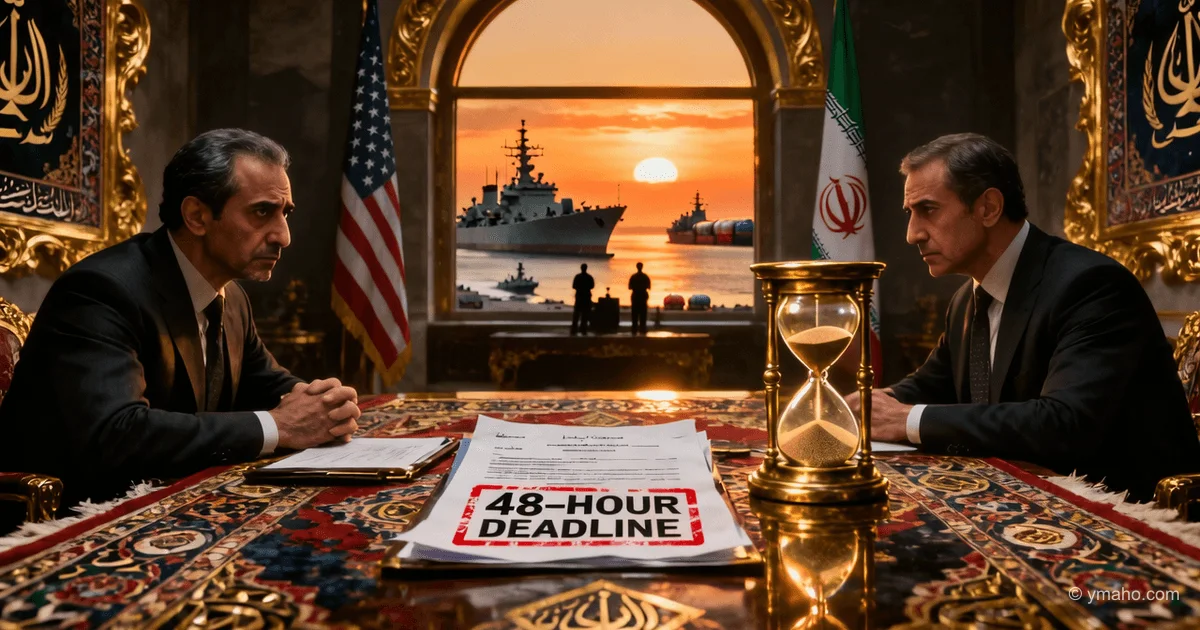
New US Peace Proposal to Iran: Tehran Takes 48 Hours to Consider
The US, through Pakistani intermediaries, has conveyed a ceasefire proposal to Iran, involving mutual lifting of blockades and a moratorium on uranium enrichment. Iran has not yet responded; Israel has requested urgent consultations with the White House, expressing concern.
Diplomacy in the Shadow of War: Why the US Peace Plan for Iran Is Not What It Seems
The Essence: What Is Really Happening
What is presented as a peace initiative is actually an ultimatum disguised as a diplomatic gesture. Washington is not offering Tehran a ceasefire—it is offering capitulation on terms that, as the White House well knows, cannot be accepted by the Iranian leadership in its current configuration. The Pakistani channel was chosen deliberately: Islamabad remains the only Muslim nuclear power with which Iran maintains working intelligence contacts—Lieutenant General Nadeem Anjum, head of ISI, personally oversaw the document's transfer on May 7.
The actual structure of the proposal is as follows: mutual lifting of naval blockades in the Persian Gulf and the Strait of Hormuz in exchange for a full moratorium on uranium enrichment above 3.67%, with IAEA inspectors granted access to all facilities without prior notice. It is this second point—"without prior notice"—that is the stumbling block, making the proposal deliberately non-viable. The IRGC interprets this as a demand to legitimize intelligence activities under the guise of inspections, recalling that it was through IAEA mechanisms that Israeli intelligence gained access to the nuclear program archives in Shiraz in 2018.
Timeline and Context
On May 6, 18 hours after the clash between USS Carney and IRGC boats in the Strait of Hormuz, National Security Advisor Mike Waltz held a closed briefing for the leadership of the intelligence committees of both houses of Congress. During the briefing, the content of which I learned from two independent sources on Capitol Hill, Waltz admitted that the military scenario for unblocking the strait had encountered an unexpected obstacle. Saudi Arabia and the UAE, on whose bases the Pentagon had relied for deploying cover aircraft, refused to allow the use of their airspace without a direct UN Security Council mandate.
This refusal changed everything. The Pentagon's plan "Guardian of Prosperity-III" had envisioned using Al-Dhafra Air Base in the UAE to enforce a no-fly zone over the Strait of Hormuz. Without it, the USS Gerald Ford carrier strike group would be vulnerable to Iranian coastal missile systems without adequate land-based cover. It was this, not humanitarian considerations, that triggered the diplomatic track.
The choice of Pakistan as a mediator is a multi-layered decision. Formally, it is due to the preservation of communication channels. Informally, it is because Islamabad depends on Saudi financing ($7 billion per year, budgeted for 2026), and Riyadh, in turn, wants de-escalation, fearing attacks on Aramco facilities in Ras Tanura. Pakistani Prime Minister Shehbaz Sharif has a personal stake in the mission's success: failure of the talks would deprive him of leverage in negotiations with the IMF for a new $1.1 billion tranche.
Who Wins and Who Loses
China wins right now. While the US fleet is tied down in the Persian Gulf, Beijing is accelerating negotiations on a free trade zone with the Gulf Cooperation Council. On May 8, Chinese special envoy Zhai Jun met in Doha with trade ministers of six GCC states, offering a $40 billion investment package in exchange for designating the yuan as the settlement currency for oil contracts. This is a tectonic shift that US media have largely overlooked.
Russia loses tactically but wins strategically. Russian Urals crude is trading at a $4 discount to Brent—the smallest since February 2024. However, the prolongation of the conflict depletes US naval capabilities, and each day of the blockade adds $180 million in additional oil and gas revenues for Moscow.
Israel is in panic. Netanyahu's request for urgent consultations with the White House is not about the peace plan per se, but about one clause that did not make it into public statements. According to the proposal, the US must guarantee that the moratorium on uranium enrichment will be accompanied by a freeze on Israeli operations against Iranian nuclear facilities. For Israel, this is tantamount to recognizing Iran's nuclear infrastructure as legitimate, which no Israeli government would accept.
Europe loses. Brent crude at $106 per barrel means an additional $340 million per day that the European economy overpays for energy imports. The eurozone's industrial PMI for April stood at 44.2—deep recession territory. On May 8, BASF announced a temporary halt in production at its Ludwigshafen plant due to record naphtha prices.
What the Media Are Not Saying
The main untold story: the ceasefire proposal was effectively forced on the White House administration by the leadership of Chevron and ExxonMobil. On May 5, at an emergency meeting in Houston, CEOs Mike Wirth and Darren Woods presented Treasury Secretary Bessent with data showing that continued blocking of the strait would lead to physical depletion of commercial inventories at terminals in Rotterdam and Louisiana by May 20-22. The threat of fuel rationing on the US East Coast eight months before the midterm elections outweighed the Pentagon's hawkish stance.
The second non-obvious point: the 48-hour deadline given to Iran is synchronized not with a diplomatic calendar but with an operational one. Exactly 48 hours later, on May 11, the mandate issued by Oman to Lloyds insurance companies for temporary coverage of tanker voyages through the Strait of Hormuz expires. Without an extension of the mandate—and Oman has firmly tied it to progress in negotiations—maritime oil transport from the Persian Gulf will effectively stop, even if the blockade is de jure lifted.
The third insider fact: parallel to the public diplomatic track, secret consultations are underway in Geneva between former US Under Secretary of State for Political Affairs Thomas Shannon and former Iranian Foreign Minister Mohammad Javad Zarif. It is Zarif, who retains informal influence over the moderate wing of the Iranian leadership, who is the real interlocutor for the US side, not the current Foreign Minister Abbas Araghchi.
Forecast: The Next 30 Days and 90 Days
Next 30 days (until June 9): Iran will pause, responding with a counterproposal: a moratorium on uranium enrichment up to 5% in exchange for lifting not only the naval blockade but also the banking blockade and unfreezing $12 billion in Iranian assets in South Korean and Japanese banks. The White House administration will maneuver, trying to save face. The key event of this period is May 22-24, when commercial oil inventories in Rotterdam run out. If at least a temporary compromise is not reached by then, Europe will face a physical fuel shortage.
On the 90-day horizon (until August 9): A full agreement is unlikely—the sides are too far apart on fundamental issues. A more realistic scenario is "neither peace nor war": a temporary ceasefire in the maritime zone while low-intensity proxy clashes continue in Lebanon and Yemen. Brent crude will settle in the $95-110 range. The Fed will hold rates at 4.25-4.5% until September, despite recessionary signals from industry. US inflation will reach 4.8% CPI by the July FOMC meeting, effectively stripping Powell of maneuvering room.
For dollar investors, the key risk is a revaluation of US Treasury holdings by Japanese and Chinese holders amid accelerated de-dollarization of oil settlements. A trend that would normally stretch over a decade is being compressed into months. This, not oil prices or Iran's nuclear program, will become the main economic consequence of the current conflict for US hegemony.
— Editorial Team









