Wall Street Pauses as US-Iran Talks Stall and Inflation Data Looms
The S&P 500 and Nasdaq paused their record rally amid rising geopolitical tensions due to stalled peace negotiations with Iran. Investors await the release of the Consumer Price Index, which is expected to show significant growth amid rising energy prices.
The Gist: What's Really Happening
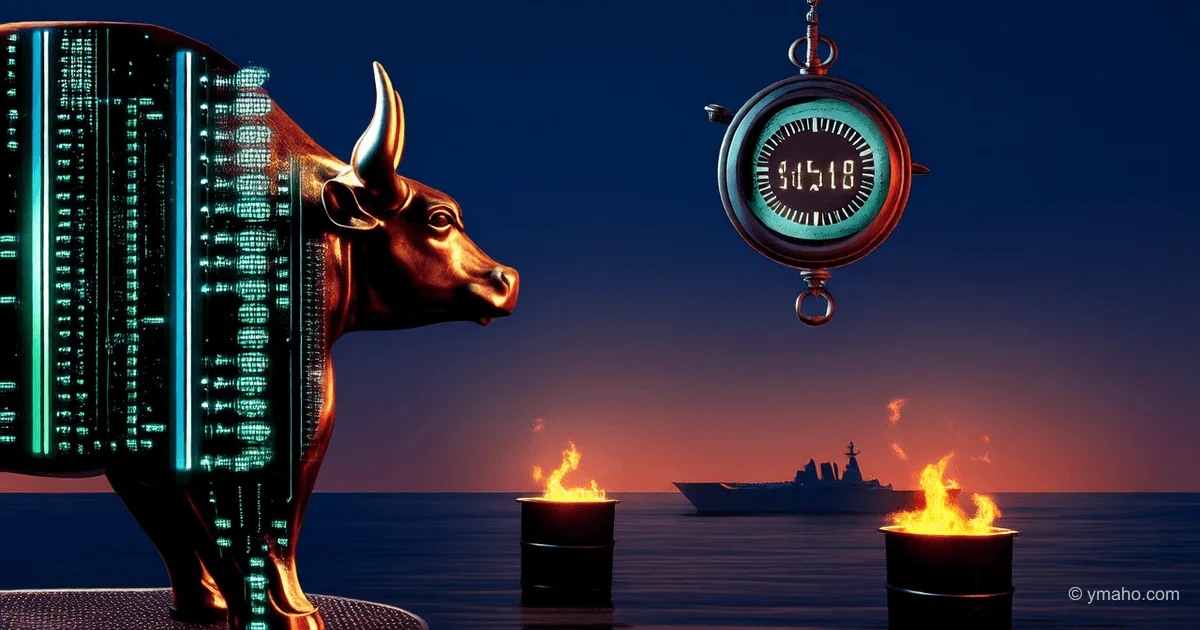
The market didn't pause because of the breakdown in talks with Iran per se. It paused because it hit the limit of its own logic. For three months, indices rallied on two narratives—a swift ceasefire and insatiable demand for AI infrastructure. On May 11, 2026, these narratives collided head-on, and the market froze, unsure which would prevail.
Donald Trump called Iran's response to the US peace proposal "absolutely unacceptable." Brent crude jumped nearly $3.20 to $104.5 per barrel; WTI rose almost $4 to $99.3. Yet the S&P 500 didn't crash—it even inched up 0.15% to 7,410 points, hovering near all-time highs. This contradiction—oil above $100 alongside record stock indices—is the central puzzle.
Art Hogan of B. Riley Wealth sums it up: earnings season is largely over, and the focus shifts back to the ability to restore oil flow through the Strait of Hormuz and lower energy prices—but that's not happening today.
The market is suspended between two narratives. The oil market screams risk: the strait, through which about 21% of global seaborne oil trade passes, has been paralyzed since late February 2026, with flows collapsing from roughly 20 million barrels per day to about 3.8 million. Saudi Aramco CEO Amin Nasser warned that markets may not stabilize until 2027 if disruptions continue for a few more weeks. The stock market counters: Alphabet's cloud revenue grew 63% year-over-year, Microsoft's AI business is generating $37 billion on an annualized basis, and Paul Tudor Jones declares the AI bull market has another year or two to run.
These two worldviews cannot both be correct—and the market is beginning to realize it.
Timeline and Context
- February 28, 2026: Hostilities begin between the US and Iran. The S&P 500 falls about 8% by March 30. Oil soars; the Strait of Hormuz is effectively blocked.
- Early April 2026: A ceasefire is announced. The market interprets this as a signal for immediate recovery. The S&P 500 not only recovers its losses but surpasses pre-war levels—breaking through 7,000, then 7,200, and setting new all-time highs by late April.
- Late April–May 2026: Brent crude exceeds $111 per barrel. But the stock market ignores it. Reason: Q1 2026 earnings season. Alphabet reports cloud revenue growth of 63% to $20.02 billion (vs. estimates of $18.05 billion); Microsoft shows annualized AI revenue of $37 billion—up 123% year-over-year. Profits are growing too fast for the market to ignore.
- May 10, 2026: Trump rejects Iran's response to peace proposals. According to the Wall Street Journal, Iran offered to transfer some highly enriched uranium to a third country but refused to dismantle nuclear facilities. Tehran denies these reports.
- May 11, 2026: The market opens lower but quickly recovers. The Dow falls 3.54 points to 49,605; the S&P 500 gains 11.38 to 7,410; the Nasdaq adds 10.19 to 26,257. Brent trades around $104.47 per barrel.
- May 12, 2026: Today. The market awaits the April Consumer Price Index release. Forecasts range from 3.5% to 4% annual inflation—a sharp jump from March's 3.3%. The energy component is expected to drive the increase.
Winners and Losers
Winners: Oil companies and the energy sector. Over the past six months, the energy sector in the S&P 500 has risen about 40%. Devon Energy is up roughly 25% year-to-date including dividends, plus announced a dividend increase and a new $8 billion buyback program after merging with Coterra Energy. Chevron benefits as an integrated major; ONEOK as a transport infrastructure operator with fee-based income less exposed to price volatility. Institutional investors have begun rotating from overheated tech into energy right now.
Winners: Those earning fee-based income from volatility. UBS reported Q1 2026 net profit of $3 billion—up 80% year-over-year, driven by record trading revenue amid market turbulence from the Iran war. The bank hit all-time highs in equities, foreign exchange, rates, and credit businesses.
Winners: Institutional investors who started rotating out of tech. The three largest companies in the S&P 500 tech sector now account for about 58% of the entire tech sector's weight. HALO sectors (Heavy Assets Low Obsolescence)—energy, utilities, industrials, materials—collectively weigh only 17% of the index, yet they are significantly less vulnerable to AI disruption and geopolitical shocks.
Losers: Retail investors sitting in overheated AI stocks without hedges. The S&P 500 is at all-time highs, but risk concentration is extreme: technology and communication services make up about 43% of the index. If CPI comes in hot and Fed rhetoric tightens, the blow will hit overvalued tech names.
Losers: The Federal Reserve. The market prices a 100% probability of rates staying unchanged at the current meeting, and now even an 18% probability of a rate hike by December 2026 is being considered. Bank of America issued a forecast pushing the first rate cut to mid-2027—six months later than previously assumed.
Losers: Consumers. The University of Michigan consumer sentiment index for May fell to 48.2—an all-time low (below even the 2008 crisis). Households' one-year inflation expectations rose to 4.5%. 70% of US farmers report they cannot afford the necessary amount of fertilizer.
What the Media Isn't Saying
Insight #1: The market is making the same mistake it made at the start of the Ukraine crisis in 2022.
UBS CEO Sergio Ermotti stated on Bloomberg Television on April 29 that financial markets are showing "excessive optimism" regarding the Iran conflict. And the numbers back him up. The S&P 500 closed at an all-time high of 7,173.91 in late April, despite negotiations remaining deadlocked. Brent crude crossed $111 per barrel. One market prices conflict resolution, the other prices risk. Both cannot be right simultaneously.
Deutsche Bank drew a direct parallel to 2022: the S&P 500 rose more than 10% in the first weeks of the Ukraine conflict on optimism over swift talks, then fell about 25% from its January peak to its October trough—the worst year since 2008. What looks like a recovery may be a trap; relief rallies and sustainable recoveries are easily confused in real time.
Insight #2: The problem isn't inflation itself, but where it hits—and that changes the game for the Fed.
The market is used to inflation hitting demand. But energy inflation hits supply. Rising jet fuel prices directly increase airlines' operating costs. Rising diesel prices translate into higher trucking costs—and thus into the final price of all consumer goods. Rising fertilizer prices mean lower crop yields, which with a 6–9 month lag will show up in higher food prices.
This is the "second wave" of the energy shock, not yet reflected in the data. Omar Sharif, analyst at Inflation Insights, forecasts that due to persistently high gasoline prices, May CPI could exceed 4%. This is exactly what IEA head Fatih Birol warns about: "We are facing the biggest threat to energy security in history."
Insight #3: The S&P 500 holds at highs not because of geopolitics, but despite it—making a fall more likely.
The market currently has two engines pulling in opposite directions. AI profits pull upward: Alphabet, Microsoft, and Amazon are growing at rates that overwhelm any macroeconomic noise. Paul Tudor Jones compares this to the early dominance of Microsoft in the 1980s and the commercialization of the internet in the mid-1990s. But simultaneously, oil above $100, a blocked Strait of Hormuz, and a Fed holding rates steady are fundamentally bearish signals that haven't gone away.
The key question: what happens if the AI narrative cracks? If even one of the hyperscalers—Amazon, Microsoft, Alphabet—delivers a weak quarterly report or cuts its capex forecast for AI infrastructure, the market loses its only bullish engine. At that moment, geopolitical risks—oil, Hormuz, inflation—will instantly become the dominant narrative.
Technical analysis confirms this risk. The 7,300 level on the S&P 500 is critical support. If buyers can't defend it, the price could fall to 7,200, then to 7,000 (the pre-war all-time high). A trigger for such a move could be a breakdown of the ceasefire with a return to active hostilities, combined with a hot CPI that forces the market to price in a rate hike—a stagflationary double whammy.
Forecast: Next 30 Days and 90 Days
30 Days (to mid-June 2026)
Today's CPI release is the first trigger. The base case for most economists: annual inflation of 3.5–3.8%, with potential up to 4% by some estimates. The market has partially priced this in, but if CPI exceeds 4%, the reaction will be sharp: Treasury yields rise, tech stocks come under pressure, and talk of rate hikes grows louder.
Simultaneously, the market will watch the meeting between Trump and Xi Jinping—the next potential geopolitical catalyst. The US intends to raise the issue of China's revenue from Iran and possible arms supplies. If the meeting signals coordinated pressure on Iran, oil could rise further. If there is any hint of Chinese mediation in peace talks, oil could fall.
The key risk over the next 30 days is that the divergence between the stock and oil markets reaches its limit. The S&P 500 between 7,300 and 7,500 is a "zone of uncertainty." A bullish scenario involves a formal ceasefire agreement through Pakistani mediation, oil dropping below $90, and the Fed returning to a neutral stance. A bearish scenario: ceasefire collapse, Brent above $110–115, CPI hotter than expected, and a rate hike on the agenda.
90 Days (to mid-August 2026)
By August, the fate of the Iran conflict as a key macroeconomic driver will be determined. Two scenarios are possible.
Prolonged conflict: Oil stays above $100, energy inflation spreads through the economy, CPI hovers near 4%. In this scenario, Bank of America is right: no rate cut until mid-2027. Beneficiary sectors: energy (continued growth), commodities, defense. Sectors under pressure: technology (overvalued), consumer discretionary (demand compression), real estate (high rates).
Conflict resolution: The Strait of Hormuz reopens, oil falls below $90, inflationary pressure eases. St. Louis Fed President Alberto Musalem has already said risks have shifted toward inflation and that holding rates "for some time" or even raising them may be necessary. But removing the geopolitical premium would give the market a powerful bullish impulse—the S&P 500 could target 7,600–7,700.
The most important thing for investors to understand right now: the market is trading not on fundamental company valuations, but at the intersection of two meta-narratives—the AI revolution and a geopolitical crisis. As long as the AI narrative dominates, the market ignores oil at $105. As soon as it weakens, geopolitical reality will strike.
Holders of overheated tech portfolios (35–40% allocation to technology and communication services) should consider rotating some capital into energy (5–8% of portfolio) and healthcare—sectors that benefit from the current macroeconomic configuration and offer better risk-adjusted returns.
The biggest risk for August: the market continues to ignore reality for a few more months, inflating a bubble in tech assets, then hits a trigger—a breakdown of the Iran ceasefire or a disappointing hyperscaler report—and corrects 15–25% in a few weeks. This is the classic 2022 pattern, and all the ingredients for a repeat are present.
— Editorial Team









