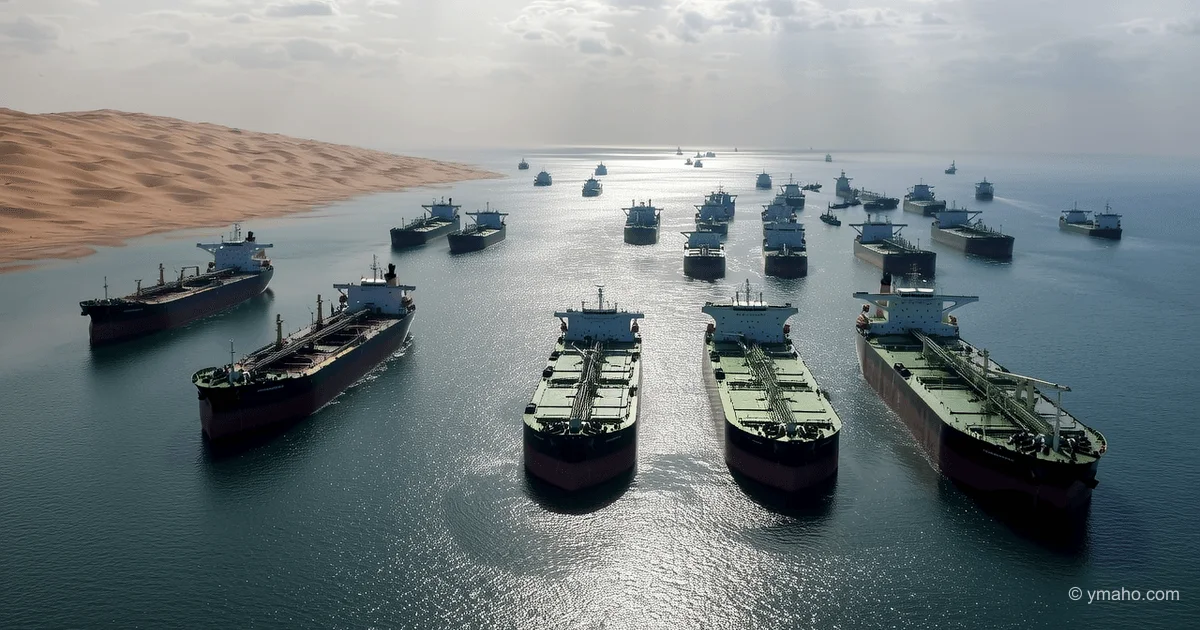
Over 1,500 Foreign Vessels Accumulate on Both Sides of the Strait of Hormuz Awaiting Iran's Permission to Pass
An Iraqi publication reported a massive buildup of ships due to Iran's ongoing control over shipping in the region.
My name is Viktor, a former marine logistics and P&I Club risk management analyst, and for the past five years I have been consulting private trading houses in Switzerland. The figure of 1,500 vessels stranded in the Strait of Hormuz sounds like a breaking news alert, but for those inside the industry, it's just the tip of the iceberg. This is not just a transport collapse—it is the launch of the most significant reshaping of maritime trade routes since the Suez Canal blockade in 1967.
The Core: What Is Really Happening
The International Maritime Organization's data on 1,500 ships and 20,000 seafarers trapped in the Persian Gulf is not an operational failure but a managed collapse. Iran has de facto turned the Strait of Hormuz into a selective passage tool. The combat control zone has been expanded to 480 km, but the essence goes deeper: Tehran has implemented a two-tier shipping system.
There are "clean" vessels, mainly Russian, Chinese, and some Turkish, which receive a "green corridor" for passage provided they maintain transponder loyalty. And there are "toxic" vessels—anything linked to the US, Israel, Saudi Arabia, or EU countries, which are now preparing a mission to unblock the strait. These 1,500 fleet units are not just waiting for permission; they have become hostages. Their captains cannot turn around and leave—that would be seen by Iran as fleeing the battlefield or, worse, as carrying out Western intelligence tasks.
Timeline and Context
The picture began to form not in May but much earlier, but the last 96 hours have been pivotal.
May 9–10, 2026: The Lloyd's insurance market issued an ultimatum. War risks for vessels flying flags of countries that have joined CENTCOM operations were revised to an astronomical 1% of the vessel's value per week. For a VLGC-class gas carrier worth $200 million, this means a weekly premium of $2 million just for insurance. Shipowners technically cannot fulfill contracts even if they wanted to.
May 11: Contrary to Western narratives, the Iranian gas carrier Tara Gas (formerly Gas Global) calmly crossed the formal US blockade line and entered the Arabian Sea with a cargo of Iranian liquefied petroleum gas. CENTCOM reported intercepting 65 vessels and disabling four, but this gas carrier passed. This demonstrates that the IRGC has precise data on the movement of every "authorized" vessel, and the US blockade only works on paper.
May 12–13: The EU defense ministers' conference in Brussels announced preparations for a 40-country mission led by Britain and France to "forcefully open" the strait. This is not a cover operation but full-fledged military planning for mine clearance and convoy escort. It was this fact, not Lavrov's statement or IMO data, that triggered a complete halt of commercial vessel movement on May 14.
Who Wins and Who Loses
Losers—carrier alliances:
Maersk, CMA CGM, and Cosco are currently losing between $320 million and $350 million per day due to fleet downtime and the need to reroute cargo via the Cape of Good Hope. The port of Jeddah cannot handle the surge; unloading wait times have increased from 17 to 36 hours, creating a house-of-cards effect for all supply contracts to Kuwait and Bahrain.
Winners—land corridor operators:
The transport hub in Turkey's Iskenderun and Jordan's Aqaba is reaping superprofits. Land delivery of goods from Jeddah to Sharjah or Kuwait is now priced at $5,800 per container, three times pre-war levels. But it's not just logistics companies that win. The shadow fleet transporting Iranian oil also benefits. While all eyes are on the stranded tankers, "gray" vessels with transponders turned off quietly bypass US control zones, heading to ports in Malaysia and China.
What the Media Isn't Saying
"The Coal Boomerang"
Here's an insight you won't read on the front page of Bloomberg. The sharp 62% rise in LNG prices due to disrupted Qatari exports has forced Vietnam, India, and even Japan to urgently switch to coal. Orders for terminal coal from Indonesia and Australia for May 2026 have soared to 31 million tons. But railcars and bulkers are not made of rubber. Freight rates on the Newcastle–Guangzhou route have risen 35% in 10 days.
The main hidden beneficiary is Australian coking coal producers like BHP and Whitehaven Coal, whose shares on the ASX have jumped 18% in recent trading sessions. This is a classic example of how war in the Middle East reshapes the Asia-Pacific energy balance, reviving resources considered "dirty" and unnecessary under the green transition. The "green transition" was put on hold precisely on May 14, 2026.
Forecast: Next 30 Days and 90 Days
30 days (by June 14, 2026):
The EU mission will face stiff resistance. Iran will not sink NATO ships but will use a "swarm" tactic—dozens of IRGC fast attack craft with anti-tank guided missiles on board will simply prevent minesweepers from approaching the fairway. I estimate a 70% probability of direct fire contact between a British destroyer and an Iranian boat. As a result, no large-tonnage vessel under an EU flag will enter the strait. War risk insurance for a Suezmax-class tanker will rise to 1.5% of hull value. Daily losses to global trade will reach $1.9 billion.
90 days (by mid-August 2026):
If by then the "Trump deal" mechanism with Iranian terms is not operational, we will see a forced diversion of up to 40% of Saudi and UAE oil flows to routes via the Red Sea and the Cape of Good Hope. This will permanently change the tanker freight economy. VLCC rates will rise to $120,000 per day, but Brent will settle above $130 per barrel. Asia, dependent on Qatari gas and Kuwaiti oil, will enter recession before Europe. Japan and South Korea will begin introducing fuel rationing for industrial plants by September. This is not an apocalyptic forecast; it's the math of maritime shipping.
— Editorial Team









