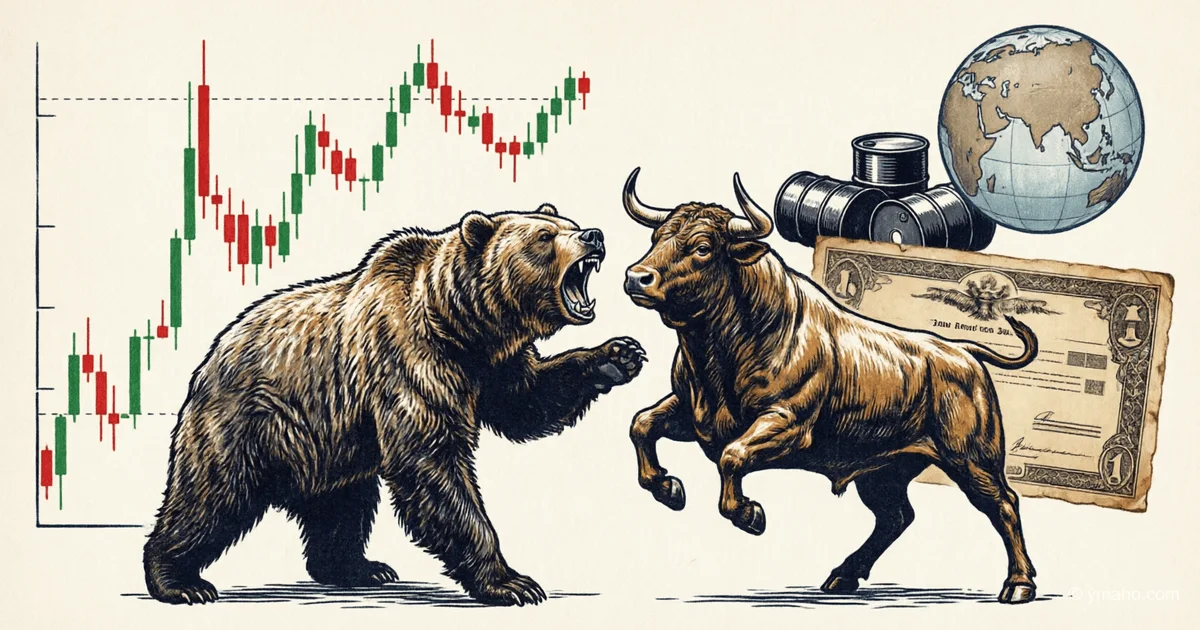
Asian stock markets fall following Wall Street amid geopolitical uncertainty
Stock indices in the Asia-Pacific region declined amid high oil prices and lack of clarity on the Middle East. Japan's Nikkei 225 fell 1.23%, while the yield on 30-year US Treasuries hit a high since 2007 at 5.18%.
The decline in Asian indices on May 20-21 is not just "geopolitical nervousness" blamed on morning reports from the Middle East. It is a structural disconnect between bond yields and equity valuations that has been building for months and has now entered an acute phase. While everyone is watching the Nikkei 225 charts, the real fire is raging in the market for the world's "safest" asset—30-year US Treasuries.
The core: what is really happening
On May 20, the yield on 30-year US Treasuries reached 5.18%—a level not seen since 2007. This is a tectonic shift. When a "risk-free" asset yields 5.18% annually in dollars, every portfolio manager recalculates the risk premium. Why invest in Mitsubishi or Toyota stocks with their volatility and forward P/E ratios around 12-14 when the US government pays over 5%?
It is this recalculation that triggered the wave of selling. The Nikkei's 1.23% drop is merely a delayed reaction to what happened in the fixed-income segment. Moreover, the Japanese market, having peaked near the psychological 40,000 yen level, became extremely vulnerable to profit-taking. Foreign investors, who were the main drivers of the Japanese stock rally, sharply reduced purchases: in the week through May 15, net inflows into Japanese stocks fell by ¥487.9 billion. This is a classic "smart money" signal before a reversal.
Timeline and context
Asian markets on May 21 did not just fall on negative news. They were paying for the breakdown of the correlation that investors had relied on for the past six months. For most of 2025 and early 2026, rising Treasury yields were accompanied by a relatively strong stock market because inflation was rising along with strong demand.
Now the situation is different. Inflation is rising due to a supply shock (the blockade of the Strait of Hormuz has sent oil prices soaring), while global demand is starting to cool. Data on foreign sales of Asian stocks for May is alarming: as of May 20, foreigners had withdrawn nearly $24.75 billion from the region, with $17.27 billion of that leaving just in the last week. South Korea experienced an unprecedented outflow of $13.14 billion, Taiwan lost $2.88 billion. This is not a correction—it's a flight.
Add to that local stories: a strike at Samsung with potential losses of 1 trillion won per day, scheduled for May 21, and the cautious stance of the Bank of Japan, which froze the rate at 0.75% but signals an inability to cope with imported inflation. Beijing, for its part, refused to cut rates, confirming that monetary authorities see no point in boosting lending amid an external storm.
Who wins and who loses
The biggest loser is the Japanese carry trade. Rising yields at the long end of the curve in the US and low rates in Japan create a classic trap. The yen remains weak (though it strengthened slightly on May 20), making Japanese assets cheap to buy but vulnerable when exiting. As soon as volatility in the bond market forces hedge funds to deleverage, they sell first what they recently bought on margin. The Nikkei, which absorbed the bulk of hot money inflows, suffers first.
Tech giants are losing. South Korea's Kospi fell nearly 1% despite Nvidia reporting better-than-expected results the day before. In the past, such a report would have lifted the entire Asian semiconductor chain. Now the market is not buying future growth because the discount rate has become too high.
The winners are physical dollars and short-term USTs. With rates at 5.18% on long-dated paper and expectations of a Fed rate hike, cash is king.
What the media are not saying
The media write about the "line in the sand" at 5% for 30-year Treasuries, breached on May 20. But they omit the mechanism that turns a simple yield rise into a weapon of mass destruction. That mechanism is the CLO (Collateralized Loan Obligations) market and the credit channel.
A rise in long-term bond yields immediately impacts the cost of corporate loans. Banks holding leveraged loan portfolios begin to book losses as spreads widen. This triggers a credit crunch—a contraction in lending. Small and medium-sized export-oriented businesses in Asia lose access to financing. Business optimism indices fall not because of geopolitics, but because banks are cutting credit lines. It is this, not missiles in the Red Sea, that is killing Asian growth.
Forecast: next 30 days and 90 days
30 days. The yield on 30-year US Treasuries will reach the 5.25%-5.50% zone, as BNP Paribas strategists predict. The Nikkei 225, which rebounded 3.33% on May 21 due to oversold conditions, will head lower again and settle below 59,000 points. Foreign selling in Asia will accelerate. The "bottom" has not yet been reached because the market is not pricing in a real recession, only a geopolitical risk premium.
90 days. If the Fed raises rates in 2027, as swaps imply, by August we will see a full-blown crisis in emerging markets. Asian currencies will weaken on average 5-8% against the dollar. However, Japan will have a specific opportunity: a sharp weakening of the yen amid Fed hawkishness and BOJ dovishness will revive interest in hedged carry trades, and the Nikkei could become a local beneficiary of capital flows from China and Korea into Japanese assets, perceived as a safe haven in the Asian region.
Editorial forecast
Asset: Nikkei 225 Futures (CME, yen)
Direction: Sideways with downside risk over the next 24-72 hours. The sharp rebound on May 21 will be bought, but any new spike in UST yields above 5.20% will trigger another wave of margin position closures.
Key levels: Resistance at 62,000, support at 59,800 (May 20 low). A break below opens the path to 58,500.
Confidence level: Medium. Daily volatility remains extreme. The trend is negative, but oversold conditions create opportunities for sharp 2-3% intraday bounces.
Main risk: A Trump statement on a deal with Iran, which would crash Treasury yields and bring foreign capital back into risk assets within a single session, sending the Nikkei above 62,000.
Editorial opinion, not investment advice.
— Editorial Team









