Bank of Canada Holds Rate Amid Weak Growth and Conflicting Oil Price Effects
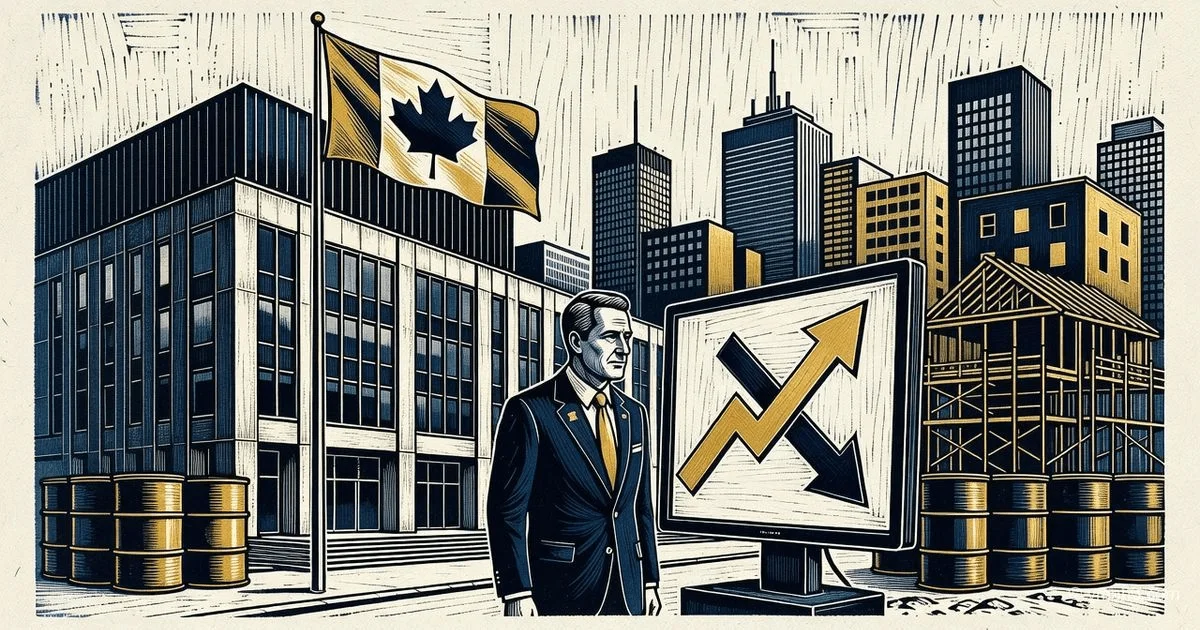
The Bank of Canada left its key interest rate unchanged as expected, citing weak economic growth and soft labor market conditions. The central bank notes two-sided risks to the rate, linked to inflationary pressure from oil prices.
Headline: The 'Two-Sided Risk' Trap: Why the Bank of Canada Froze Its Rate but Is Ready to Raise or Cut — and What Really Awaits the Loonie
Insider analysis: How a weak economy, high oil prices, and 'Macklem's trap' create a perfect storm for the Canadian dollar
[The Gist]: What's Really Happening
The Bank of Canada (BoC) on June 10, 2026, held its key interest rate at 2.25% for the fifth consecutive time. The decision was expected — 80% of economists polled by Reuters predicted a pause. But, as is often the case with central banks, the devil is in the details of the press release and the statements by Governor Tiff Macklem.
The official version: the central bank is balancing two equally likely risks. On one hand, weak economic growth (GDP contracted 0.1% in the first quarter, the second consecutive quarterly decline) and a soft labor market. On the other, high oil prices (Brent above $90 per barrel, $10 higher than the BoC's April forecast), which could lead to persistent inflation if the energy shock begins to spill over into other prices.
But there is one key nuance that official press releases gloss over: the BoC finds itself in a situation where its policy may be ineffective either way. A rate hike would kill the already fragile recovery (especially in the housing sector, which accounts for a third of the CPI basket). A rate cut would fuel inflation and weaken the Canadian dollar, making imports even more expensive. Holding the rate steady is simply a way to 'buy time' and shift responsibility to external factors.
Macklem described the situation as a 'dilemma' at the press conference, since a rate hike could slow growth, while easing could allow inflation to become entrenched. He also noted that 'the economy is weak but not in an outright recession.' This is a subtle distinction: a technical recession (two consecutive quarters of negative growth) exists, but Macklem refuses to use the word to avoid panic.
The most important point that news headlines miss: the phrase 'ready to act as needed' was left unchanged from the April statement. This signals to the market that the BoC is not tying its hands. Unlike the ECB or the Bank of England, which have more predictable trajectories, the BoC leaves both doors open — both a hike and a cut. Economists at Scotiabank called the press conference a 'dud,' saying they could have simply canceled the event since nothing new was said.
Timeline and Context: From 4.5% to 2.25% and Back?
| Date | Event | BoC Rate | Significance |
|---|---|---|---|
| Mid-2024 | Start of easing cycle | 4.5% → | 100 bps cut over the year |
| End-2025 | End of easing cycle | 2.25% | Reached lower bound of neutral range |
| Jan-Jun 2026 | Five consecutive meetings — no change | 2.25% | Longest pause since 2020 |
| June 10, 2026 | Fifth consecutive meeting — rate at 2.25% | 2.25% | Market prices in 25 bps hike by year-end |
| July 15, 2026 | Next meeting + MPR release | Expected: 2.25% | Key moment — new inflation forecasts |
Key Canadian Economic Indicators (as of June 2026):
| Indicator | Value | What It Means |
|---|---|---|
| Key rate | 2.25% | Lower bound of neutral range |
| GDP (Q1 2026) | -0.1% annualized, second consecutive decline | Technical recession, though BoC denies |
| Unemployment (May) | 6.5-7% (fluctuating) | Labor force 'little changed since start of year' |
| CPI inflation (April) | 2.8% y/y | Within target range 1-3%, but expected to rise to 3% |
| Core inflation | ~2.0% | Well-anchored expectations |
| Brent oil price (vs. April MPR) | +$10/barrel | Key risk for inflation |
| Market expectation (OIS) | +25 bps by end-2026 | Market does not believe in 'pause forever' |
What Economists at Major Banks Say:
| Bank/Expert | Rate Forecast by End-2026 | Key Argument |
|---|---|---|
| Desjardins | No change until 2027 | Economy in excess supply |
| TD Securities | No change in 2026, hike to 2.75% in 2027 | Well-anchored expectations |
| Scotiabank | Neutral forecast, but criticizes BoC | Macklem overestimates trade risks |
| Rabobank | No change until year-end | Structural weakness in consumption |
| CIBC Capital Markets | 'Very patient' bank, pause | Any hike would be 'sequential' |
| Aviva Investors | 'Signal of patience, not comfort' | Don't rush to conclusions about a hike |
| Ninepoint Partners | Hike hard to justify | Housing too weak for a hike |
Who Wins and Who Loses
Winners:
Borrowers with floating rates (mortgage holders, businesses): 2.25% is historically low for Canada, especially considering the rate was 4.5% in 2024. No hike means their loan payments won't rise in the coming months. The government also sent $3.1 billion in checks to low-income households on June 5 and increased GST/HST credits by 25% for 5 years, supporting consumption.
Exporters to the US (especially energy and lumber): A weak Canadian dollar (USD/CAD around 1.3970-1.4020) makes Canadian goods cheaper for US buyers. Export volumes have been rising since summer 2025 thanks to the weaker CAD and a growing US economy. The threat of US tariffs remains, but for now it's a bargaining chip in negotiations, not a reality.
Sellers of USD/CAD options in the 1.3900-1.4030 range: The currency pair is consolidating in an ascending channel, and option sellers collect premium on low volatility. Technical levels: support at 1.3960 (channel floor), resistance at 1.4020-1.4030.
US energy importers (indirectly): Canada is the largest oil supplier to the US. A weak CAD and high oil prices ($90+ Brent) create a 'double whammy' for US consumers, but Canadian producers benefit.
Losers:
Canadian importers of consumer goods: With USD/CAD at 1.40, each US dollar costs 1.40 CAD. Imports from the US (food, electronics, cars) are 5-7% more expensive than a year ago when the rate was closer to 1.32. This squeezes retail margins and ultimately feeds into inflation.
Canadian travelers and the tourism industry (inbound): For Americans, travel to Canada has become cheaper (good for Canadian tourism), but Canadians traveling to the US pay 6-8% more. The balance is negative for Canada, as Canadians spend more abroad than Americans do in Canada.
Holders of long-duration Canadian bonds: Yields on 2-year Canadian bonds rose before the meeting and then consolidated. But if the BoC is forced to hike due to inflation, long bond prices will fall. For now, the market prices in one hike by year-end, creating risk for dovish positions.
Funds betting on divergence between BoC and Fed policy: The Fed holds rates at 4.25-4.50% and is not cutting (CPI inflation 4.2%). The BoC is at 2.25%. The 200-225 bps spread is comfortable for carry trades, but if the Fed hikes or the BoC cuts, positions could be closed at a loss.
What the Media Isn't Saying
Insight #1: The BoC cannot raise rates because it would kill the housing sector, but it cannot cut because that would fuel inflation — a classic central bank trap.
Housing accounts for a third of the CPI basket in Canada. At a 2.25% rate, mortgage payments are already at the limit for many households. Any rate hike would trigger a wave of defaults and a drop in real estate prices, hitting the banking system.
At the same time, inflation is already accelerating: CPI hit 2.8% in April and, according to TD Securities, will peak around 3% in Q2 2026. This is above the BoC's target (2%) but still within the target range (1-3%). If the BoC cuts rates, inflation could easily exceed 3% and spiral out of control.
Holding the rate is not a 'golden mean' but simply the 'least evil.' The central bank hopes that inflationary pressure from high oil prices will prove temporary ('look through' in BoC terminology) and that the economy will recover in the second half of the year without additional stimulus.
Insight #2: Macklem overestimates the threat of trade wars and underestimates structural changes in the Canadian economy.
Scotiabank, in its analysis, sharply criticizes Macklem: 'I still believe Macklem overestimates trade policy risks. Exports have been recovering since summer 2025, and the weakening CAD amid a growing US economy is why export volume trends are sustainable.'
But there is an even deeper point: the BoC's statement did not mention two crucial structural changes. First, government spending and transfers ($3.1 billion + increased GST/HST credits) that will support consumption. Second, the AI boom, which also went unmentioned despite Canada being home to many AI startups and data centers.
This means the BoC may systematically underestimate the growth potential of the Canadian economy in the second half of 2026. If the economy recovers more strongly than expected while inflation remains high, the BoC will be forced to raise rates despite housing weakness.
Insight #3: The market prices in a rate hike by year-end, but 80% of economists expect a pause — this is rare and creates volatility.
According to a Reuters poll, over 80% of 34 economists expect the BoC to keep rates at 2.25% through end-2026. However, money markets (OIS — overnight index swaps) still price in a 25 bps hike by year-end with a probability of around 50-60%.
This gap between economist forecasts and market expectations is rare. Usually, markets react faster to data than analysts. Here, the market seems to believe that inflationary pressure from oil and government spending will outweigh, while economists focus more on GDP and housing weakness.
Who is right? Probably no one. The BoC, like other central banks, will make decisions based on data (data-dependent). This means any CPI release, employment data, or oil news will cause sharp moves in USD/CAD. Trading the Canadian dollar in the coming months will be like a roller coaster, not a smooth sail.
Forecast: Next 30 Days and 90 Days
Next 24-72 hours (until June 15, 2026):
USD/CAD: Trading in the 1.3960 – 1.4030 range. Technical picture: ascending channel on H4 remains, price above Ichimoku cloud, indicating a bullish trend. Key support: 1.3960 (channel floor and buyer interest zone). Resistance: 1.4017-1.4030 (local high, false breakout).
Breakout probability: Below 1.3960 with active stop-loss on short positions — this is a 'bull trap,' according to some traders. A breakout above 1.4030 would open the path to 1.4100, but that requires a strong catalyst (e.g., a new spike in oil prices or escalation in the Middle East).
Reaction to oil: Brent is fluctuating around $88-90. If Iran closes the Strait of Hormuz or attacks resume, oil could jump to $95-100, and the CAD would strengthen (USD/CAD falls to 1.3850-1.3900) since Canada is an oil exporter. Paradoxically, high oil prices are theoretically good for the CAD, but in practice they also signal a global recession, which ultimately hurts the CAD.
Next 30 days (until July 12, 2026):
USD/CAD: Range 1.3800 – 1.4150. Key drivers: Canadian CPI data for May (expected 2.9-3.0%) and June employment data. If CPI exceeds 3%, the market will start pricing in a BoC rate hike with 70-80% probability, and the CAD will strengthen to 1.3850-1.3900.
Key date — July 15, 2026: Next BoC meeting, which coincides with the release of the Monetary Policy Report (MPR) — the quarterly forecast. This is when the BoC will present updated estimates for inflation and growth. If the MPR shows that inflation will remain above 2% longer than expected, it will signal a possible hike in the second half of 2026.
Best 30-day strategy: Sell strangle options on USD/CAD with short strikes at 1.3800 and 1.4150. Expect the pair to stay in range until the July MPR. Volatility will likely remain low as the BoC is in wait-and-see mode.
Next 90 days (until September 12, 2026):
USD/CAD (base case, 60% probability): Drift up to 1.4200-1.4300. Reasons: weakness in the Canadian economy (GDP contracting, unemployment rising), high oil prices already priced in, and the market shifting focus to the rate differential with the Fed (4.50% vs 2.25% = 225 bps in favor of the USD).
Alternative scenario (25% probability): If the BoC begins signaling a hike (e.g., in the July MPR) due to persistent inflation, USD/CAD could fall to 1.3600-1.3700. But this is unlikely, as it would require three conditions: CPI above 3.5%, strong GDP growth in Q2, and no recession.
Pessimistic scenario (15% probability): Global recession due to escalation in the Middle East, oil at $120+, CAD falls to 1.4500-1.4700, despite Canada being an oil exporter. In a recession, all commodity currencies fall regardless of their structure.
Key risk for the Canadian economy: US tariffs. If Trump imposes significant tariffs on Canadian goods (currently negotiations on CUSMA revision are ongoing), the BoC would be forced to cut rates to support growth, even if inflation is high. This would lead to a sharp weakening of the CAD. For now, this scenario is assessed as low probability (20-25%), but the stakes are enormous.
Editorial Forecast
Asset: USD/CAD
Direction: Sideways in the 1.3960-1.4030 range over the next 24-72 hours, then likely a drift up to 1.4150-1.4200 within 30 days on continued weakness in the Canadian economy and the BoC's pause.
Key levels: Support — 1.3960 (20-day EMA and channel floor), a break below opens the path to 1.3900-1.3920. Resistance — 1.4030 (local high), 1.4100 (psychological level).
Confidence level: Medium (60%). Main risk — unexpectedly high Canadian CPI data (above 3.0%), which would force the market to revise BoC rate expectations toward a hike, and USD/CAD could fall to 1.3850-1.3900.
Key risk to the forecast: Escalation of the Middle East conflict with a subsequent spike in oil prices to $100+. In that case, the CAD could strengthen (USD/CAD falls to 1.3800) in the short term, but if the conflict escalates into a full-scale war, a global recession would crush all commodity currencies, including the CAD, to 1.4500. Probability — 15-20%, but the consequences are catastrophic for the forecast.
The editorial opinion is not investment advice. All trading decisions are made by you.
— Editorial Team