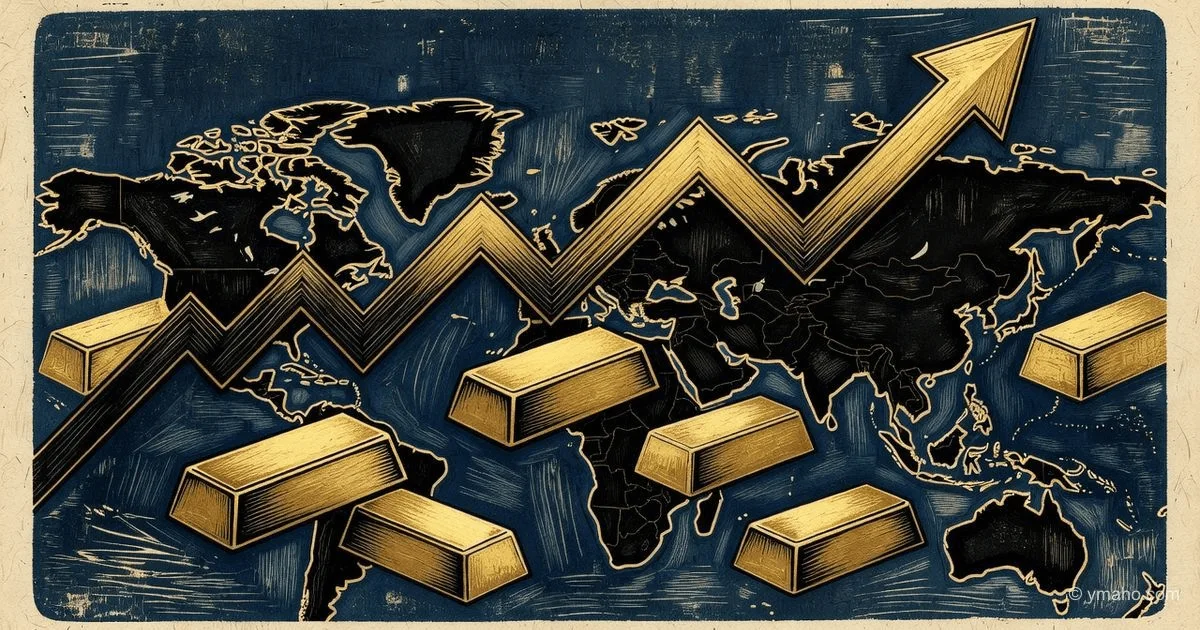
Gold Rises on Risk Aversion and Fed Pause Expectations, Reaching Multi-Month Highs
Amid dollar fluctuations and ongoing geopolitical tensions in the Middle East, investors are actively turning to safe-haven assets. This is pushing gold prices higher, setting new record highs on expectations of Fed policy easing.
Headline: Gold Rush 2.0: Why Record Growth Is Not a 'Flight to Safety' but a Reset of Global Reserves
Insider view: geopolitics as a trigger, central banks as the driving force, and a hidden signal of the end of the dollar era
[The Gist]: What Is Really Happening
Trump's announcement canceling strikes on Iran and promising 'peace soon' did not cause gold to fall, as one might expect, but rather a sharp jump—from $4,071 to $4,215 per ounce (a $144 gain on the evening of June 11). At first glance, this is a paradox: a reduction in geopolitical risk should decrease demand for safe-haven assets. But gold is behaving differently, and there are three systemic reasons for this.
First, the market has stopped believing in the dollar as a reliable 'safe haven.' Gold is rising not out of fear of war, but out of fear that remains after the announcement of peace. Investors and central banks no longer automatically return to the US currency after the geopolitical premium is removed. They stay in gold because they are uncertain about the future.
Second, Trump may cancel strikes today, but the market remembers that escalation was real, and the Strait of Hormuz is not yet open. Iranian mines remain in the water, warships are in position. Even if a peace agreement is signed, restoring oil supplies will take months, and the geopolitical premium in gold prices will not disappear until the strait is operating at full capacity.
Third, the main driver of gold's rise now is not speculators, but the world's central banks. In the first quarter of 2026, they bought 244 tonnes of gold—3% more than in Q1 2025 and above the five-year average. This trend has not only slowed but intensified in April-May, despite the price correction. Central bank gold purchases have become a strategic choice, not a tactical hedge.
The key insight that is overlooked: 'risk aversion' is only half the truth. The other half is 'flight from the dollar' as a reserve currency. According to the European Central Bank, gold's share in global official reserves has reached 27% for the first time, surpassing the share of US Treasury bonds. This is a tectonic shift happening before our eyes, and it has nothing to do with the Middle East conflict.
Timeline and Context: How We Got to $4,200+ and Why It's Not the Limit
| Date | Event | Gold Price (USD/oz) | Reaction |
|---|---|---|---|
| January 2026 | Peak of rally after US elections | $5,597 | All-time high |
| April-May 2026 | Correction on strong US labor market data | $4,500 → $4,350 | Decline on expectations of high Fed rates |
| June 10, 2026 | US CPI release: 4.2% (above forecast) | Drop to $4,100 | Inflation = Fed rates higher for longer = gold cheaper |
| June 11, 2026, 14:30 | Trump announces cancellation of strikes on Iran | Jump from $4,100 to $4,240 in 2 hours | Rally of 140 points |
| June 11-12, 2026 | Iran denies deal, but market does not fall | Consolidation above $4,200 | Market no longer reacts to denials |
| June 12, 2026, morning | Consolidation above $4,210 | $4,215–$4,235 | New multi-month high within correction |
Fundamental factors supporting the price:
| Factor | Data | Impact |
|---|---|---|
| Central bank purchases (Q1 2026) | 244 tonnes (+3% YoY) | Structural support, reduces market supply |
| Central bank purchases (April 2026) | 17 tonnes (net) | Trend intensified after price drop |
| Gold share in global reserves | 27% (surpassed US Treasuries for first time) | Paradigm shift: gold is the new #1 central bank asset |
| China's gold reserves (May 2026) | 2,331.5 tonnes (+9.95 tonnes for the month) | 19th consecutive month of purchases, six-month high |
| Industrial demand (AI infrastructure) | +1% QoQ | New source of demand from high tech |
| Speculative positions (COT) | Net long ~171,000 contracts | Below January peak, speculators not overheated |
| ETF inflows/outflows | -88 tonnes for the year, but +282 tonnes vs last year | Institutional demand remains high |
Who Wins and Who Loses
Winners:
Central banks of BRICS and Eastern European countries: They bought gold on dips in April-May, and now their reserves are rising in value. Poland (+45 tonnes in H1), China (+9.95 tonnes in May), Uzbekistan (+24 tonnes), and Czech Republic (+5 tonnes) are the main winners of this rally. Their 'buy on dips' strategy worked perfectly.
Long-term holders of physical gold: For them, the correction from $5,597 to $4,000 was an opportunity to average down. Now, with a return above $4,200, their portfolios are back in profit. Investors who entered in 2022-2023 at $1,800–$2,000 are particularly winning—their paper returns exceed 100%.
Mining companies (Newmont, Barrick Gold, Agnico Eagle): With gold above $4,000 per ounce, these companies' operating margins reach 45-50%. Gold miner stocks rose 3-5% over the past two days, outperforming the metal itself. The reason is operating leverage: a 1% rise in gold price increases company profits by 2-3%.
Silver investors: The white metal rose 5% to $67.37 per ounce—even stronger than gold. Silver has a dual nature (safe haven + industrial metal), and amid rising geopolitical risks and demand from green energy, it receives double support.
Losers:
Short-term speculators who sold gold short: Those who bet on a drop to $3,800–$4,000 after inflation data were forced to close positions at a loss on Thursday evening. The $140 rally in a few hours wiped out their stop-losses. Estimates put short-sellers' losses at $1.5–2 billion in one day.
Holders of US Treasury bonds (especially long-dated): Gold's rise on 'peace' news signals that investors prefer physical assets to US paper debt. The 10-year Treasury yield fell from 4.54% to 4.47%, but that didn't help. Long-term US Treasury holders have underperformed gold by more than 15% year-to-date.
Fiat currencies of developing countries (Turkish lira, Argentine peso, Egyptian pound): Gold is rising in dollars, and these currencies weaken against the dollar even faster. Gold importers in these countries pay 30-40% more in local currency than a year ago, exacerbating inflation and currency crises.
Investors who sold gold at the bottom ($4,023–$4,070): Psychologically the most painful. Those who panicked after four days of decline and sold at the lows are now watching the $140–$200 rally and cannot get back in.
What the Media Isn't Saying
Insight #1: The main driver of growth is not Iran, but a structural breakdown of the reserve currency system.
Why didn't gold fall after the 'peace' news? Because over the past three years, something unprecedented has happened: gold's share in global official reserves reached 27%, surpassing US Treasury bonds for the first time. This means central banks no longer believe in the US dollar as the only reliable store of value.
The data is undeniable: in Q1 2026, central banks bought 244 tonnes of gold, with major buyers including not only China and Russia, but also Poland, Czech Republic, Uzbekistan, Malaysia, and Indonesia. These countries are not part of an 'axis of evil'—they are ordinary members of the global economy diversifying reserves because they see the risk of dollar asset freezes (as happened with Russia in 2022).
This is 'fear of the next time,' which will not disappear after any peace agreement is signed. Gold is now not a speculative asset, but a strategic one. And its price will rise as long as central banks buy 800–850 tonnes per year (forecast for 2026).
Insight #2: Artificial intelligence has created a new major buyer of gold—industry.
Another non-obvious factor: gold is needed for manufacturing chips and electronics used in AI infrastructure. In Q2 2026, industrial demand for gold rose 1% year-on-year, reaching 82 tonnes. The main driver is the construction of data centers for training AI models, where gold is used due to its high conductivity and corrosion resistance.
This may seem like a small number, but it is significant. Previously, industrial demand for gold was stable or declining. Now it is growing, in sync with rising capital expenditures on AI. If this trend continues (and it will, as the AI race is just beginning), gold will have a third source of demand—after jewelry and central banks.
Insight #3: The gold market has switched to a 'buy the rumor, sell the fact' mode in reverse.
Usually, gold rises on war rumors and falls on peace news. But on June 11, the opposite happened: peace news caused a rise. What does this mean? It means investors no longer believe in the dollar as a safe haven. They no longer sell gold to buy dollars when risk subsides. They hold gold because they trust no fiat currency.
This is a fundamental change in market psychology. If gold was once a hedge against disaster, it has now become a core asset in portfolios. Central banks buy it as a strategic reserve. Institutional funds buy it as a diversifier against the dollar. Retail investors buy it as protection against inflation. And this trend will not change after one tweet is canceled.
Forecast: Next 30 Days and 90 Days
Next 24-72 hours (until June 15, 2026):
Gold (XAU/USD): Consolidation above $4,200. If Trump does not sign an agreement with Iran over the weekend (75% probability), the price will hold above $4,180. If he does, a short-term pullback to $4,120–$4,150 is possible, but not lower, as structural factors are stronger. Key levels: support $4,100–$4,120, resistance $4,240–$4,260.
Silver (XAG/USD): Will continue to rise, outperforming gold. Target level $70–$72 within a week if gold stays above $4,200.
Gold miner stocks (GDX ETF): Will rise 2-3% on Monday, outperforming gold. Best candidates: Newmont (NEM), Barrick Gold (GOLD), Agnico Eagle (AEM).
Next 30 days (until July 12, 2026):
Gold range: $4,100 – $4,350. Main factor: Fed reaction to inflation (CPI 4.2% and PPI 6.5% make rate cuts impossible until November). This limits gold's upside potential above $4,400 in the short term.
Peace scenario: If the US-Iran deal is actually signed (25-30% probability), gold could correct to $4,000–$4,080. But this will be temporary because central banks will continue buying.
Escalation scenario: If negotiations collapse (50-60% probability), gold will rise to $4,400–$4,500 due to a new geopolitical premium.
Best 30-day strategy: Buy gold call options with strike $4,200–$4,300 and expiry end of July. Cost: 2-3% of the underlying asset, potential gain: 30-50% if gold moves to $4,400.
Next 90 days (until September 12, 2026):
Base forecast (55% probability): Gold in range $4,200 – $4,600. Central banks will continue buying 200-220 tonnes per quarter, and industrial demand from AI will remain strong. Key threshold: $4,600 (50-day moving average and psychological level).
Optimistic forecast (25% probability): If the Fed signals rate cuts in Q4 (due to economic slowdown, not inflation), gold could surge to $5,000–$5,200, approaching January highs.
Pessimistic forecast (20% probability): If the dollar unexpectedly strengthens due to new geopolitical shocks and central banks temporarily pause purchases, a drop to $3,800–$4,000 is possible. But this is unlikely given the current central bank trend.
Main risk: Fed rate decision on June 18-19. If Jerome Powell takes a maximally hawkish stance (no hint of cuts in 2026), the dollar will strengthen, and gold could fall $100–150 in one session.
Long-term target (12-18 months):
Professor Thorsten Polleit from the University of Bayreuth forecasts gold at $3,000–$3,500 by end of 2026, based on average 2012 returns. I consider this forecast too conservative. Given central bank purchases (800+ tonnes per year), gold's share in reserves (27% and growing), and industrial demand from AI, I expect $4,500–$5,000 by end of 2026 and a test of $6,000 in 2027.
Editorial Forecast
Asset: Gold (XAU/USD)
Direction: Up with short-term correction on bad news from Iran talks, but structural uptrend remains intact.
Key levels: Resistance — $4,240–$4,260 (immediate), $4,350–$4,400 (next). Support — $4,100–$4,120 (50-day EMA), $4,000–$4,023 (recent low).
Confidence level: High (70%). Three independent factors support the price: central bank purchases, geopolitics, and declining trust in the dollar.
Main risk to forecast: Hawkish surprise from the Fed at the June 18-19 meeting. If Powell says rates will remain high until end of 2027, gold could lose $100–150 in a few days, testing $4,000–$4,050. However, even in this case, central banks will likely use the drop to increase reserves, limiting the correction's depth.
The editorial opinion is not an investment recommendation. All trading decisions are made by you.
— Editorial Team