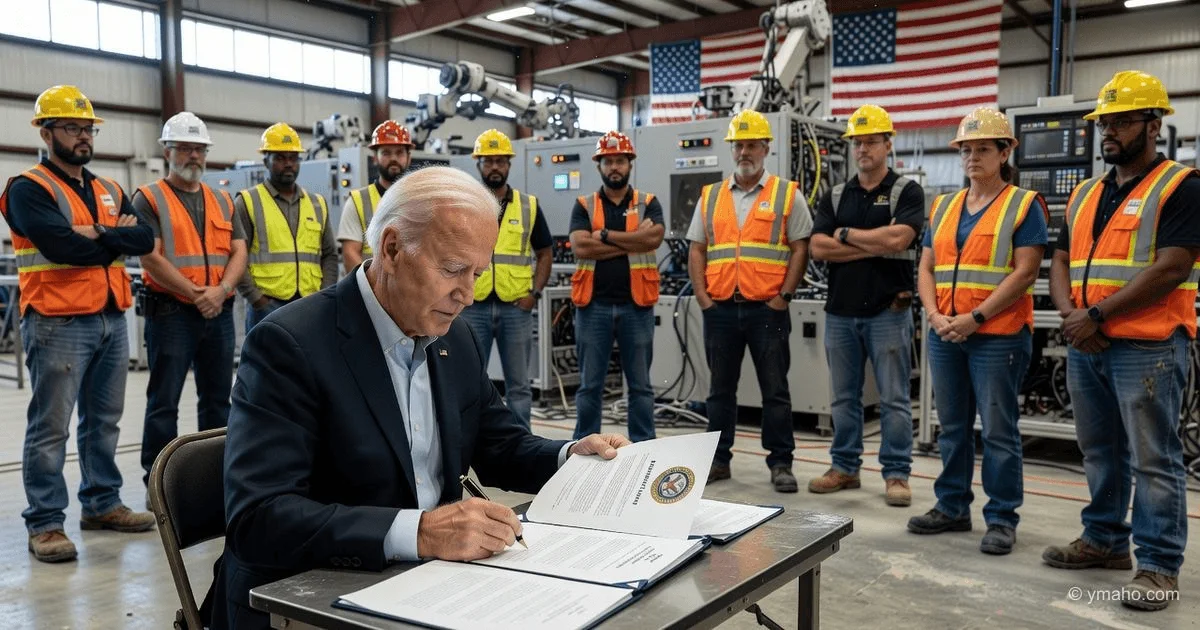
Biden Announces $2.5 Billion for Chip Development in the US
The new funding package under the CHIPS Act aims to build factories in Texas and Ohio to reduce dependence on Asian manufacturing.
$2.5 Billion for the Assembly Line: Why Biden Is Actually Launching a 'Quantum Lend-Lease' Against China
[The Gist]: What's Really Happening
The Biden administration has announced a new $2.5 billion tranche under the CHIPS Act, aimed at building factories in Texas and Ohio. Formally, this is another phase of the program to bring semiconductor manufacturing back to the US. However, in practice, this package is less about 'building factories' and more about restructuring the entire value chain in microelectronics, including materials, chemicals, and even AI systems for discovering new compounds.
The $2.5 billion figure is just one piece of the puzzle. In recent weeks, the US Department of Commerce also announced $500 million for SandboxAQ (an Alphabet spin-off) to develop new semiconductor materials using AI. Another $2 billion was allocated to quantum technologies. In total, for June 2026, the volume of new commitments under the CHIPS Act exceeded $5 billion, making this month the most intense since the law was passed.
The structure of these infusions shows that Washington has shifted from a 'flood production with money' strategy to a 'vertical control' strategy—from raw materials and chemicals to finished chips and quantum computing. Ohio and Texas are just the tip of the iceberg. The invisible part is the hundreds of millions going into fundamental science and infrastructure to create a 'safety cushion' against future sanctions from China, which controls critical rare earth metals and chemicals needed for production.
Timeline and Context
The escalation of investments is no coincidence. It is driven by a clear timeline that links political deadlines and industrial realities.
| Date | Event | Significance |
|---|---|---|
| May 2026 | US Commerce Department announced 9 letters of intent for $2.013 billion for quantum companies | First major 'quantum' tranche of the CHIPS Act |
| June 2026 | $500 million for SandboxAQ for AI-driven materials for production | Acknowledgment that 'building factories' is not enough—new substances are needed |
| June 2026 | $50 million for Coherent to expand its plant in Sherman, Texas | Increased production of indium phosphide for fiber optics in AI data centers |
| June 17-19, 2026 | Official Biden announcement of the $2.5 billion package | New impetus for Intel projects in Ohio and elsewhere |
Importantly: Ohio is already facing delays. Intel's 'Silicon Heartland' project in New Albany has been officially postponed to 2030 due to capital management issues and declining demand for contract manufacturing. Nevertheless, new money is being announced right now. Why? Because the Biden administration is trying to create a 'promise effect' ahead of the 2026 midterm elections: to show that money is flowing into 'swing states' (Ohio is a classic swing state), even if actual factories won't appear there for another four years.
Who Wins and Who Loses
Winners:
Coherent Corp. Receives $50 million to expand its Texas plant, quadrupling indium phosphide production and creating over 1,000 new jobs. This turns Sherman into a key hub for fiber optic components needed for AI infrastructure. Interestingly, Coherent closely collaborates with Nvidia, which also attended the groundbreaking ceremony.
Google AdInline article slotSandboxAQ. This startup, valued at $5.75 billion, receives $500 million to develop alternatives to 'forever chemicals' (PFAS), new catalysts, and magnets without rare earth elements. This is a huge advance: the US government gets a stake in the company and royalties from future licenses. For SandboxAQ, this is not just money—it's government approval and access to national lab data.
US chemical manufacturers. Indirectly, those who can replace imported chemicals benefit. As industry press notes, factories are being built, but supply chains for specialty chemicals are not. The new package stimulates domestic production of these reagents.
Losers:
China. This is the main target. The CHIPS Act aims to reduce dependence on Asian manufacturing. $2.5 billion for factories plus $500 million for rare earth alternatives is a direct blow to China's monopoly on rare earths and critical materials.
Intel and its shareholders. Although money is allocated, most Ohio projects are delayed. Construction is dragging, and competition from TSMC (Arizona) and Samsung (Texas) is intensifying. The market may see $2.5 billion as 'too little, too late' to salvage Intel's reputation in contract manufacturing.
European equipment manufacturers. The EU is preparing its own 'Chips Act 2.0' but is lagging in funding speed. US subsidies create an imbalance: equipment manufacturers (e.g., ASML) will have to prioritize US capacity, slowing European fab development.
What the Media Isn't Saying
First and foremost: the new package is a response to a congressional scandal. In May 2026, Rep. Zoe Lofgren (D-CA) accused the administration of spending $2 billion from the CHIPS Act on quantum technologies illegally, contrary to Congress's intent, which allocated the funds specifically for microelectronics, not quantum. Lofgren called it 'communism, not capitalism' and accused the administration of funneling money to 'insiders.'
Now, in June, the administration is allocating $2.5 billion specifically for factory construction to show: 'We haven't forgotten the main goal of the CHIPS Act.' This is a political move to counter criticism and demonstrate that money is going to its intended purpose. Media write about 'construction' but ignore the political context—this is image repair after the May scandal.
Second subtle nuance: the $500 million for SandboxAQ is a precedent. For the first time, the US government is taking a stake in a private company under the CHIPS Act. This transforms the program from 'subsidies' into 'investments.' This means the state becomes a venture capitalist—it will receive a share from the commercialization of breakthrough materials. If SandboxAQ finds a PFAS replacement or creates magnets without rare earths, the US government gets royalties. This is a fundamentally new model of 'state capitalism 2.0,' which is being kept quiet because it contradicts the official narrative of a 'free market.'
Third hidden factor: the connection to Nvidia. SandboxAQ has already raised over $1 billion from private investors, including Nvidia and Eric Schmidt. And Coherent is expanding production for Nvidia data centers. So the entire new $2.5 billion package effectively subsidizes infrastructure for Nvidia—the leader in the AI race. Chips produced in Ohio and Texas will go to AI servers. This is hidden government support for one player at the expense of others. AMD and Intel Foundry may lose out, even though formally everyone gets money.
Forecast: Next 30 Days and 90 Days
Next 30 days:
- Coherent (COHR) stock will get support at $65–70 due to expansion news. However, the $50 million volume is only 0.5% of market cap, so the reaction will be muted.
- The semiconductor index (SOXX) may rise 2–3% on positive sentiment, but pressure from Ohio delay news will weigh—investors are tired of promises without quick results.
90 days:
- By September 2026, we will see initial results from SandboxAQ in PFAS replacement—lab prototypes. This could trigger a rise in 'green chemistry' stocks (e.g., Ecolab).
- A new round of congressional criticism is expected: Democrats will demand a report on how the $2.5 billion is distributed and whether it will go to specific states for job creation. This will create volatility, but not fundamental change.
- If China responds by tightening gallium and germanium exports, US equipment maker stocks (Applied Materials, Lam Research) could rise 5–8%, as the market sees $2.5 billion as a 'protective mechanism.'
Editorial Forecast
Based on current data: we expect a modest 1–2% rise in Nvidia (NVDA) stock over the next 48–72 hours, as the entire package indirectly supports AI infrastructure, where Nvidia is a key beneficiary. Key resistance for NVDA is $130, support is $122. Confidence level: low, since $2.5 billion is a drop in the ocean compared to Nvidia's annual revenue ($60 billion), and the market may ignore the news. Main risk to the forecast: if investors focus on Ohio factory delays, it could create negative sentiment for the entire sector, and NVDA could fall alongside Intel.
This is an editorial opinion, not investment advice.
— Editorial Team