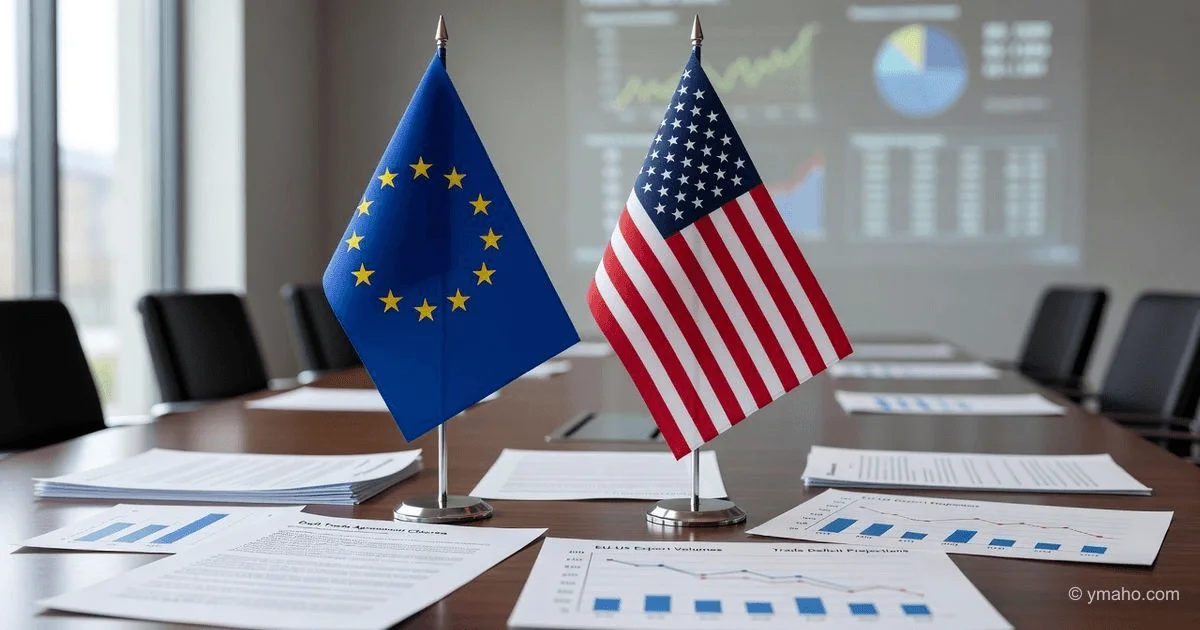
FT: EU Prepares €20 Billion in Retaliatory Tariffs on US Goods
The European Commission is drawing up a list of American goods for potential tariffs in response to Trump's levies, with a decision possible as early as next week.
The €20 Billion 'Trade Bazooka': Why the EU Is Really Targeting the US Midterms
What's Really Happening
The European Commission has formally approved the first package of retaliatory tariffs on American goods worth over €20 billion. The list includes soybeans, Harley-Davidson motorcycles, corn, rice, textiles, plastics, cosmetics, and electrical equipment. The decision was backed by 26 EU countries, with only Hungary voting against. The tariffs will be phased in: some from April 15, others from December 2026.
However, the real amount hanging over markets is not €20 billion but €93 billion ($106 billion). The first package is just a down payment. The full arsenal of countermeasures the EU has ready includes not only classic tariffs but also the use of the 'trade bazooka' — the Anti-Coercion Instrument (ACI), adopted in 2023 and never used before. This tool allows Brussels to unilaterally restrict US companies' access to European government procurement, control service exports, and impose tariffs bypassing standard WTO procedures.
Why €20 billion and not €93 billion? This is where political math comes in. The EU is using a strategy of 'escalation dominance': first, strike at goods sensitive to Republican states (soybeans — Iowa, motorcycles — Wisconsin, bourbon — Kentucky), then reserve the right to expand the list at any time. This is a classic tactic of managed escalation, giving Brussels leverage without immediately collapsing all trade. The main goal is not to punish the US but to force Washington back to negotiations on full implementation of the July 2025 trade agreement, which the EU has yet to fully execute.
Timeline and Context
To understand how we got here, look at the timeline of the last 12 months. This is not a sudden conflict but a programmed scenario.
| Date | Event | Significance |
|---|---|---|
| July 2025 | Trump and von der Leyen strike a deal at Turnberry | EU commits to remove tariffs on US industrial goods, US agrees to cap tariffs at 15% |
| August 2025 | US adds 407 categories of goods under steel and aluminum tariffs | EU secures a clause: if metal tariffs are not reduced below 15% by end of 2026, Brussels can suspend preferences |
| February 2026 | US Supreme Court rules use of 1977 law for tariffs unconstitutional | Trump promises a 'backup plan' and threatens new tariffs |
| June 2026 | EU approves first €20 billion retaliatory tariff package | 26 countries in favor, Hungary against |
| June – December 2026 | Full ratification vote in European Parliament expected | If US does not lower steel tariffs by Dec 31, 2026, EU activates preference suspension mechanism |
Key nuance: The European Parliament has already approved legislation giving the European Commission the right to suspend trade preferences for the US if Washington fails to meet its obligations. This means Brussels has a legal 'trigger' that can be pulled anytime after December 31, 2026, if steel and aluminum rates remain above 15%.
Meanwhile, the real damage from tariffs is already tangible. In Q1 2026, EU exports to the US fell 30% year-on-year — the sharpest drop among all trading partners except Iran (-44%). The US accounts for about 19% of European exports, or roughly €120 billion annually, so even a small reduction hits European carmakers, pharmaceuticals, wine, and cheese producers hard.
Winners and Losers
Winners:
European Commission and Ursula von der Leyen. She gains a powerful political tool: ahead of the 2027 European elections, she can position herself as the 'defender of European interests' against aggressive US trade policy. €20 billion is not a sum but a signal.
Google AdInline article slotEuropean steel and aluminum producers. They have long demanded protection from US dumping. Although US 50% tariffs on metals remain in force, EU countermeasures create symmetric pressure that could force Washington to reconsider.
Exporting countries that replace US goods in the EU. For example, Indonesia, with which the EU recently signed a CEPA agreement (exports up 23% in Q1), as well as India and the UK. The higher the tariffs on the US, the more attractive the market for other suppliers.
Losers:
American farmers and producers from 'red' states. Soybeans, corn, rice, poultry, nuts, whiskey — all export hits from Iowa, Nebraska, Kentucky, and Tennessee. These states are Republican strongholds in Congress, and targeting them is a direct attempt by the EU to influence US domestic politics ahead of the 2026 midterms.
German automotive sector. Formally, car tariffs are not yet imposed, but they hang in the air. German car exports to the US have already fallen amid uncertainty, and the US market accounts for about 15% of BMW and Mercedes-Benz sales.
Ireland. Its vote against tariffs showed Dublin, as with the Apple case, favors maintaining the warmest possible ties with the US. Ireland stands to lose more than others from escalation, as its economy critically depends on American multinationals.
But there is a third, hidden loser: China. While the EU and US are busy with mutual tariffs, Beijing is signing favorable trade deals and ramping up rare earth metal exports, using the situation as leverage. The EU is forced to fight a two-front trade war: with the US and with China, which has tightened controls on exports of gallium, germanium, and graphite — critical for European semiconductor industry.
What the Media Isn't Saying
First and foremost: €20 billion is a decoy. Media report on tariffs but miss the ACI — the Anti-Coercion Instrument. This is a legal 'nuclear option' allowing the EU to exclude US companies from government procurement without waiting for WTO rulings. If the EU uses ACI, it won't be Iowa farmers who suffer, but Boeing, Microsoft, Google, and other giants that land billion-dollar contracts in European defense, infrastructure, and IT. This is what French Trade Minister Nicolas Forissier discussed in his Financial Times interview, but that part of his statement is barely quoted in mass media.
Second, what goes unsaid: the time gap between tariffs and elections. July 2026 is the peak of the US campaign season ahead of the Congressional midterms. The EU is deliberately synchronizing escalation with this period to maximize political pressure on Republicans. Tariffs on soybeans and bourbon hit precisely those states where Republicans cannot afford to lose farmers' votes. This is not an economic but a political operation.
Third: the EU is already preparing compensation mechanisms for its own producers. Internal European Commission documents provide for subsidies to European farmers and steelmakers who suffer from Chinese retaliation or possible escalation with the US. This is not reported because the amount of these subsidies (around €7 billion) may exceed the revenue from collected tariffs. Essentially, the EU is paying its producers not to protest the trade war — classic protectionism disguised as 'defense of sovereignty'.
Fourth insight: the July 2025 EU-US trade agreement is practically dead. It contained a sunset clause until December 31, 2029, with a mandatory review in 2029. But both sides have already violated the spirit of the deal: the US kept 50% steel tariffs not envisioned in the main text, and the EU delayed ratification and now uses the delay as leverage. The deal has become a fiction, and both sides are preparing for a full-blown trade war that could last until the end of the decade. Neither side wants to admit this publicly because markets would react with an immediate correction.
Forecast: Next 30 Days and 90 Days
Next 30 days:
- The euro will continue to face pressure against the dollar, but the decline will be limited (range $1.08–1.10). Markets price in up to 70% probability that the EU will start collecting tariffs as early as April, creating inflationary pressure on the European economy, which could halt the ECB's rate-cutting cycle.
- Shares of European automakers (VW, BMW, Stellantis) will show leading volatility of ±5–7% over 2–3 weeks as markets price in the risk of expanding tariffs to cars.
- Watch soybean futures on the CBOT — a 3–5% decline is likely in the next 5–10 days as European traders start replacing US soybeans with Brazilian and Indonesian supplies.
90 days:
- If by mid-September the US does not offer a revision of steel tariffs, the EU will activate the preference suspension mechanism across the entire range of goods. This could collapse transatlantic trade by another 15–20%.
- European investors will start shifting from stocks of companies dependent on US exports (LVMH, Mercedes, Airbus) into safe havens — gold and German government bonds (Bunds), whose yields could fall to 1.8–2.0%.
- In parallel, the EU will accelerate trade agreements with Indonesia and Australia to compensate for lost access to the US market. This could create a long-term trend: reducing the US share of European imports from the current 19% to 15% by end of 2027.
Editorial Forecast
Based on current data: we expect a short-term weakening of the euro to $1.075–1.078 within the next 48–72 hours as markets digest the tariff news and price in the risk of an expanded list. Key support for EUR/USD is $1.0720, resistance at $1.0950. Confidence level: medium, as the market has already partially priced in escalation (exports fell 30% in Q1). The main risk to the forecast is a sudden Trump announcement of new tariffs, which could push the pair below $1.07, or conversely, a signal of resumed negotiations, which would return the euro to the $1.09–1.10 range.
This is an editorial opinion, not investment advice.
— Editorial Team