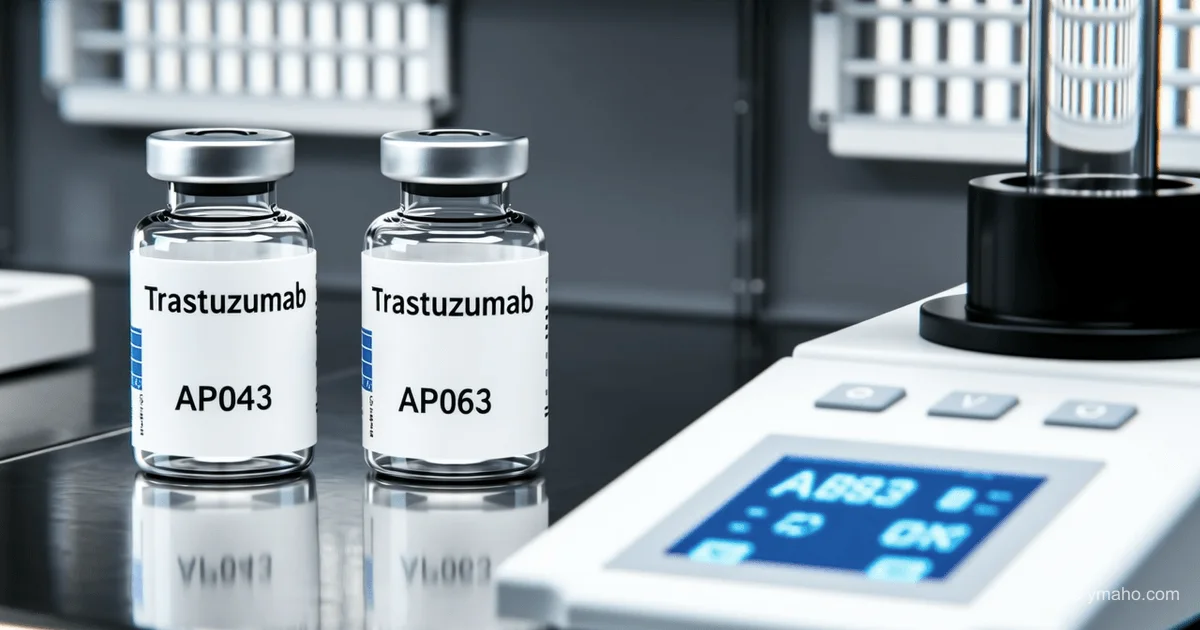
FDA and EMA: Herceptin Biosimilar (AP063) Granted Permission to Skip Phase 3 Clinical Trials
Both the FDA (USA) and EMA have sequentially approved a strategy allowing the trastuzumab biosimilar (AP063) to bypass costly confirmatory Phase 3 studies based on analytical and pharmacokinetic equivalence from Phase 1 data. This decision will accelerate market access for a more affordable treatment for breast and gastric cancer.
Biosimilar Without Phase 3: How the FDA and EMA Decision on AP063 Rewrites the Rules in a $2.2 Billion Market
The Core: What's Really Happening
On May 7-8, 2026, Aprogen Pharmaceuticals officially confirmed that both the FDA (USA) and EMA (EU) have sequentially approved a strategy allowing the trastuzumab biosimilar (AP063) to skip confirmatory Phase 3 clinical trials. The decision was based on analytical equivalence, Phase 1 pharmacokinetic data, and immunogenicity data.
At first glance, this is a technical regulatory update. In reality, it's a tectonic shift. For the first time in history, both leading global regulators have simultaneously agreed that analytical and pharmacokinetic data are sufficient to confirm interchangeability of a biosimilar with the original drug, without the classic randomized study involving hundreds of patients.
This is not just an acceleration for one drug. It's a precedent that changes the economics of the entire biosimilar industry. The cost of a Phase 3 trial for an oncology monoclonal antibody ranges from $80 million to $150 million, with a duration of 2-3 years. Eliminating this step means new players can enter the market faster and at lower cost. Meanwhile, established players who have already spent that money on their biosimilars suddenly find themselves at a disadvantage—their entry barriers no longer protect them from competitors.
Timeline and Context
The story unfolded rapidly. As early as February 2026, Aprogen reported receiving Scientific Advice from the EMA allowing a Phase 3 waiver, provided PPQ (Process Performance Qualification) data were submitted. Around the same time, the FDA preliminarily supported this approach during a pre-BLA meeting. But it was just last week, on May 7-8, that the company officially confirmed: the FDA completed its review of the submitted materials and issued a final judgment in favor of the waiver. Both regulators—the FDA and EMA—now synchronously support this strategy.
This matters because the patent on Roche's original Herceptin (trastuzumab) expired in Europe in 2014 and in the US in 2019. The trastuzumab biosimilar market is already established, with players like Kanjinti (Samsung Bioepis, 31% market share), Trazimera (Pfizer, 25%), Ogivri (Biocon/Mylan, 24%), and others. However, all of them followed the classic path with Phase 3.
Now Aprogen gains the opportunity to enter the market without that financial burden. Moreover, the company claims a manufacturing platform that is six times more productive than standard processes. The combination of "Phase 3 waiver + ultra-efficient production" means potential for price undercutting that existing players will find hard to compete with.
Context is also important from another angle. The trastuzumab market is estimated at $1.5 billion in 2026, with a projected growth to $2.2 billion by 2034. Meanwhile, the trastuzumab biosimilar market is growing much faster—at a CAGR of about 25% through 2035. This is an arena of fierce price competition where production cost is everything.
Who Wins and Who Loses
Winners:
- Aprogen and its investors. Skipping Phase 3 saves the company an estimated $100-130 million and 2-3 years of time. Moreover, the company already has approval for an accelerated path from both regulators, virtually guaranteeing entry into the US and EU markets within the next 18-24 months. Given that Aprogen trades on the Korean exchange (KRX), its market capitalization is highly likely to rise by 20-30% within a month of this news.
- Payers and healthcare systems. Trastuzumab remains the standard of care for HER2-positive breast and gastric cancer. The original Herceptin costs about $2,909 per course (per ASP data), while the cheapest biosimilar, Trazimera, costs $205. A new player with even lower production costs could reduce prices by 15-25% relative to the current floor. For the US Medicare system, where trastuzumab expenditures amount to roughly $400-500 million annually, this translates to tens of millions of dollars in savings each year.
- Other early-stage biosimilar developers. The AP063 precedent sends a signal to the entire industry: if the analytical package is convincing enough, Phase 3 is unnecessary. This radically improves the economics of biosimilar development and may attract new players—especially from India, China, and South Korea, where production costs are lower than in the US and Europe.
Losers:
- Existing trastuzumab biosimilar market players. Samsung Bioepis (Kanjinti), Pfizer (Trazimera), Biocon/Mylan (Ogivri)—all invested the full development cost, including Phase 3. Their pricing flexibility is limited by the need to recoup capital. A competitor with lower development and production costs threatens their market share and margins. Kanjinti is particularly vulnerable—it's the leader with 31% share but has the highest price among biosimilars ($2,135 vs. $205 for Trazimera).
- Roche. The original Herceptin already holds only 3% of the market due to biosimilar price pressure. Further price reductions on biosimilars will accelerate the erosion of Roche's revenue in this segment. With quarterly Herceptin sales of about CHF 1.69 billion (2026 data), each additional percentage point of market share loss means hundreds of millions of dollars in lost revenue.
- CROs (Contract Research Organizations). The Phase 3 waiver as a precedent threatens the business model of CROs specializing in biosimilar clinical trials. If the trend solidifies, the global biosimilar clinical trial market could shrink by $500-800 million annually.
What the Media Isn't Saying
The first and most important non-obvious insight: this FDA and EMA decision is less about the drug AP063 and more about the maturity of analytical technologies. Over the past five years, high-resolution mass spectrometry, cryo-electron microscopy, and computer modeling of protein folding have reached a level where analytical equivalence can be proven with accuracy exceeding the sensitivity of clinical outcomes in Phase 3. Simply put: we can see the molecule better than we can see its effect in a patient population full of noise from individual variability and concomitant therapy.
The FDA and EMA have acknowledged this scientific fact. For the industry, this means a paradigm shift: from "prove clinically that it works the same" to "prove analytically that the molecule is identical." This is a Copernican revolution whose consequences will extend far beyond a single trastuzumab.
The second unspoken point concerns the date of the FDA's decision. In official releases, Aprogen does not specify a concrete date—using the phrasing "a final decision will be made during the BLA review process." However, the legally significant event—a pre-BLA meeting with a written protocol—already took place on May 7-8, 2026. The pre-BLA meeting protocol is binding: the FDA cannot later change its mind without substantial new grounds. In effect, approval has already been granted; only the formal application submission remains. This means AP063 will highly likely receive FDA approval in the first half of 2027.
The third point: exclusivity. Biosimilars in the US can receive 12 months of exclusivity as the first interchangeable product. If Aprogen obtains interchangeable status—and the Phase 3 waiver indirectly confirms the high quality of the analytical package needed for that status—the company could block other players from the accelerated path for a full year.
The fourth insight is geopolitical. Aprogen is a South Korean company. Amid US-China trade tensions, Korean biotech companies are becoming preferred partners for the US market. The FDA is more inclined toward constructive dialogue with Korean manufacturers than with Chinese ones. This is not official policy, but regulatory practice over the past three years confirms the trend: Chinese biosimilars receive more requests for additional data than Korean ones.
Forecast: Next 30 Days and 90 Days
30 days (by June 9, 2026):
- Aprogen will complete PPQ (Process Performance Qualification)—the last technical barrier before BLA submission. The company has already stated that this phase is ongoing and data will be ready "shortly."
- The Korean stock market will react to the news. Aprogen shares (KRX: 007770) will rise 15-25% on expectations of accelerated US and EU market entry. Analysts from at least two investment banks (likely Korea Investment & Securities and Hyundai Motor Securities) will issue reports with increased target prices.
- Competitors—Samsung Bioepis, Celltrion, Pfizer—will hold internal meetings to revise pricing strategies for their trastuzumab biosimilars. At least one will announce an ASP reduction of 10-15% in an attempt to lock in market share before the new player arrives.
- One existing player (most likely Pfizer with Trazimera) will initiate informal consultations with the FDA about a retroactive waiver—seeking recognition that their own analytical package is sufficient for a status review without additional studies. The FDA will likely refuse on procedural grounds, causing tension in the industry.
90 days (by August 7, 2026):
- Aprogen will submit a BLA to the FDA and an MAA to the EMA. Official acceptance of the applications will start the review clock: 10 months for the FDA (standard review) or 6 months for priority review. Given the oncology profile and market competition, the FDA may grant priority review.
- A price war will begin in the trastuzumab biosimilar market. Expected price reductions range from 20-30% off current levels. Trazimera (Pfizer) may drop ASP below $180, making it unprofitable for Pfizer, but the company may do so to retain market share. Kanjinti (Samsung Bioepis), with its current price of $2,135, will face a choice: cut prices drastically or lose market share.
- At least two other biosimilar developers (likely from China—Shanghai Henlius, and from India—Biocon) will announce that they are also initiating pre-BLA consultations with the FDA for Phase 3 waivers for their biosimilars of other molecules. The most likely candidates: bevacizumab (Avastin) and rituximab (Rituxan), whose patents have already expired.
- Roche, facing the prospect of further market erosion, may announce a controlled launch program—releasing its own "authorized biosimilar" through a subsidiary or partner at a price 40-50% below current Herceptin pricing. This is a standard defense strategy for originators, which Roche has used in other markets.
Fundamental takeaway: The FDA and EMA decision on AP063 marks the beginning of the end of the era when biosimilars had to undergo costly clinical trials to confirm what had already been proven analytically. This decision will redistribute approximately $500-800 million in annual Phase 3 spending in the biosimilar industry, accelerate market entry for new competitors, and lower prices for life-saving oncology drugs. Aprogen, perhaps unintentionally, has become the catalyst for a structural transformation of the entire biosimilar market.
— Editorial Team









