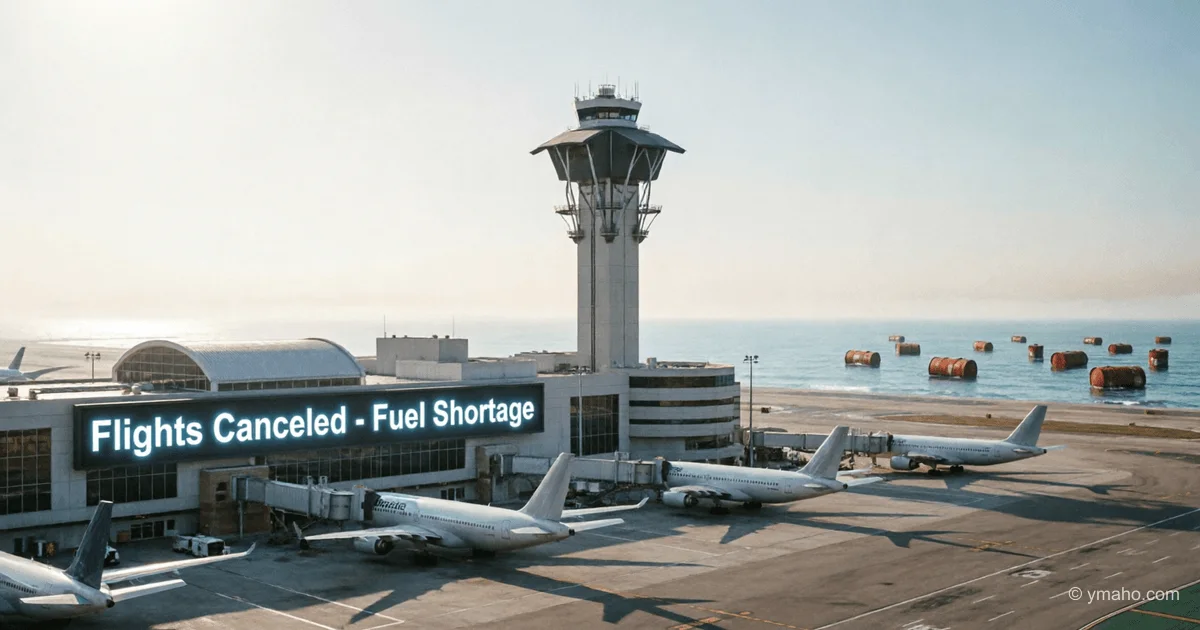
California on the Brink of Aviation Fuel Crisis Due to Middle East War
The US West Coast, particularly California, faces the threat of a severe aviation fuel shortage this summer. The region, dependent on supplies from Asia, is struggling because Asian markets themselves are facing a raw material shortage due to disruptions in the Strait of Hormuz.
Analytical article: 'Fuel Island on Fire' — Why California Is on the Verge of Aviation Collapse
When people talk about the global energy crisis caused by the Gulf War, they usually imagine Europe freezing without gas or China buying up Russian oil. But the epicenter of the impending transport collapse may be where it is least expected — in California, the world's fourth-largest economy.
The US West Coast faces the threat of a severe aviation fuel shortage this summer. Jet fuel inventories in California have fallen to 2.6 million barrels — the lowest level in two and a half years, down more than 25% from last year's peak. The cause is a perfect storm: the blockade of the Strait of Hormuz has disrupted supply chains from Asia, Asian markets themselves are facing a raw material shortage, and two major refineries have closed in California itself. For the first time in decades, the world faces the real prospect that summer air travel in one of the busiest aviation hubs on the planet could be paralyzed.
Event Details and Timeline
California is a unique region in terms of energy supply. Cut off from the rest of the country by mountains and deserts, it is not connected to the national pipeline system and exists as a 'fuel island.' About 75% of crude oil and more than 25% of gasoline are imported by sea. Aviation fuel is the most vulnerable segment: before the war, about 20% of the state's needs were covered by imports from South Korea, Japan, and Singapore.
The Gulf War and the blockade of the Strait of Hormuz — through which about 20% of the world's oil and 24% of global aviation fuel exports pass — dealt a devastating blow to this scheme. Asian refineries, dependent on Middle Eastern oil, faced a sharp shortage of raw materials. As a result, refining margins in Singapore soared to $30 per barrel, and jet fuel prices in Asia hit a record $240 per barrel. China, Thailand, and India imposed restrictions on fuel exports to preserve domestic inventories. This means that the Asian supplies California is accustomed to have sharply declined — expected to drop by 50% compared to normal volumes.
To make matters worse, several technological disasters and structural changes have occurred within California itself:
- December 2025: Closure of the Phillips 66 refinery in Los Angeles with a capacity of about 150,000 barrels per day.
- October 2025 – January 2026: Fire at the hydrocracking unit of the Chevron refinery in El Segundo, knocking out aviation fuel production capacity.
- February 2026: Valero prematurely closes its refinery in Benicia (near San Francisco), another blow to production.
In total, the state has lost nearly 20% of its refining capacity over the past six months — right in the midst of a global crisis.
The result is already visible: the price of jet fuel at Los Angeles International Airport (LAX) has reached nearly $15 per gallon — about 50% higher than at Denver ($10) or Newark ($11) airports, and more than double the price before the war.
Impact and Significance
For the aviation industry: The crisis has already led to actual flight cancellations. Airlines operating on thin margins are forced to cut their route networks:
- Norse Atlantic Airways has completely canceled all summer flights from LAX.
- Air Canada has reduced flights from New York to Toronto and Montreal.
- Delta Air Lines has canceled several flights.
- United Airlines has raised fares by up to 20% and is canceling flights on off-peak days, forecasting additional costs of $11 billion due to the fuel shortage.
The average airfare in the US has risen by about 25%, and on five-hour transcontinental flights, prices have doubled in some cases. Budget carriers are particularly vulnerable, such as Spirit Airlines, which reportedly may need a federal aid package to prevent bankruptcy.
For tourism and major events: California is preparing to host FIFA World Cup matches in June 2026, as well as the celebration of the US semiquincentennial. Both events could be disrupted. Experts warn: if the fuel shortage persists, tourists will avoid trips due to exorbitant airfares.
For the US economy as a whole: California's problems are America's problems. The state generates about 14% of the country's GDP. If air travel to major hubs (LAX, San Francisco, San Diego) is severely restricted, it will hit supply chains, business tourism, and high-tech exports.
For society: Gasoline prices in California have already reached $5.85 per gallon, 45% higher than the national average ($4.03) and close to historical highs. Diesel costs $7.49 per gallon, worsening logistics and further fueling inflation.
Reactions of Key Players
Airlines are in 'survival' mode. United Airlines has directly stated that some carriers may not survive this crisis if fuel prices do not stabilize. Carriers are introducing additional baggage fees, reducing flight frequencies, and consolidating routes.
The US administration is trying to mitigate the blow. On April 22, a temporary waiver of the Jones Act was announced — a century-old law requiring that shipping between US ports be carried out only by American vessels. This allows tankers from the Gulf of Mexico to deliver fuel to California via the Panama Canal. However, this measure is described as 'temporary' (60 days with possible extension) and, according to experts, its effect will be limited due to a shortage of ships and the Panama Canal's capacity.
Major oil companies (Chevron) are using the crisis as an argument in political battles. 'The conflict in the Middle East has exposed the danger of California's decision to outsource energy production outside the state,' a Chevron representative said. 'Taxes, bureaucracy, and excessive regulation have cost the state nearly 18% of its refining capacity in just the past year.'
California regulators maintain calm on the verge of panic. A representative of the California Energy Commission stated that 'current jet fuel inventories are within historical norms, albeit at the lower end,' and that 'with stable refinery operations, the state can meet demand.' These statements contradict assessments by independent experts, who describe the situation as 'critical.'
Forecast and Conclusions
Experts agree: the next three weeks will be decisive. Patrick De Haan, head of petroleum analysis at GasBuddy, put it bluntly: 'If we don't get a concrete peace agreement in the next three weeks, I'm very nervous about the West Coast this summer in terms of jet fuel. It's not going to be good for California's economy.'
Most likely scenario for summer 2026:
- Ticket prices will continue to rise — an additional increase of 20–40% over current levels is expected.
- Flight cancellations will intensify — especially affecting regional flights and routes to Europe and Asia.
- Fuel sales restrictions — for the first time since the 1970s, quotas may be introduced for refueling private jets and cargo flights.
- Relief will not come soon — even if construction of new pipelines (the Western Gateway Pipeline System project) starts immediately, completion is planned only for 2029.
California's long-term structural problems — refinery closures, lack of pipelines, strict regulation — will remain even after the war ends. The crisis has merely exposed a vulnerability that has been building for years.
Conclusion: The aviation fuel situation in California is not a temporary inconvenience but a systemic crisis that could escalate into a transport disaster. If the Strait of Hormuz does not reopen by May, summer travel to California will become prohibitively expensive, and some destinations will be completely inaccessible. The World Cup, which was supposed to be a celebration for Los Angeles, risks turning into a logistical nightmare. Investors in air travel and tourism are advised to prepare for the worst: the era of cheap and accessible air travel across America appears to be coming to an end.
— Editorial Team









