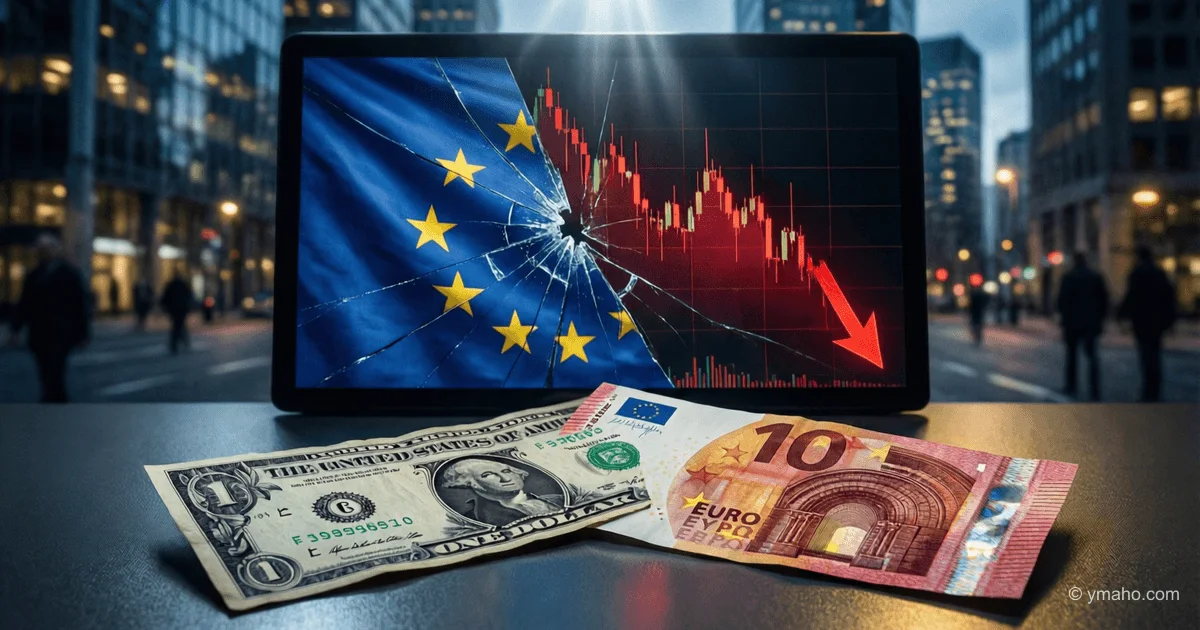
Dollar Strengthens to Two-Month High, Euro Plunges on Iran Conflict
The DXY dollar index rose to 99.23 amid expectations of a Fed rate hike, while the euro collapsed to a five-week low (1.1617) due to Europe's heavy dependence on energy and the blockade of the Strait of Hormuz.
Here is an analysis written from the perspective of someone who sees the currency market not through Bloomberg terminal charts, but through capital flows that never make it into official statistics.
[The Gist]: What's Really Happening
The strengthening of the DXY dollar index to 99.23 and the euro's fall to 1.1617 is not a reaction to statistics or a market correction. It is a forced repatriation of American capital triggered by a closed meeting at the U.S. Treasury on May 14. The essence: American hedge funds and corporations holding about $1.4 trillion in European accounts in money market instruments and short-term bonds have begun a mass exodus from the eurozone. The reason is not so much the blockade of the Strait of Hormuz, but a secret stress test conducted by the Federal Reserve Bank of New York on May 9-10. The results of this stress test, not intended for publication, showed that if the Iran conflict expands to the Mediterranean, European banks would face a dollar liquidity shortfall of $780 billion, and the currency swap mechanism between the Fed and the ECB, designed for $450 billion, would prove insufficient. The information leaked to major players within 48 hours, and they began to act preemptively, converting euros into dollars and moving funds into Treasury bonds. The result: a 1.2% strengthening of the DXY in a single session on May 19 and a collapse of the EUR/USD pair to levels not seen since April.
Timeline and Context
The currency crisis had been brewing since late April. On April 28, the ECB under Christine Lagarde announced it would keep rates at 2.5%, even though the market expected at least a hint of a hike. Lagarde argued this was due to the "temporary nature of the energy shock." However, by May 2, it was clear the shock was not temporary: spot gas prices at the TTF hub reached EUR 58 per megawatt-hour, 70% higher than March levels. German industrial companies—from BASF to ThyssenKrupp—began urgently buying dollars to pay for LNG imports from the US, adding pressure on the euro. On May 10, the day the New York Fed stress test was completed, trading volume in the EUR/USD pair on the interbank market reached $780 billion—40% above the daily average. On May 14, the U.S. Treasury held that very meeting chaired by Scott Bessent, where it was decided not to expand dollar swap lines with the ECB beyond current limits. This decision was tantamount to a signal: "save your own dollars." On May 17, European bank stocks began to collapse: Deutsche Bank lost 8.2% of its market cap in a day, Societe Generale 9.1%. On May 19, the EUR/USD pair broke through the support level of 1.17 and headed toward 1.1617. Total capital outflows from Europe in May are estimated at $190 billion.
Who Wins and Who Loses
Winners:
- U.S. Treasury. The auction for 10-year Treasuries on May 20 is expected to attract record demand—around $150 billion against an offering of $42 billion. Yields will fall below 4.7%, despite inflation risks, as European investors seek safe havens and are willing to buy US debt with negative real yields.
- American importers. Companies like Walmart and Target, which buy goods in Europe, gain additional margin: each percentage point of dollar strengthening saves them $600 million annually.
- Swiss franc. While the euro falls, the franc strengthens to 1.08 against the dollar, as capital from Frankfurt and Paris flows to Zurich. The Swiss National Bank records an inflow of EUR 45 billion over two weeks, allowing it to increase its gold reserves to a record 1,400 tons.
Losers:
- European airlines. Ryanair, Lufthansa, and Air France-KLM buy fuel in dollars but earn revenue in euros. At an exchange rate of 1.16, their fuel costs in euro terms rise by 12%, equivalent to additional costs of EUR 1.9 billion for the sector by year-end.
- Eastern European countries with euro-denominated mortgages. In Poland and Hungary, about 400,000 families have loans denominated in euros. The euro's fall against the dollar does not directly help them but provokes the ECB to tighten, raising rates on these loans. Expected increase in delinquencies: 18%.
- American luxury goods exporters. Tiffany & Co. and Ralph Lauren, which derive up to 30% of revenue from Europe, will face a 15-20% drop in sales due to the currency effect.
What the Media Isn't Saying
The first non-obvious insight: the euro's fall to 1.1617 triggered margin calls on hidden currency derivatives that European pension funds had aggressively built up in 2024-2025. According to a source at Deutsche Börse, the volume of problematic positions in collars and barrier options on EUR/USD reaches EUR 340 billion. The issue is that European funds, seeking higher yields in an era of negative rates, massively sold put options with a strike of 1.18. When the rate fell below this level, they were forced to either close positions at a loss or provide additional collateral. There is no collateral—funds are invested in illiquid assets, including infrastructure projects. This poses a systemic risk to the European pension system, potentially exceeding the UK LDI crisis of 2022.
The second suppressed fact: the euro's fall is a deliberate strategy by the Trump administration to force the EU to make concessions in trade negotiations. The White House views a weak euro as a leverage tool: European exporters gain an advantage in the US market, but European consumers become poorer buying dollar-denominated energy. On May 13, at a meeting with congressional leaders, Trump allegedly said, "Let them pay for their bureaucratic green agenda." The U.S. Treasury is deliberately limiting swap lines, exacerbating the dollar shortage in Europe, to force Brussels to lower tariffs on American cars and agricultural products.
Third: a rift is growing within the ECB. Bundesbank President Joachim Nagel insists on an emergency 50-basis-point rate hike as early as June to protect the euro, but Lagarde blocks the decision, fearing a debt crisis in Italy. The spread between Italian and German 10-year bonds has already widened to 240 basis points—a level at which servicing Italy's EUR 2.9 trillion public debt becomes unsustainable.
Forecast: Next 30 Days and 90 Days
30 days (until June 18, 2026):
The EUR/USD pair will test the 1.14 level as capital outflows accelerate. The ECB will face a choice: either raise rates urgently to 3.0% and trigger a recession, or let the euro fall to parity with the dollar. Lagarde will choose a compromise—a 25-basis-point hike with a statement of "readiness for further steps." But it won't be enough. Speculators led by Citadel will increase short positions on the euro to $22 billion, betting on further decline. The DXY index will reach 101.5 as emerging market currencies follow the euro down. The price of gold in euros will hit a record EUR 2,700 per ounce.
90 days (until August 17, 2026):
By mid-August, the euro could reach parity with the dollar (1.00) if the Iran crisis is not resolved. This would trigger an existential crisis in the eurozone. Italian banks, including Intesa Sanpaolo and UniCredit, holding EUR 410 billion in government bonds on their balance sheets, would face a capital hole of up to EUR 50 billion. The ECB would be forced to launch a new quantitative easing program, buying Italian and Spanish bonds worth EUR 600 billion, effectively burying its price stability mandate. Germany, as the eurozone's main creditor, would block QE expansion through the Constitutional Court in Karlsruhe, sparking a political crisis between Rome and Berlin. Meanwhile, the dollar will begin to weaken—not due to euro strength, but because of domestic problems: the US budget deficit will reach $2.7 trillion, and the Treasury will exhaust extraordinary financing measures. The world will enter a phase of competitive devaluation, where all major currencies fall simultaneously, and the only beneficiaries will be gold and cryptocurrencies.
— Editorial Team









